


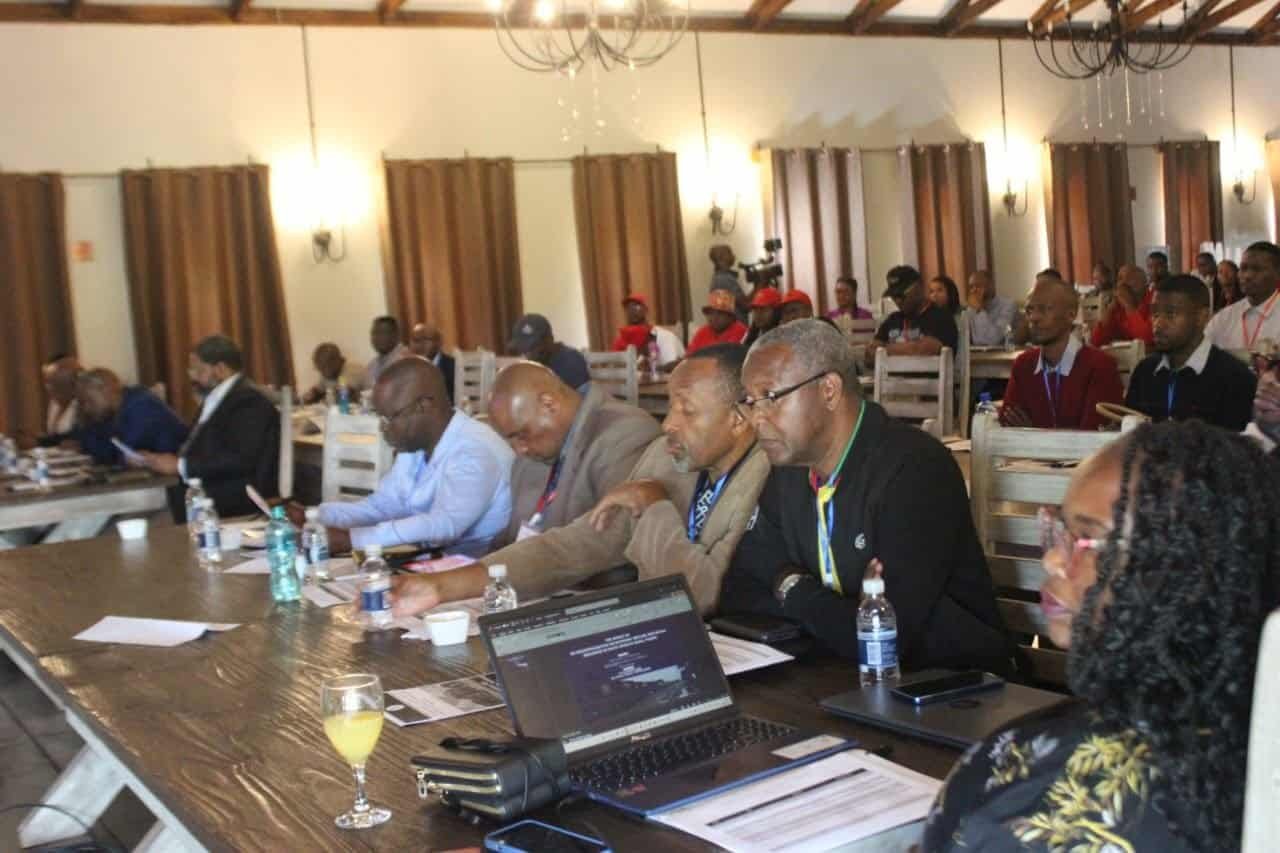
Government officials, business leaders, and civil society organisations converged in Heidelberg this week for a crucial symposium addressing one of South Africa’s growing crises, the socio-economic impact of de-industrialisation on small towns.
Hosted jointly by the South African Chamber of Commerce and Industry (SACCI) and the Lesedi Black Business Forum (LBBF), the symposium aimed to examine how the withdrawal, downsizing, or relocation of key industries has reshaped ,and in some cases devastated, local economies.
Event organiser Zamokwakhe Ludidi Somhlaba, a political economist and head of research and political risk advisory at Frontline Africa Advisory in Pretoria, said the choice of Heidelberg was deliberate.
“We are holding this event in Heidelberg to discuss a very important subject: de-industrialisation, the slow but profound erosion of small towns’ industrial and economic base. That is what today’s gathering is about,” Somhlaba said.
He explained that the research underpinning the symposium focused on two towns hit hardest by industrial decline, Lichtenburg, following Clover South Africa’s 2021 relocation to KwaZulu-Natal, and Komati, which suffered severe economic fallout after Eskom decommissioned its coal power station in 2022.
“We were tasked to produce a research paper that looks at the impact of de-industrialisation on social resilience and economic performance in the affected towns,” he said.
Somhlaba warned that Heidelberg itself shows early signs of industrial erosion, citing the example of British American Tobacco’s (BATSA) local plant, which has experienced a decline in production capacity in recent years.
“The reason the event took place here is because Heidelberg is beginning to show warning lights, we’re seeing early indications of imminent exits by anchor industries,” he noted.
Somhlaba said the symposium was “well attended,” drawing delegates from all spheres of society, including representatives from the Office of the Premier, the Department of Trade, Industry and Competition, and the Gauteng Department of Economic Development, alongside organised labour such as FAWU (Food and Allied Workers Union) and civil society groups including #NotInMyName International.
“The issue is not just about job losses but about livelihoods. It was important that we had various organisations represented. Coming out of that is a sense that this is a national emergency,” Somhlaba said.
He added that the Gauteng provincial government “is already seized with efforts to create industrial clusters as part of its broader economic agenda,” describing this as a necessary step toward revitalisation.
The discussions also included case studies presented by SACCI on Komati and Lichtenburg, offering evidence-based recommendations on how policymakers could better anticipate and mitigate the collapse of small towns anchored by a single employer or industrial base.
Delivering a powerful address, Lesedi Local Municipality Executive Mayor Mluleki Nkosi said the symposium could not have come at a more critical moment for Heidelberg and surrounding towns such as Devon and Ratanda.
“Lesedi has historically benefited from its strategic location along the N3, N12, N17, and other corridors, and its proximity to Johannesburg and Ekurhuleni. Towns like Heidelberg grew as centres for manufacturing, agriculture, transport, and light industry,” Nkosi said.
But over the past two decades, he added, there has been a steady decline in industrial activity, as manufacturing plants closed, rail-related jobs disappeared, and agricultural processing facilities either relocated or scaled down operations.
Nkosi outlined five key drivers of de-industrialisation in the Lesedi Local Municipality: Relocation of industries to major logistics hubs or lower-cost regions; Technological changes reducing the need for human labour; Global trade pressures, especially in textile and agro-processing sectors; Decline in railway operations, weakening Heidelberg’s role as a transport hub; and Skills and infrastructure gaps, deterring companies from remaining in the area.
The impact, he warned, has been deeply felt.
“Job losses have pushed unemployment, especially among youth and women, to concerning levels. Informal trading has increased as formal jobs decline. Local businesses have suffered, and our municipal revenue base is under pressure,” Nkosi said.
Nkosi pointed to British American Tobacco’s Heidelberg factory as a symbol of both Heidelberg’s industrial legacy and its current vulnerability.
Citing an Oxford Economics report (2023), he said the factory contributed significantly to Lesedi’s economy, supporting 3,854 jobs and contributing R3.2 billion to local GDP in 2022. However, the sector has faced mounting challenges.
“The report notes that the tobacco industry has been under pressure due to the COVID-19 tobacco ban and illicit trade, which forced the legal industry to close shop while illicit cigarettes flooded the market. Since 2020, the company has retrenched over 30% of its workforce,” Nkosi said.
He stressed that the community must act now to prevent similar industrial exits.
Nkosi urged collaboration between government, business, and communities to rebuild small-town economies through diversification, innovation, and inclusive growth.
“With collaboration between local government, private investors, and community organisations, we can write a new chapter of growth and inclusion for our towns,” he said.
“I call on all of us here today, policymakers, community leaders, business partners, to work hand-in-hand in building a resilient and diversified economy that leaves no one behind. Reviving these communities is not just an economic task; it is a moral duty to the people who call these places home.”
The symposium concluded with calls for practical interventions, including the establishment of local economic resilience task teams, promotion of small enterprise development, and investment in skills retraining to prepare communities for post-industrial economies.
Delegates also highlighted the need for better coordination between local municipalities, provincial departments, and national agencies in responding to early warning signs of industrial decline.
For Heidelberg, the event was more than just an academic exercise, it was a wake-up call. As industries falter and economic activity slows, small towns across South Africa face a choice: adapt or risk collapse.
Through gatherings like this, organisers hope that collective action and sound policy can help small towns reclaim their place as engines of inclusive growth.
“Every small town and every village matters,” Nkosi concluded. “Reviving these communities means giving South Africans hope again.”

