


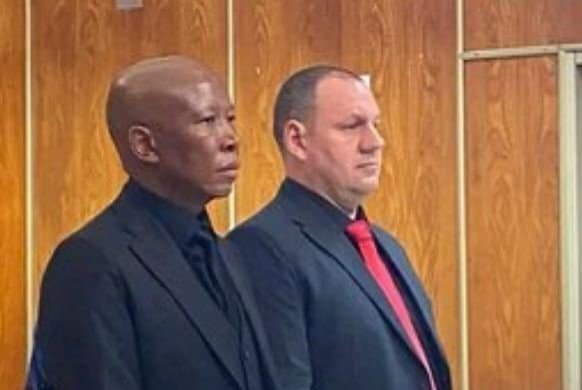


The East London Magistrate’s Court has found Economic Freedom Fighters (EFF) leader Julius Malema guilty of firearm-related charges stemming from a rally in Mdantsane in 2018. The judgment, hailed by the National Prosecuting Authority (NPA) as a victory for the rule of law, has reignited fierce political debate about the state’s pursuit of Malema and the wider implications for opposition politics in South Africa.
Magistrate Annette Olivier, delivering judgment, said the evidence presented by the state had been conclusive. “Indeed, the inference sought is supported by all the facts contained as per the evidence presented in court. And therefore, the following findings are made. You may stand up, accused one and two. Accused one, in respect of counts one, two, three, four, and five, you are found guilty as charged,” she declared.
Malema was convicted of unlawful possession of a firearm, unlawful possession of ammunition, discharging a firearm in a built-up area, failing to take reasonable precautions for person or property, and reckless endangerment. His co-accused, Adrian Snyman, the security company director alleged to have handed him the weapon, was acquitted on all charges. The matter has been postponed to January 23, 2026, for pre-sentencing.
EFF Cries Political Persecution
The EFF wasted no time in condemning the verdict, calling it “politically motivated persecution.” In a strongly worded statement, the party argued that the case was deliberately pursued over seven years to undermine Malema’s political influence.
“It is no surprise that the state has pursued this matter to this point,” the statement read.
“There have always been coordinated attempts to discredit and sabotage the EFF and its leadership. From the moment CIC Malema and the EFF fearlessly confronted corruption in the highest offices, demanded land expropriation without compensation, and exposed the capture of the state by both local and global capital, the system has sought to silence him by any means necessary.”
EFF spokesperson Sinawo Thambo sharpened the attack, describing the outcome as a contradiction in justice. “How does it make sense that the person accused of providing the firearm is acquitted, yet the one accused of merely holding and firing it is found guilty? This is not justice—it is a witch hunt,” Thambo said.
The party has vowed to appeal the ruling, questioning the court’s reliance on “hearsay evidence” and accusing the judiciary of bowing to “imperialist and right-wing agendas.”
The Acquittal of Snyman
Observers note that Snyman’s acquittal raises legal and political questions. If the prosecution could not prove beyond reasonable doubt that Snyman handed Malema the firearm, why was Malema convicted for possession of the very same weapon?
Analysts argue that the court may have found sufficient evidence that Malema discharged a firearm recklessly, regardless of ownership, while failing to link Snyman directly to the act of supplying the weapon. However, the optics—one man acquitted and the other convicted on interlinked charges—has created fertile ground for claims of selective justice.
Malema’s Courtroom History
This is not Malema’s first run-in with the courts. Over the past decade, he has been a frequent presence in South Africa’s legal system, often framing his battles as political persecution.
He previously faced trial on fraud and corruption charges linked to his business interests in Limpopo, cases that were later withdrawn. In 2019, Malema and other EFF leaders faced charges related to their disruption of the State of the Nation Address, but the matter fizzled out. He was also charged for incitement during the Brackenfell High School protests, when EFF members clashed with parents in a racially charged standoff. That case was dismissed.
Malema has also been at the centre of court cases over freedom of speech, including singing the struggle song “Shoot the Boer”, which he defended as part of the liberation heritage. While courts have restricted some of his rhetoric, Malema has consistently emerged politically strengthened, portraying himself as a victim of an establishment bent on silencing radical dissent.
The Meaning of the Guilty Verdict
For the NPA, the conviction is a demonstration of its impartiality. “The judgment reaffirms the NPA’s commitment to upholding the rule of law and proper administration of justice, without fear or favour,” said NPA spokesperson Luxolo Tyali.
Yet politically, the ruling could cut both ways.
On one hand, it provides Malema’s critics with ammunition to argue that he is reckless, irresponsible, and unfit to lead. On the other, it reinforces his core narrative of being persecuted by a biased system, a narrative that has historically consolidated support among his base.
Analysts suggest that this case could deepen Malema’s appeal to disenfranchised voters. “Every time Malema is dragged to court, it strengthens his claim that he is the only leader the establishment fears. That message resonates with the youth, the poor, and the marginalized who see themselves in his struggle,” one observer explained.
Way Forward: 2026 in Sight
With sentencing scheduled just months before South Africa’s 2026 local elections, the political stakes are high. The EFF has already begun rallying its supporters, warning that an attack on Malema is “an attack on the millions who look to the EFF as a vehicle for change.”
Sinawo Thambo made it clear that the party would not be deterred: “The persecution of the CIC is ultimately an attack on the poor, the landless, and the workers of this country. Fighters will not retreat. We will not surrender.”
The EFF’s strategy appears twofold: appeal the ruling legally while weaponising the guilty verdict politically. If history is any guide, Malema will seek to transform his court appearances into stages for political theatre, painting himself as a freedom fighter confronting an oppressive system.
The guilty verdict against Julius Malema marks a significant chapter in his long history of courtroom battles. While it represents a legal blow, politically it may serve to entrench his position as South Africa’s most disruptive opposition leader. Whether the courts or the ballot box ultimately decide Malema’s future, one thing is clear: the EFF is not treating this as a defeat, but as yet another battle in what it calls the “war for economic freedom in our lifetime.”

