


The long-delayed Madlanga Commission of Inquiry into Political Killings is finally set to commence its hearings on Wednesday, 17 September 2025, despite mounting legal challenges and fierce opposition from political parties. The commission, chaired by Constitutional Court Justice Mbuyiseli Madlanga, was appointed by President Cyril Ramaphosa in the wake of shocking revelations by KwaZulu-Natal Provincial Police Commissioner Lieutenant-General Nhlanhla Mkhwanazi.
In July, Mkhwanazi rocked the security establishment with a bombshell press briefing in Durban, accusing senior figures within the justice and policing system — including then-Police Minister Senzo Mchunu and Deputy Police Commissioner for Crime Detection Shadrack Sibiya — of corruption, interference in investigations, and links to political violence in KwaZulu-Natal. His disclosures led to the suspension of both Mchunu and Sibiya, while President Ramaphosa hastily appointed Firoz Cachalia as acting Minister of Police.
The Madlanga Commission was initially scheduled to begin on 1 September 2025, but failed to sit after logistical and infrastructure problems at its Pretoria venue. The delay embarrassed the government and prompted the suspension of two senior officials within the Department of Justice responsible for the commission’s preparations.
Now, with infrastructure challenges reportedly resolved, the commission is expected to begin hearing testimony this week. It has been tasked with probing the systemic patterns of political killings in KwaZulu-Natal and beyond, a scourge that has plagued South Africa’s democratic institutions for over a decade, particularly around elections and intra-party contests.
The commission’s mandate extends to investigating alleged collusion between political figures, elements of law enforcement, and organised criminal syndicates. However, its very composition and legality are already the subject of court proceedings.

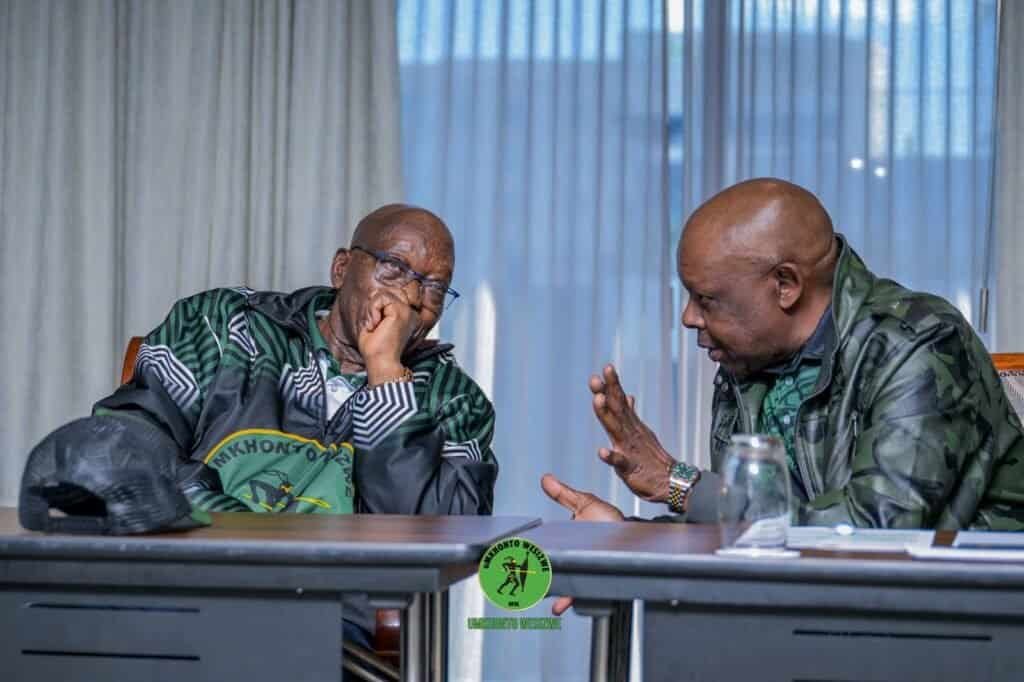
On Monday, the uMkhonto weSizwe Party (MK Party) issued a scathing statement rejecting the decision to start hearings before its legal challenge is heard in the Pretoria High Court later this week.
“The uMkhonto weSizwe Party unequivocally rejects the reckless and unlawful decision of the so-called Madlanga Commission to commence hearings on Wednesday, despite the fact that its very legality, establishment and composition are scheduled to be challenged before a Full Bench on Thursday, 18 September,” the statement read.
The MK Party, led by former President Jacob Zuma, argues that appointing a sitting judge to lead an inquiry into allegations that also touch the judiciary represents an egregious conflict of interest.
“This Commission can never command legitimacy, independence, or public confidence. Its findings are pre-tainted and will amount to nothing more than an expensive political smokescreen,” the party said.
The MK Party further condemned Ramaphosa’s decision to sideline Mchunu and install Cachalia as acting police minister, calling it an “unconstitutional usurpation of executive authority.”
The party insists that proceedings should be suspended until the court has ruled on the matter.
The launch of the Madlanga Commission comes at a time of deep political volatility. The ruling Government of National Unity (GNU) has already been criticised for failing to curb political violence, particularly in KwaZulu-Natal, where killings linked to intra-party battles in the ANC, IFP, and other formations have left scores dead over the years.
Civil society groups have cautiously welcomed the commission, saying it offers a potential mechanism for uncovering the networks driving political killings. However, they warn that without genuine political will, its recommendations may end up like those of the Zondo Commission into State Capture — shelved or selectively implemented.
The MK Party seized on this scepticism in its statement, accusing Ramaphosa of “hypocrisy” for ignoring Zondo’s findings while rewarding implicated figures with Cabinet posts.
“What South Africans are left with is nothing more than costly political theatre designed to shield Ramaphosa and his faction from accountability,” the statement declared.
Critics have also pointed out that the commission’s work may overlap with that of Parliament’s Ad Hoc Committee on Political Killings, established earlier this year. Running two parallel investigations, some warn, could produce contradictory outcomes and further muddy the waters.
Yet defenders of the commission argue that a judicial inquiry, with powers to subpoena witnesses and compel testimony under oath, is better positioned to pierce the veil of silence that has protected perpetrators of political violence for decades.


For Justice Madlanga, who is due to retire from the Constitutional Court in 2026, the inquiry represents both a test of judicial credibility and a chance to address one of South Africa’s most intractable crises. The commission’s hearings are expected to stretch over several months, with the first witnesses including whistle-blowers, law enforcement officers, and families of victims of political violence.
While its eventual recommendations will not be binding, they could carry significant political weight ahead of the 2026 national elections. The inquiry’s findings may also influence the fate of suspended officials like Mchunu and Sibiya, who maintain their innocence and claim they are victims of a political purge.
With the commission’s start now imminent, the spotlight is once again on Ramaphosa’s embattled administration. For some, the Madlanga Commission is a long-overdue attempt to confront the entrenched culture of political killings. For others, it is yet another expensive distraction designed to buy time and legitimacy.
What is clear is that its commencement, against the backdrop of fierce opposition and ongoing legal battles, ensures that the coming weeks will be as much about the politics of the commission as about the killings it is meant to investigate.

