


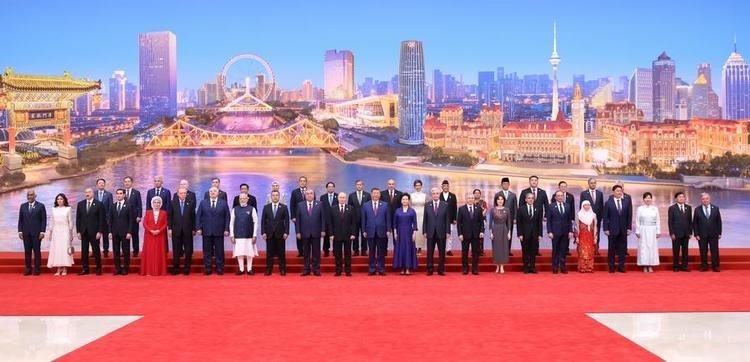
The 2025 Shanghai Cooperation Organisation (SCO) Summit in Tianjin, China, stands as a watershed moment in the annals of global geopolitics. Hosted by the People’s Republic of China under the visionary leadership of President Xi Jinping, this two-day gathering from August 31 to September 1 brought together leaders from over 20 non-Western nations, including Prime Minister Narendra Modi of India and President Vladimir Putin of Russia.
Representing approximately 40% of the world’s population and spanning 24% of the Earth’s land area, the SCO has evolved from a regional security forum into a formidable pillar of multipolarity, driving economic growth that rivals the West. As the Economic Freedom Fighters (EFF), we celebrate this event not merely as a diplomatic exercise but as irrefutable evidence that the multipolar global order is here—and unstoppable.
It signals the definitive eclipse of Western unipolar hegemony, paving the way for a more equitable world where the Global South, including a united Africa, claims its rightful sovereignty.
At the heart of the summit’s significance lies its bold challenge to the decaying unipolar system dominated by the United States of America. For decades, Washington and its allies have wielded economic coercion, military aggression, and cultural imperialism to maintain global dominance. Figures like Donald Trump embody this arrogance, with isolationist and racist policies rooted in white supremacist ideologies that perpetuate inequality.
The Tianjin Summit, however, delivered a resounding rebuke. The adoption of the Tianjin Declaration outlines a 10-year strategy for advancing multipolarity, emphasizing security, economic cooperation, and global governance reform. President Xi’s address called for the democratization of international relations and enhanced representation for developing countries, rejecting hegemonism and power politics in favor of true multilateralism. This vision resonates profoundly with the EFF’s anti-imperialist ethos, as it dismantles structures that have long exploited the Global South.
The deepening ties between China and Russia, highlighted at the summit, exemplify this shift. In an era of NATO expansionism and U.S.A.-led proxy wars, the SCO fosters peace through economic integration and cultural exchange, not militarized intimidation. The summit yielded 24 new agreements on security, economy, and governance, including initiatives on AI cooperation and green industry platforms.
China’s pledge of $280 million in aid to SCO members underscores a commitment to shared prosperity, contrasting sharply with Western conditional loans that breed dependency. Multipolarity, as articulated here, diffuses power among multiple contenders, fostering legitimacy and consensus rather than unilateral dictates.
It promises a fairer order, where no single hegemon dominates, allowing regions like Asia, Eurasia, and Africa to thrive on their terms. While some warn of chaos in this transition, the EFF views it as revolutionary liberation—chaotic only for those clinging to outdated supremacy.
Central to this unstoppable multipolar tide is Africa’s full inclusion, framed through the lens of Pan-Africanism and continental unity. The EFF is inspired by the summit’s potential to integrate Africa as a co-architect, not a peripheral observer. Pan-Africanism—our enduring quest for unity, self-determination, and economic independence—aligns seamlessly with the SCO’s emphasis on solidarity among developing nations. From the African Union’s Agenda 2063 to grassroots anti-neocolonial struggles, Africa’s momentum positions it as a vital partner in platforms like the SCO and BRICS.


South Africa’s longstanding role in BRICS has already amplified Africa’s voice, serving as a gateway to the continent via the African Continental Free Trade Area. The recent BRICS expansion, incorporating Egypt and Ethiopia, enhances this influence, with Ethiopia emerging as a potential “Pan-African voice” within the bloc. These developments foster South-South cooperation, promoting inclusive growth in infrastructure, technology, and human capital.
The African Union’s G20 membership further paves the way for deeper ties, learning from its coordination of regional integration to inform BRICS strategies. Many African states seek BRICS affiliation to emulate leaders like China and India, champions of the Global South who uphold equality and advocate for reformed global institutions.
Without Africa’s participation, multipolarity remains incomplete. A united continent leverages its vast resources—minerals, youthful population, and burgeoning markets—to drive mutual benefits. The EFF commits to forging stronger links between African liberation movements and these platforms, ensuring Pan-Africanism fuels the Global South’s ascent.
This inclusion accelerates decolonization, shaking up the world order by providing alternative economic and political avenues for Africa. As more African nations eye BRICS membership, the bloc’s emphasis on the African agenda—prioritized under South Africa’s leadership—heralds a future where our continent escapes neocolonial debt traps and resource exploitation.
No discussion of the summit’s significance is complete without addressing de-dollarization, a cornerstone of economic sovereignty. The EFF has long championed moving away from the U.S. dollar, viewing it as a tool of imperial coercion. President Xi’s proposal for a new SCO Development Bank marks a monumental stride, aimed at creating alternative payment systems that circumvent the dollar.
Aligned with BRICS aspirations, this includes BRICS Pay—a digital platform for non-dollar transactions—and alternatives to SWIFT. By mid-2025, China-Russia trade had reached 95% in local currencies, proving feasibility amid U.S. sanctions.
De-dollarization enhances sovereignty, reducing reliance on IMF and World Bank debt traps that impose austerity on developing nations. For Africa, trading in local currencies shields economies from U.S. sabotage, fostering inclusive growth. Initiatives like the Pan-African Payment and Settlement System complement these efforts, while BRICS proposals for green funds and barter systems further erode dollar dominance.
Trump’s threats against BRICS only underscore the urgency; they reveal a fading empire’s desperation. Iran’s summit call to sever ties with the dollar system cements this as a model for multipolar finance.
In essence, the EFF unequivocally endorses the SCO Summit’s outcomes. This vanguard of multipolarity delivers a clear message to the U.S. and Western Europe: unilateral bullying is over. The Global South will no longer tolerate dictation from a declining power.
We stand in solidarity with China, Russia, India, and all participants, pledging to advance this agenda in South Africa and across Africa. Progressive forces must rally to hasten a just, multipolar world.
As the EFF pursues economic freedom in our lifetime, inspired by such milestones, we declare: together, we shall overcome.


Ambassador Carl Niehaus is an EFF Member of Parliament (MP).

