


The President of the World Bank, Ajay Banga, has praised Mozambique’s vast energy potential, declaring it uniquely positioned to become Southern Africa’s “energy back office” through a strategic mix of hydroelectric, gas, solar, and wind power.
Speaking Saturday during a visit to Songo district, home to Mozambique’s Cahora Bassa Hydroelectric, the World Bank President said: “I am here to see first-hand what is being done in the energy sector. President Daniel Chapo has clearly laid out his vision—he is determined to harness Mozambique’s incredible natural assets. The country has hydro, gas, sun, and wind. You’ve got everything needed to create a robust energy production and transmission system.”
The World Bank chief noted that no other country in the region possesses the same scale or variety of energy assets, stressing: “This is a real opportunity—not just to admire what was built 50 years ago, but to build on that legacy for the next generation of investment.”
Among the priority initiatives under discussion is the Mpanda Nkuwa hydropower cascade project, expected to generate an additional 1,500 megawatts downstream from the existing Cahora Bassa dam. Simultaneously, investment is being mobilised for a 400-megawatt solar power facility as part of a broader push for renewable energy expansion.
Ajay Banga also praised President Chapo’s long-term vision. “If you look at a ten-year picture, the goal is clear: to turn Mozambique into an energy powerhouse and the strategic energy hub of Southern Africa. It’s an ambition we support—and one that requires not only public funding but well-structured public-private partnerships.”
The World Bank Group is preparing a comprehensive support package for Mozambique’s energy ambitions. This includes project design and financing from the International Finance Corporation (IFC), partial risk guarantees from the International Bank for Reconstruction and Development (IBRD), political risk insurance from the Multilateral Investment Guarantee Agency (MIGA), and concessional financing from the International Development Association (IDA).
“It’s like an orchestra,” the World Bank chief said. “You need all the instruments playing in harmony. That’s the kind of partnership we are building with Mozambique.”
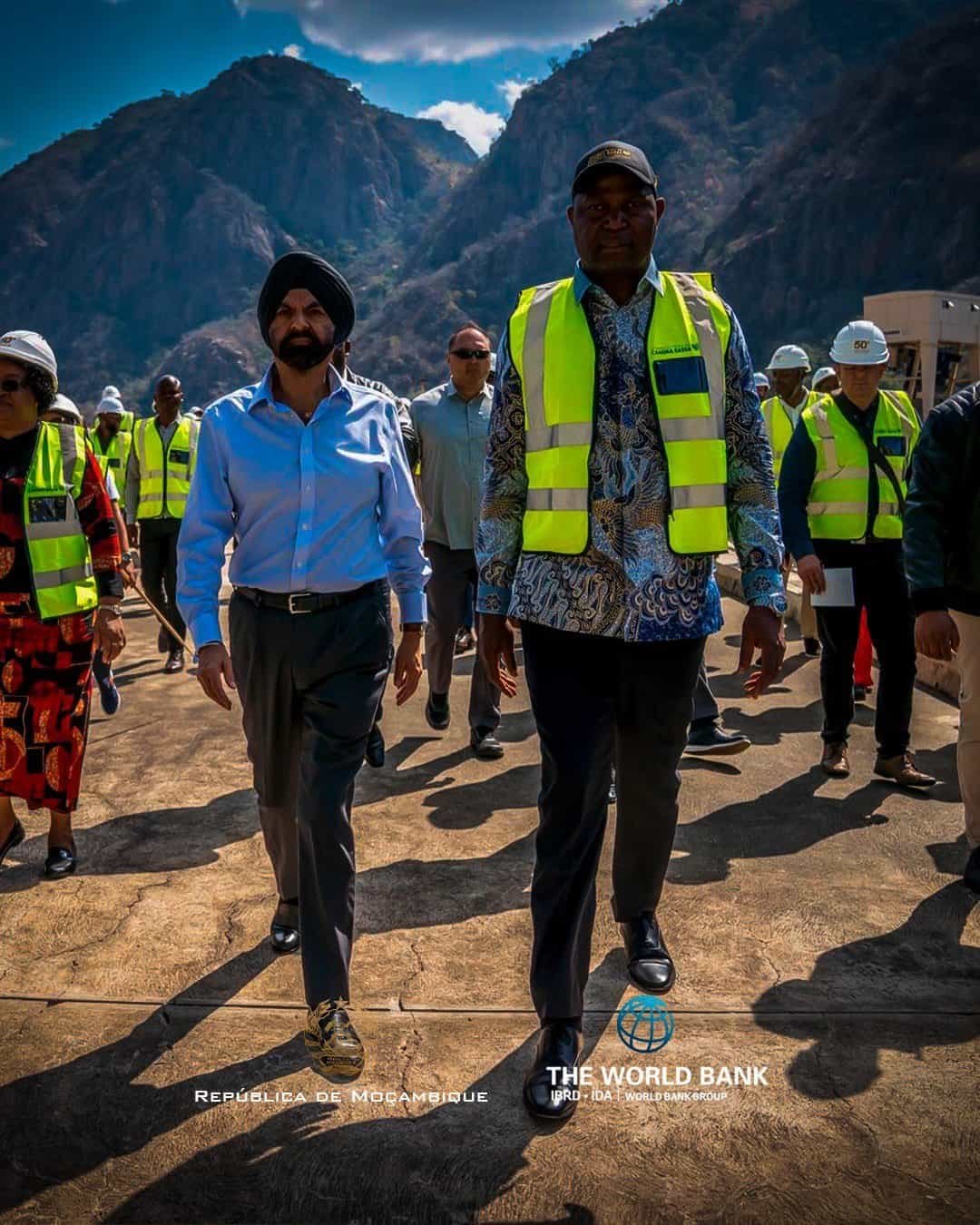
On his part, Mozambican President Daniel Chapo, has announced his country’s ambition to become the main energy distribution hub in Southern Africa, citing vast natural and infrastructural resources currently under development.
“We want to be the hub for electricity distribution in Southern Africa,” said Chapo. “We have assets ready for investment to boost energy production, starting with the Cahora Bassa Hydroelectric Plant (HCB), which is undergoing an expansion to increase its generation capacity. We are also advancing the Mpanda Nkuwa project.”
According to Chapo, Mozambique is not limiting its ambitions to hydroelectric power. “We also have significant natural gas reserves,” he said, highlighting current projects such as the combined-cycle power station in the Maquinar region and the ongoing operations at CTRG (Central Térmica de Ressano Garcia).
In Inhambane, the government is completing the 450-megawatt Temane thermal power plant, the largest power station built in Mozambique since independence. The Rovuma Basin in the north also holds substantial gas reserves.
“ENH [National Hydrocarbon Company] holds a legally mandated gas quota, and our goal is to maximise electricity production from this gas,” Chapo said.
Mozambique is also exploring renewables to diversify its energy mix. “We have already begun solar power initiatives in Mocuba and Metoro,” the President noted. “Here, where we are now, we will soon begin constructing a 400-megawatt solar power plant to further boost HCB’s capacity. The feasibility and environmental impact studies are complete, and we are moving towards the tender and construction phase.”
Additionally, President Chapo said the country’s geography makes it suitable for wind energy production.
He also emphasised Mozambique’s ongoing collaboration with the World Bank Group, particularly the International Finance Corporation (IFC), to attract public-private partnerships and other investments in the energy sector.
Beyond energy, President Chapo outlined four priority areas for partnership with the World Bank: tourism, agriculture, mineral resources, and infrastructure. “We believe our development corridors—Maputo, Beira, and Nacala—can generate significantly more revenue through improved transport and logistics services,” he concluded.

