


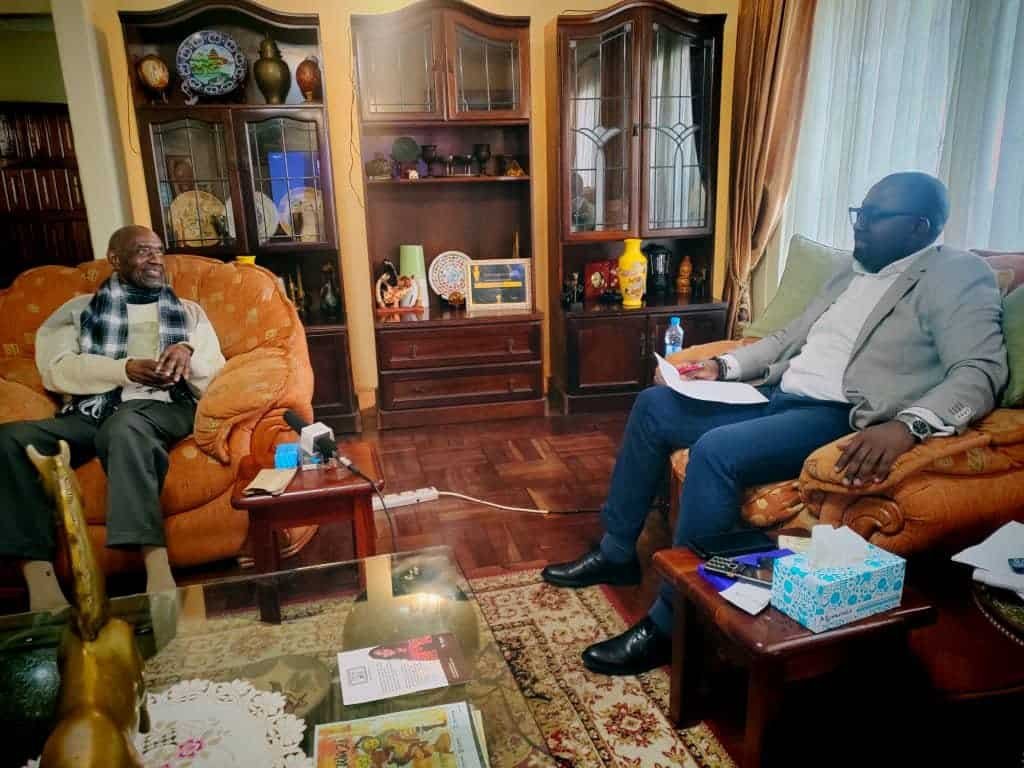
The sun hung low over Lusaka’s Olympia neighborhood, casting a warm glow on the quiet street leading to Vernon Johnson Mwaanga’s residence. Known to Zambians as “VJ,” this towering figure in the nation’s history welcomed me into his home, a place brimming with artifacts and ornaments collected from his travels around the world, each piece a testament to a life steeped in diplomacy and history.
I had come to talk about Kenneth Kaunda, Zambia’s founding president, and his role in the liberation struggle and pan-African unity. What I got instead was an unforgettable journey through history, guided by a man whose life has been a cornerstone of Zambia’s story. At 81, VJ’s presence was magnetic, his voice rich with wisdom and humor, his memory sharp as ever. Amid the treasures of his global journeys, what began as a conversation unfolded into a masterclass on politics, diplomacy, and the heart of a nation.
Kaunda’s Vision: The Heart of Zambia’s Liberation
VJ settled into his chair, his eyes alight with the spark of memory. “KK was the soul of our fight,” he said, his voice warm as he recalled Kenneth Kaunda’s leadership of the United National Independence Party (UNIP) in the early 1960s.
Drawing inspiration from Mahatma Gandhi’s non-violent resistance, Kaunda led the Cha-cha-cha campaign, a daring wave of civil disobedience that shook the foundations of British colonial rule.
“He brought together 75 ethnic groups under ‘One Zambia, One Nation,’” VJ said, a note of awe in his tone. “In a land as diverse as ours, that was no small miracle.”
Kaunda’s vision stretched far beyond Zambia’s borders. VJ leaned forward, painting a vivid picture of post-independence Zambia in 1964, when Kaunda transformed the young nation into a haven for Southern Africa’s liberation movements.
From Angola’s MPLA to Zimbabwe’s ZANU and ZAPU and South Africa’s ANC, Zambia offered refuge, training camps, and resources, even when it strained the economy.
“The copper boom hid the costs for a while,” VJ explained, “but when prices crashed in the ’70s, we felt the weight of our solidarity.” He recounted his own role as Foreign Minister, facilitating Kaunda’s 1975 White House visits to rally support against apartheid. “KK believed a free Zambia was incomplete while our neighbors were in chains,” VJ said. “That was pan-Africanism in action.”
The Winds of Change: Challenging the One-Party State
The mood shifted as VJ turned to the late 1980s, a time when economic hardship and discontent with UNIP’s one-party state, cemented by the 1973 constitution, stirred calls for reform. As a trusted ally of Kaunda, VJ faced a pivotal moment. “I went to KK in the late ’80s,” he said, his voice softening with the weight of the memory. “I told him the winds of change were sweeping Africa. Multiparty politics was the future.” Kaunda’s response was fiery. “He blasted me,” VJ said with a chuckle, mimicking Kaunda’s animated gestures. “He accused me of betraying the revolution.”
Undeterred, VJ acted decisively. That same day, he returned to his office, penned a resignation letter from Kaunda’s government, and delivered it to State House himself. Seeking perspective, he traveled to Tanzania to consult his mentor, President Julius Nyerere. “Julius agreed with me,” VJ recalled. “He was already discussing multiparty reforms with his own colleagues. It confirmed what I knew: the one-party state couldn’t last.”

Building the MMD: A New Chapter
VJ’s conviction led him to co-found the Movement for Multiparty Democracy (MMD) in 1990, alongside former UNIP stalwarts and labor leaders. He shared a personal anecdote about the MMD’s search for a presidential candidate. “I was living in Lusaka, and Frederick Chiluba, then ZCTU president, was based in Ndola. He’d stay with me when he visited,” VJ said, a nostalgic smile spreading across his face. “When we asked FTJ to run, he was hesitant. He told me, ‘VJ, I’m not sure I’m the one.’ I said I’d back him fully, I never wanted the presidency myself. My place has always been behind the scenes, serving the nation.”
A Model Transition and a Hope for the Future
VJ’s eyes gleamed as he described the 1991 elections, a turning point for Zambia. Chiluba’s MMD swept to victory, claiming 76% of the presidential vote and 125 of 150 parliamentary seats. “What made it special was UNIP’s grace,” VJ said. “KK conceded with that famous wave of his white handkerchief, a moment that set a standard for Africa.”
He contrasted this with later transitions, noting that most, from Chiluba to Levy Mwanawasa, Rupiah Banda, and Michael Sata; upheld Zambia’s democratic spirit. The exception was 2021, when Edgar Lungu’s reluctance to concede to Hakainde Hichilema cast a shadow. “Rupiah Banda had to step in to keep the peace,” VJ said with a sigh. “It reminded us that democracy is fragile.”
Despite this, VJ’s pride in Zambia’s journey shone through. “We’ve built something special, but we must stay vigilant,” he said. “The courts, the constitution, the people, they’re the backbone of our unity. Zambians will always choose leaders who bring us together.” His hope for a better Zambia was clear: a nation that honors its past while forging a path for the next generation.
A Legacy Etched in Time
As our time wound down, VJ shared a quiet revelation; the Zambia Institute for Diplomatic Studies, which he helped found, will soon bear his name. “It’s humbling,” he said, his voice steady but touched with emotion. “I’ve given my life to Zambia, through diplomacy, politics, and writing. If this inspires young Zambians to learn our history, I’ll rest easy.”
Driving away from VJ’s home as the sun dipped below the horizon, I felt like I’d stepped out of a living history book. His stories, of Kaunda’s vision, the fight for multiparty democracy, and Zambia’s democratic resilience weren’t just memories; they were lessons in courage and conviction.
Surrounded by the artifacts of his global travels, VJ hadn’t just recounted Zambia’s story; he’d brought it to life with the warmth and wit of a true storyteller. As Olympia faded in my rearview mirror, I carried with me the weight of a nation’s history, and the inspiration of a man whose legacy, like Kaunda’s, is woven into Zambia’s soul.
Kalumbu Lumpa is a media practitioner in Zambia.

