


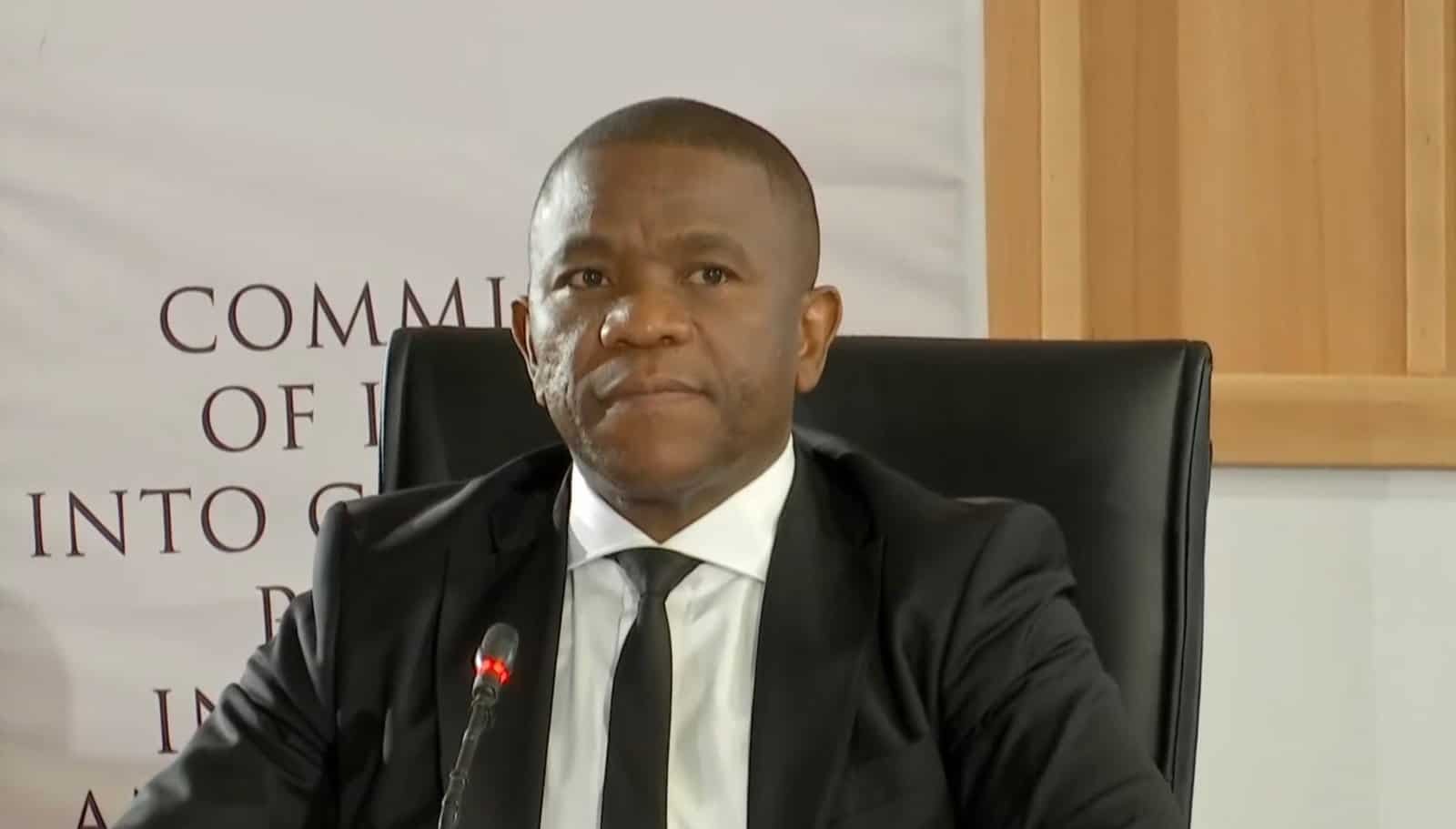
Day three of the Madlanga Commission of Inquiry saw KwaZulu-Natal Police Commissioner Lieutenant General Nhlanhla Mkhwanazi deliver another round of shocking testimony, this time focusing on suspended Police Minister Senzo Mchunu’s alleged ties to businessman Brown Mogotsi, irregular use of classified police documents, and the role of political figures and businessmen in compromising the country’s intelligence structures.
Mkhwanazi opened Friday’s session by revisiting the case of Mokgotsi, whom he directly linked to the suspended minister.
“As I wanted to indicate on Thursday, the issue of a gentleman called Brown Mokgotsi, who is an associate of the minister, was confirmed by the Chief of Staff,” Mkhwanazi testified.
He told the inquiry that when questioned in a parliamentary sitting on 5 March, Mchunu denied knowing Mokgotsi. But later in March, the minister allegedly contradicted himself.
“In a private conversation, he confirmed knowing the person, although denying that he was an associate. He said the person was a comrade. And I said, I do not know the difference between a comrade and an associate. The words we used were ‘associate,’ as confirmed by the Chief of Staff.”
Mkhwanazi said he first encountered Mokgotsi’s name on 30 September 2024, when he received a WhatsApp message about an allegation of “defeating the ends of justice” at Mpangeni Correctional Facility. That incident, he explained, later became widely publicised.
Turning to another incident, Mkhwanazi revealed how political figure Fadiel Adams lodged complaints using material he should not have had access to.
“On 29 October 2024, Mr Adams went to Cape Town Police Station and opened three cases. These cases do not even warrant registration. There are no elements of crime in his complaint,” Mkhwanazi testified.
“But nonetheless, he opened them, and they were about vetting procedures within Crime Intelligence — a space he ought not to play in. He took sensitive information, went to a police station, and opened a case. That means he had access to records within Crime Intelligence, secret information he should not have been in possession of.”
According to Mkhwanazi, Adams claimed there was abuse of the secret fund account.
“His allegation was that these funds were being channelled to places where they were not supposed to go, including the procurement of vehicles for a political task team in KwaZulu-Natal. Surely as a complainant, you must provide proof. He did not.”

Mkhwanazi claims that Adams also alleged that the task team served as a private armed force for former Police Minister Bheki Cele.
“That is what he put in the documents, in the A1 statement he gave to the police. He accused the team of being an armed force for General Cele,” Mkhwanazi explained.
Two days later, Adams repeated the exact same complaints at the Orlando Police Station in Johannesburg. “On 29 and 31 October, he opened identical charges in Cape Town and Orlando. These are in our police records,” Mkhwanazi said.
Mkhwanazi then turned to what he described as the most alarming discovery — classified police documents in the possession of private businessmen.
“On 1 October 2024, I received a suspicious message at 7:44 in the morning. The sender attached a police letter and a factual report. The content of the occurrence book and the report were exactly the same, and it surprised me because these are documents of the police. A person who is not in the police should not be in possession of them,” Mkhwanazi testified.
“He is from North West, but he had a copy of the occurrence book from Empangeni in KwaZulu-Natal. For him to get there, he would need to take at least two flights. How did he obtain that OB? This was shocking to me.”
Mkhwanazi said his team will display information about Suleiman Karim, a businessman based in the North West.
Mkhwanazi tied Karim directly to Vusimuzi “Kat” Matlala, the businessman whose R360 million contract with the police has been under heavy scrutiny.
“There is a businessman in North West, Mr Suleiman Karim, who had direct communication with Matlala. Their communication involved the cancelled contract Matlala had with the police service,” Mkhwanazi testified.
“Matlala was approaching him to help engage with the minister to stop cancellation of his contract. Mr Karim committed to do that because he has a relationship with the minister.”
This revelation follows the Alexandra Magistrate’s Court decision earlier this week denying Matlala bail, with the court ruling he was a flight risk who might interfere with witnesses. The National Prosecuting Authority welcomed the outcome.


Mkhwanazi continued naming political figures he accused of interfering with the state’s intelligence structures.
On Thursday, he accused Democratic Alliance MP Dianne Kohler Barnard of breaching the law by releasing classified information.
“She has disclosed sensitive information that compromises the security of the state,” he said.
On Adams, he was equally blunt: “Mr Adams has been sharing information that he was not authorised to access. That compromises the security of the state.”
The police commissioner described what he saw as a dangerous pattern of collusion between politicians and businessmen.
“It surprised me that documents of the South African Police Service, including the occurrence book, are in the hands of private businessmen. That is dangerous,” he said.
Day three of his testimony has widened the circle of names implicated in political interference and police capture. With Mokgotsi, Mchunu, Adams, Karim, Matlala and Kohler Barnard all in the spotlight, the commission now faces mounting pressure to unravel what Mkhwanazi described as a dangerous network corroding the country’s law enforcement from within.

