


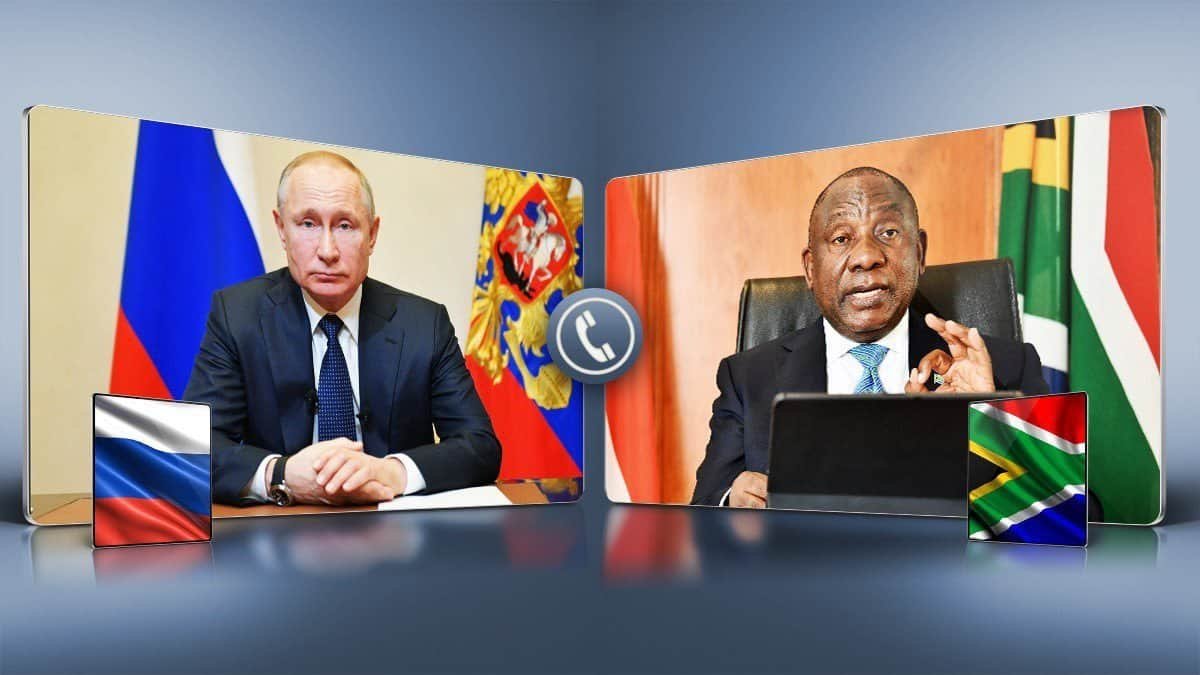
President Cyril Ramaphosa has held a crucial telephone conversation with Russian President Vladimir Putin amid ongoing efforts to resolve the deadly Russia-Ukraine conflict and strengthen South Africa’s strategic posture in a rapidly shifting global order.
The discussion took place on the afternoon of Thursday, 7 August 2025, and was initiated at the request of President Putin, who sought to brief Ramaphosa on Russia’s position in the Ukraine peace process. According to the Presidency, the two heads of state also discussed a range of bilateral and geopolitical issues, reaffirming a long-standing relationship that dates back to the Cold War.
Ramaphosa welcomed the update from Moscow and reiterated South Africa’s commitment to a peaceful resolution of the conflict, expressing his continued support for “all efforts aimed at ending the war and establishing a lasting peace between Russia and Ukraine.”
This engagement comes just a day after Ramaphosa held a separate call with U.S. President Donald Trump, adding a dramatic layer to South Africa’s balancing act in a world once again split between competing superpowers.
South Africa has walked a diplomatic tightrope since Russia launched its full-scale invasion of Ukraine in February 2022, refusing to condemn Moscow at the United Nations while calling for dialogue and peace. The African National Congress (ANC) maintains historical ties with Russia, whose former Soviet Union supported the liberation struggle against apartheid.
President Ramaphosa has previously participated in African-led peace missions to both Kyiv and Moscow, where he urged Ukrainian President Volodymyr Zelensky and President Putin to commit to negotiations. However, critics argue that South Africa’s reluctance to take a firm stance has left its global standing vulnerable.
The latest call between the two leaders signals a continuation of Pretoria’s policy of “strategic non-alignment,” which seeks to keep diplomatic and economic relations open with both the West and the East — even as tensions deepen between NATO-aligned countries and the BRICS bloc.
Presidency Spokesperson Vincent Magwenya confirmed the call and emphasised the importance of open diplomatic channels in global conflict resolution.
“President Ramaphosa welcomed the opportunity to be briefed by President Putin on the unfolding peace initiatives. South Africa remains committed to any process that ends the violence and contributes to a lasting, just peace,” Magwenya said.
According to diplomatic sources, Putin used the opportunity to present his version of the evolving situation on the ground in Ukraine and to stress Russia’s interest in a negotiated end to hostilities.
However, analysts remain sceptical of the Kremlin’s intentions.
“Putin is attempting to control the narrative by reaching out to African and Global South leaders,” said an international relations expert. “The aim is to create the impression of goodwill while reinforcing alliances outside the Western sphere.”
Russia’s engagement with South Africa is part of a broader outreach to the continent. In recent years, Moscow has deepened military, trade, and energy ties with several African nations through its Africa-Russia Summits and various bilateral deals.
The timing of this call is especially notable given President Ramaphosa’s high-profile conversation on 6 August with Donald Trump, who remains a polarising figure in international affairs. While the content of that call remains undisclosed, insiders suggest trade tensions and U.S.-Africa tariffs were among the key topics.
More than three years into the war, the Russia-Ukraine conflict has claimed thousands of lives, displaced millions, and triggered a food and energy crisis felt across Africa. South Africa, as a leading voice on the continent and a member of BRICS alongside Russia, has consistently advocated for diplomacy over military escalation.
In their conversation, both leaders agreed to deepen their strategic partnership. It remains unclear what this entails, but sources suggest that economic cooperation, nuclear energy discussions, and further multilateral engagement under BRICS could feature prominently in upcoming summits.
As Ramaphosa continues to navigate one of the most volatile geopolitical landscapes in recent history, his latest diplomatic moves suggest an assertive yet cautious foreign policy — one that seeks to protect national interests while promoting a global peace agenda from an African perspective.

