
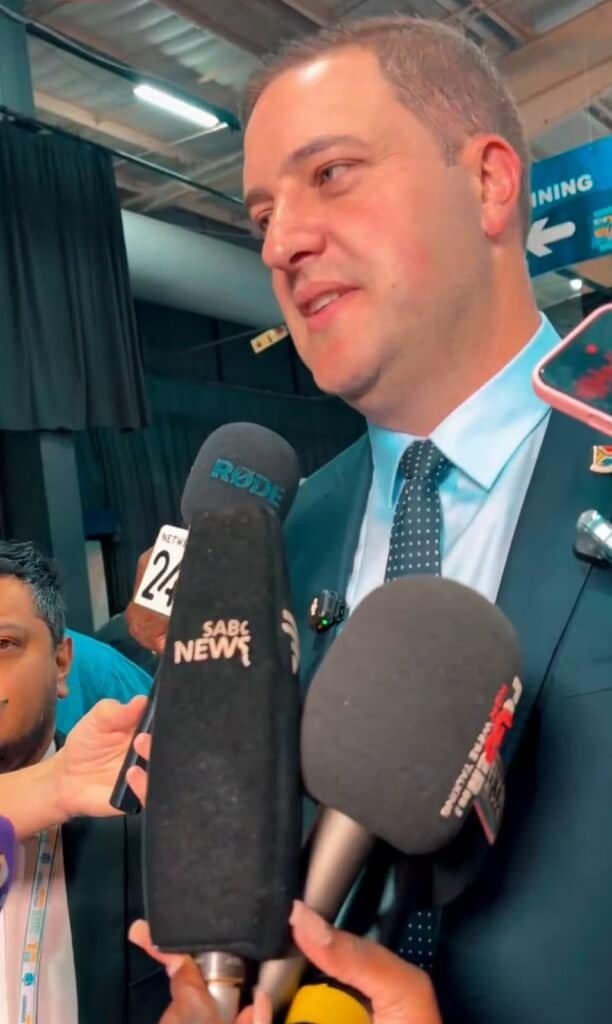
Democratic Alliance (DA) leader Geordin Hill-Lewis has described the party’s performance in the 2026 local government elections as a political earthquake, expressing excitement over the ANC’s declining support, particularly in Johannesburg, where the DA was leading with 40.3% against the governing party’s 17%.
Addressing journalists at the National Results Operations Centre in Midrand on Friday morning, Hill-Lewis said the election results reflected a significant shift in South Africa’s political landscape, with the DA making gains in metropolitan municipalities, townships and rural communities.
He singled out Johannesburg, where the ANC was only two percentage points ahead of ActionSA, saying the governing party could potentially fall to third position as the counting process continued.
“It’s a remarkable thing in South Africa that the DA is leading with 40.3% in Johannesburg, and the ANC has dropped to 17%. They’re just two points ahead of ActionSA. They may very well drop to third. This is remarkable. It’s an earthquake politically, frankly,” Hill-Lewis said.
He said the results had once again brought home the scale of the political changes taking place, with attention now turning to which parties would negotiate to form the next municipal administrations.
Hill-Lewis said he was deeply hopeful about South Africa’s future, describing the election outcome as an historic opportunity to turn around towns and cities.
The DA leader said his party was the only one expected to govern a metropolitan municipality with an outright majority, following what he described as a strong endorsement by voters in Cape Town.
The party was also emerging as the largest political party in four other metropolitan municipalities: Johannesburg, Tshwane, Ekurhuleni and Nelson Mandela Bay.
According to Hill-Lewis, the DA was expected to gain 104 additional wards and approximately 233 councillors across the country.
He also highlighted the party’s growing support among black voters, claiming that roughly one million black South Africans had voted for the DA.
The party had also recorded its highest-ever support in Cape Town townships, with similar gains in townships across the country, particularly in areas where it governs.
Hill-Lewis attributed the growth to voters recognising the DA’s efforts to improve governance and living conditions.
“These results reflect a growing, stronger DA that is now deeply embedded in every single community in the country, and that truly represents every part of South Africa,” he said.
However, with several municipalities expected to require coalition arrangements, the DA has already started engaging political parties to establish possible governing partnerships.
Hill-Lewis said the party was not prepared to rule out potential coalition partners at this early stage, arguing that doing so could undermine its negotiating position.
He said discussions had started in earnest on Thursday and would continue on Friday.
“At the moment, we are open to talking with everyone, and we are talking with everyone, and that’s how we will proceed for the next few days at least,” he said.
Hill-Lewis acknowledged that the DA would not necessarily end up working with every political party, citing differences in political positions and governance principles.
However, he said excluding parties before negotiations had properly started would be self-defeating.
On the question of who should occupy mayoral positions in municipalities requiring coalition governments, Hill-Lewis said the DA’s general position was that the largest party within a coalition should lead the administration.
He said voters could be surprised if a relatively smaller party secured a mayoral position despite being part of a coalition in which another party had received significantly more support.
His comments come amid discussions about the mayoral race in Johannesburg, where the DA has fielded senior politician Helen Zille, while ActionSA leader Herman Mashaba has also expressed an interest in becoming mayor.
However, Hill-Lewis stressed that the DA’s position was not an immovable condition and that the final arrangements would depend on negotiations.
“That’s certainly, I think, the general view inside the DA. But again, I don’t want to say that it is a hard and fast immovable position. We have to go and have those discussions in the negotiating chamber,” he said.
Asked whether the same principle would apply in KwaZulu-Natal, where the uMkhonto weSizwe Party (MK Party) had secured significant support, Hill-Lewis said the principle related to the largest party within a governing coalition, rather than automatically giving the largest party in a province the right to govern.
He acknowledged that the DA had serious concerns about the MK Party, saying its political positions and leadership appeared to change frequently.
Nevertheless, he maintained that the party would not refuse to engage with it before discussions had taken place.
Hill-Lewis said the DA’s openness to negotiations did not mean it would compromise on its principles, identifying corruption as a clear non-negotiable.
“We cannot have parties that will further the aims of state capture and grand looting that we’ve seen in so many of these cities. That is a clear non-negotiable,” he said.
The DA wants coalition partners committed to integrity, zero tolerance for corruption, merit-based appointments, sound financial management and measurable improvements in basic services.
Hill-Lewis said the objective was to establish stable administrations capable of addressing residents’ everyday challenges, including water shortages, unreliable municipal services, crime and unemployment.
He invited political parties willing to put residents first to join the DA in building governments focused on improving municipalities.
The party has also committed to making its coalition agreements publicly available once negotiations have been concluded.
Hill-Lewis said the DA would respect the mandates received by all political parties and approach negotiations with the aim of building inclusive, capable and stable governments.
“South Africa can work for everyone. The DA is ready to do our part,” he said.


