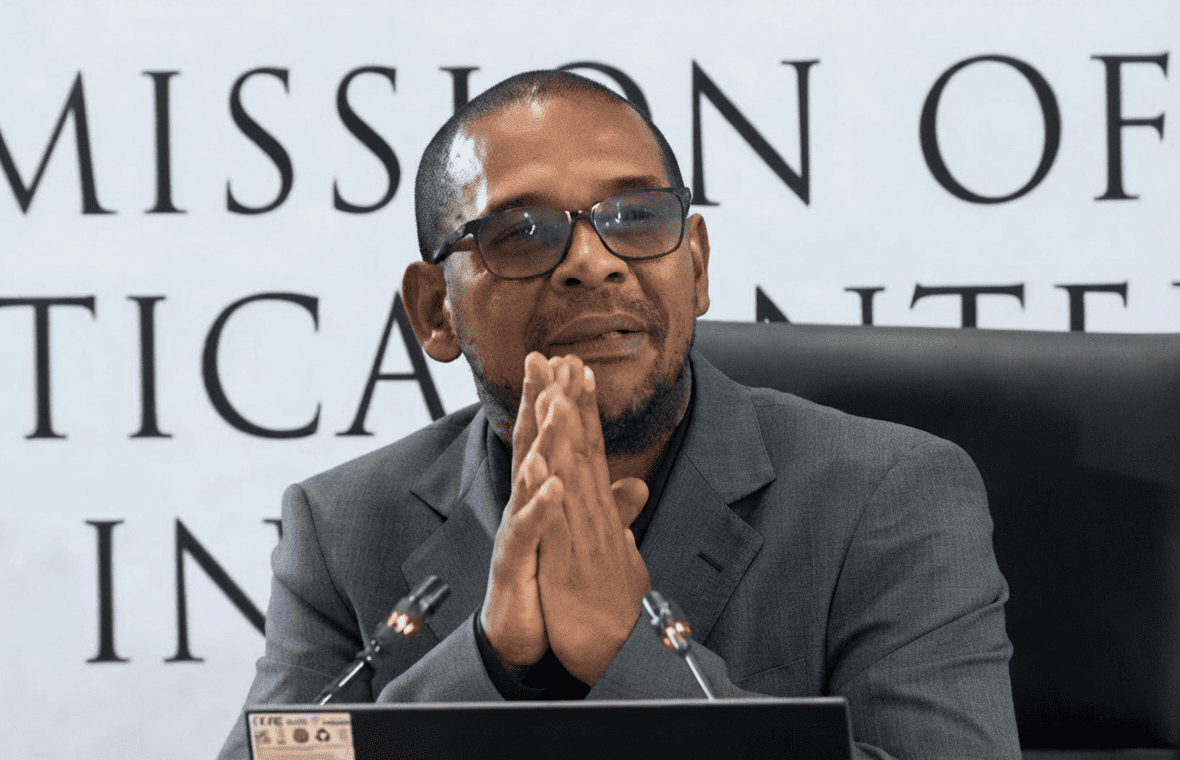
Suspended National Coloured Congress MP Fadiel Adams was forced to account for contradictory statements at the Madlanga Commission of Inquiry on Wednesday, apologising to the inquiry after evidence showed he had received a Rule 3 notice months earlier than he previously claimed.
Adams returned to the witness stand amid intense questioning from commission chair Justice Mbuyiseli Madlanga, who confronted him with emails showing that the commission had sent him correspondence, including a Rule 3 notice, in October 2025.
The questioning followed Adams’ previous appearance before the commission on August 11, when he said he had not received the notice at the time it was sent.
Madlanga reminded Adams that he had previously told the commission that he had only become aware of the Rule 3 notice about three months ago.
Adams confirmed that he had made the statement.
The chairperson then took him through a series of emails sent by the commission on October 3, 2025.
Madlanga focused particularly on the Rule 3 notice attached to the first email.
The evidence showed that Adams responded to the commission’s email on October 14, 11 days after it had been sent.
This raised questions about his previous claim that he had only become aware of the notice much later.
Adams accepted responsibility for the confusion and apologised to the commission.
He said the misunderstanding stemmed from his interpretation of the emails and the Rule 3 notice.
The issue is significant because the commission had been attempting to secure Adams’ evidence for months. He eventually submitted his witness statement late on August 10, prompting the postponement of his initial appearance.
The commission is investigating allegations relating to criminality, corruption and political interference in the criminal justice system. Adams is expected to face detailed questions about his whistleblower complaint concerning Crime Intelligence and how he came into possession of classified documents.
The commission has previously heard that Adams’ complaint to the Investigating Directorate Against Corruption was based on classified Crime Intelligence material which he claimed had been slipped under the door of his parliamentary office.
But the Rule 3 notice was not the only issue that returned to haunt Adams.
His explanation for the delayed submission of his evidence, which he attributed partly to a malfunctioning parliamentary laptop, also came under renewed scrutiny.
During his previous appearance, Madlanga described the laptop explanation as difficult to believe and urged Adams to take the commission seriously.
Parliament subsequently disputed Adams’ account.
Parliamentary spokesperson Moloto Mothapo said an examination of the institution’s ICT Service Desk records found no evidence of persistent laptop malfunction, hardware failure, repeated freezing or the device being repeatedly submitted for repairs.
The records instead reflected routine technical support requests, including password resets, assistance with logging into a device, a Wi-Fi update and an electronic disclosure-related request.
Parliament also pointed out that MPs are provided with multiple devices, including a laptop, tablet and smartphone, allowing them to continue working if one device develops problems.
Madlanga confronted Adams with an interview he had given to journalists after his previous appearance, during which Adams claimed he had provided the media with proof that his laptop had malfunctioned.
The chairperson told Adams that the only physical evidence he appeared to have provided was an instance in which he used another MP’s laptop.
Madlanga questioned how that single incident could prove Adams’ assertion that his laptop had been malfunctioning from October 2025 until roughly three months ago.
Adams maintained that the laptop had malfunctioned and argued that the evidence he provided was intended to demonstrate that his explanation was not something he had invented specifically for the commission.
Madlanga pressed him further.
“If you were being untruthful,” the chairperson suggested, “that’s a simple suggestion I’m making to you.”
Adams rejected the characterisation, insisting that he had provided the media with the evidence available to him to show that the laptop problems predated his appearance before the commission.
The chairperson also ordered the playing of another video in which Adams accused Parliament of defaming him after the institution challenged his laptop claims.
In the footage, Adams said Parliament had accused him of lying and indicated that his legal representatives would take action against the legislature.
Madlanga subsequently questioned Adams about comments concerning an alleged oral engagement with ANC MP Nqola.
Adams apologised if his conduct had created that impression.
The repeated confrontations have placed Adams’ credibility firmly at the centre of his evidence before the commission.
His handling of classified Crime Intelligence documents, the circumstances surrounding his complaint to IDAC and his interactions with investigators are expected to face further scrutiny as Advocate Lee Segeels-Ncube leads his evidence.
The commission’s investigation comes against the backdrop of a wider inquiry into allegations involving senior police officials, Crime Intelligence and alleged political interference.
Adams is a key witness because his complaint helped trigger investigations into allegations within Crime Intelligence.
His evidence is therefore expected to shed light not only on the documents he received but also on how they were transmitted to authorities and the role he played in subsequent investigations.
The commission is continuing with Adams’ testimony.