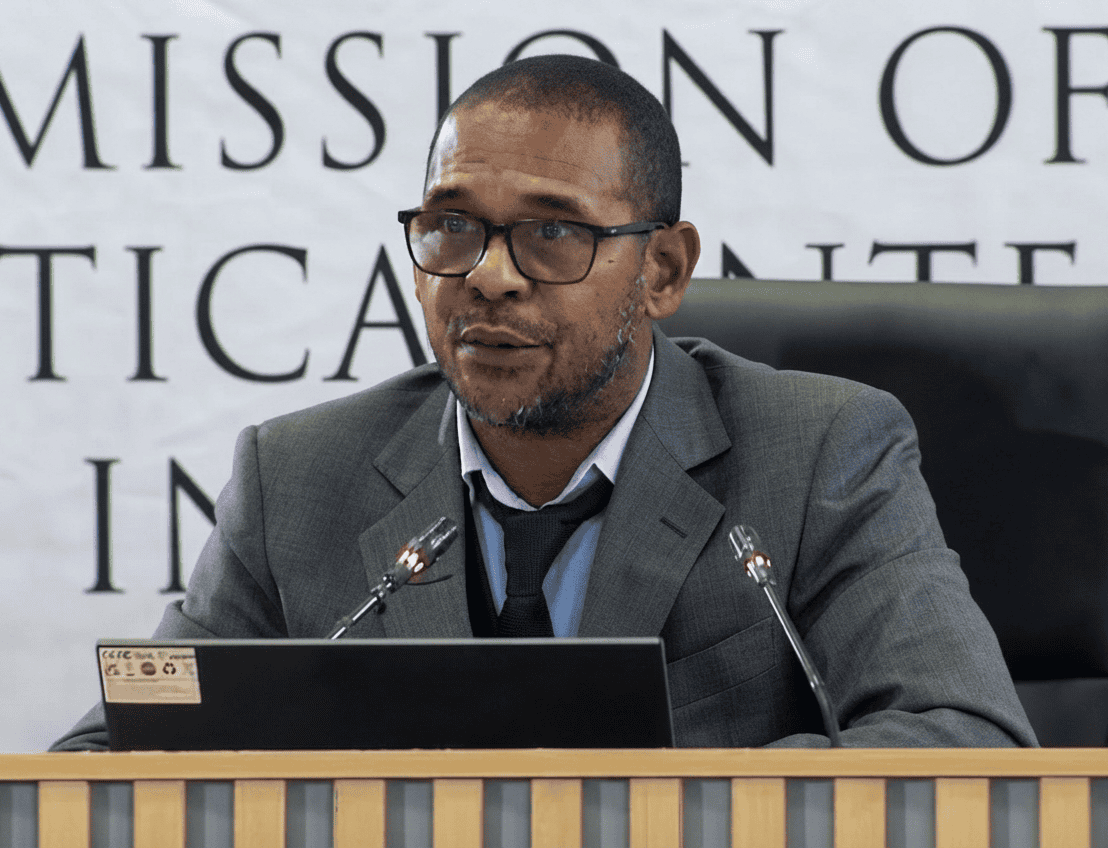
National Coloured Congress leader and suspended MP Fadiel Adams returned to the witness stand at the Madlanga Commission on Thursday, facing sustained questioning over classified documents, missing dockets and information he says was supplied to him by the late police officer Andre Lincoln.
Adams is giving evidence for a second day before the commission, which is investigating allegations of criminality, political interference and corruption in South Africa’s criminal justice system.
At the start of proceedings, Advocate Lee Seegels-Ncube told the commission that an audio recording of an Investigating Directorate Against Corruption (IDAC) meeting with Adams on 6 January 2025 had been made available to both the inquiry and Adams.
She said Adams would identify the portions of the recording he wanted played, to ensure the commission was not accused of “cherry-picking” evidence.
Adams was then taken through documents he claims were slipped under the door of his parliamentary office.
He confirmed that many of the dockets and documents before the commission were material he had previously handed to IDAC, but said there appeared to be additional documents before the inquiry that he had never provided.
However, Adams made a significant correction to his earlier evidence.
He told the commission he no longer believed that documents he found in his parliamentary office were connected to General Lushaba.
“I was wrong… I don’t think that was in the envelope,” Adams said, acknowledging that there was nothing in the alleged envelope relating to an incident involving Lushaba’s house being broken into.
Adams said he obtained information about that incident from either Patricia Mashale or Mary de Haas.
The correction added to questions about the reliability and origins of some of the information Adams has presented to the commission.
He repeatedly cited Lincoln, who died in May 2025, as the source of information about several matters. Adams said Lincoln had told him that Crime Intelligence boss Lieutenant General Dumisani Khumalo did not have security clearance.
But Seegels-Ncube questioned why Adams had not disclosed Lincoln as his source before his death.
Adams said he would never have revealed Lincoln as his source while he was alive.
The advocate also challenged Adams over his failure to tell Parliament’s Ad Hoc Committee that he had informed then Police Minister Senzo Mchunu about classified documents he allegedly found in his office.
Adams conceded that he should have disclosed this, saying he was angry at the time because he believed Ian Cameron had “moved heaven and earth” to prevent him from appearing before the committee.
The evidence then turned to Brown Mogotsi and alleged assistance Adams received in opening criminal cases in Orlando, Soweto.
Co-commissioner Sandile Khumalo asked whether Adams was among people allegedly assisted by alleged political fixer Brown Mogotsi in November and December 2024.
Adams denied this.
He said he knew Mogotsi through Lincoln, who had told him that Mogotsi was close to Mchunu. Adams said his interaction with Mogotsi followed Lincoln’s complaint that he had not received his “mention” and that the minister was not acting on it.
Evidence from Witness G, identified as Mogotsi’s alleged handler, has indicated that Mogotsi helped Adams open cases in Orlando.
Adams identified Witness G as “Elvis”, saying Lincoln introduced them, but disputed the witness’s account.
He also faced questions over an email he sent Mchunu after allegedly being told that dockets were going to be intercepted.
Seegels-Ncube pointed out that Adams sent the email just 24 hours after being informed that Western Cape dockets had allegedly been intercepted.
Adams initially said Lincoln told him the Orlando dockets were going to be stolen, but later qualified his evidence, saying Lincoln may only have warned that they could be taken.
He conceded that he may have pre-empted events and acknowledged that he could have worded his email better.
Seegels-Ncube accused Adams of using his position as an MP to approach the minister despite having no evidence that the dockets had actually been intercepted.
Commissioner Sesi Baloyi said the circumstances “stink of machinations”, questioning why Adams did not challenge his alleged source at the time.
The inquiry also heard fresh questions around Stuart Sharnick, an ally of suspended Deputy National Police Commissioner Shadrack Sibiya.
Sharnick was seen inside the commission venue for a second consecutive day and, shortly after a break, was observed confronting a journalist in the designated media area. The reason for the confrontation was not immediately clear.
On Wednesday, Adams came to Sharnick’s defence, disputing claims that he was a serial hijacker and telling the commission that he had never been convicted of hijacking.
The commission is expected to continue testing Adams’ evidence as it examines the origins of documents, allegations around missing dockets and his links to people implicated in the wider inquiry.
The commission’s work comes against the backdrop of its second interim report, which recommended investigations and possible disciplinary or criminal proceedings involving several individuals, including Sibiya, Mogotsi and Witness G.
President Cyril Ramaphosa has extended the commission’s deadline, with the final report now due on 16 November 2026 and evidence scheduled to close on 2 October.