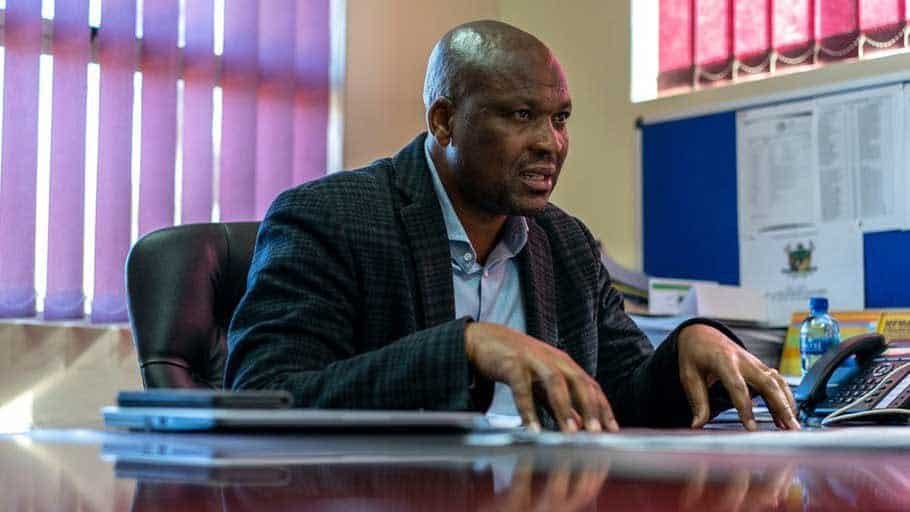
The man believed to be at the centre of the political conspiracy behind the 2017 assassination of former ANC Youth League Secretary General Sindiso Jethro Magaqa made a brief but significant appearance in the Mzimkhulu Magistrates’ Court on Tuesday.
Zweliphansi Stanley Skhosana (55) stood in the dock facing a litany of serious charges, including conspiracy to commit murder, murder, unlawful possession of a prohibited firearm, unlawful possession of a firearm, possession of ammunition, and defeating the administration of justice. He appeared calm and composed as the National Prosecuting Authority confirmed that the matter had been remanded to 01 August 2025 to allow the defence time to appoint legal counsel for a formal bail application.
This latest development follows Skhosana’s arrest by the SAPS Political Killings Task Team, which African Times first reported on 28 July 2025. That report revealed that Skhosana, a former municipal manager of the Umzimkhulu Local Municipality, had long been suspected of playing a shadowy role in politically motivated killings in southern KwaZulu-Natal.
African Times has learned that Skhosana’s name featured prominently in intelligence briefings compiled between 2018 and 2021, but no action was taken until recently, when the SAPS reconstituted its specialised team to crack down on political assassinations – a scourge that continues to claim lives across the country, particularly in KwaZulu-Natal and Mpumalanga.
Sources close to the investigation say Skhosana was allegedly part of a network of municipal officials and politically connected individuals who colluded to eliminate perceived threats within ANC structures, especially those who spoke out against corruption. Magaqa, who was serving as an ANC PR councillor at the time of his death, had been vocal about maladministration in Umzimkhulu’s infrastructure projects, particularly relating to tender fraud worth millions of rands.
In its 28 July expose, African Times highlighted how Sindiso Magaqa had made enemies within local political circles after he started investigating the controversial multimillion-rand upgrade of the Umzimkhulu Memorial Hall. Shortly before he was gunned down, he had requested official documents through council channels – a move believed to have triggered his assassination.
Magaqa was shot multiple times in a drive-by shooting in July 2017 and died in September that year due to complications related to his injuries. Two of his colleagues were wounded in the same attack.
Although three suspects were initially arrested, the case stalled for years, sparking allegations of a cover-up within the ANC and elements of the state apparatus. Family members, civil society groups and former ANC Youth League leaders repeatedly called for the re-opening of the case and full exposure of the plot behind the killing.

Now, with Skhosana in custody, those calls appear to have finally yielded results. His arrest has sent ripples across political and administrative circles in KwaZulu-Natal, with observers saying it could reopen a Pandora’s box of unresolved political killings linked to corruption in local government.
Reacting to the court appearance, National Prosecuting Authority regional spokesperson Natasha Ramkisson-Kara confirmed that the charges against Skhosana are supported by substantial new evidence gathered over recent months. “The matter is remanded to August 1 for the appointment of legal counsel. We are confident in the merits of the case and will oppose bail,” she said.
While the NPA has remained tight-lipped about the exact nature of the evidence, insiders say it includes ballistic and cellphone data, as well as sworn affidavits from former municipal employees who have since turned state witnesses.
Legal analyst Thobani Mkhize said Skhosana’s court appearance marks a “turning point” in the fight against politically motivated killings. “It shows that pressure from media, civil society, and the public can force the state to act, even years after a crime has occurred. If Skhosana is convicted, it will be a damning indictment of how long the justice system allowed impunity to reign,” he said.
Meanwhile, former colleagues of Magaqa in the ANC Youth League have renewed calls for a Judicial Commission of Inquiry into political killings. “The death of Magaqa was not an isolated event. It was part of a pattern,” said one former ANCYL provincial leader, who requested anonymity.
KwaZulu-Natal remains the epicentre of political violence in South Africa. According to 2025 data from the Global Initiative Against Transnational Organised Crime, the province accounts for more than 40% of all politically linked killings in the country, with over 130 assassinations recorded since 2016.
As the country prepares for the August court date, Magaqa’s family says they are cautiously optimistic. “It’s been eight long years of pain, silence, and waiting,” said one of Magaqa’s siblings outside the courtroom. “We just want justice for Sindiso.”