Anti-immigration activists and opposition parties have given President Cyril Ramaphosa’s long-awaited migration intervention a lukewarm reception, arguing that the government’s latest promises are unlikely to resolve what they describe as a worsening illegal immigration crisis.
Ramaphosa addressed the nation on Sunday evening, acknowledging widespread public concerns over illegal immigration, border security, pressure on public services and the employment of undocumented foreign nationals. He unveiled a comprehensive government strategy that includes tougher border controls, increased deportations, stricter penalties for employers hiring undocumented workers, dedicated immigration courts and the recruitment of 10,000 labour inspectors.
However, within hours of the address, some of the country’s most vocal anti-illegal immigration campaigners dismissed the proposals as impractical and overdue.
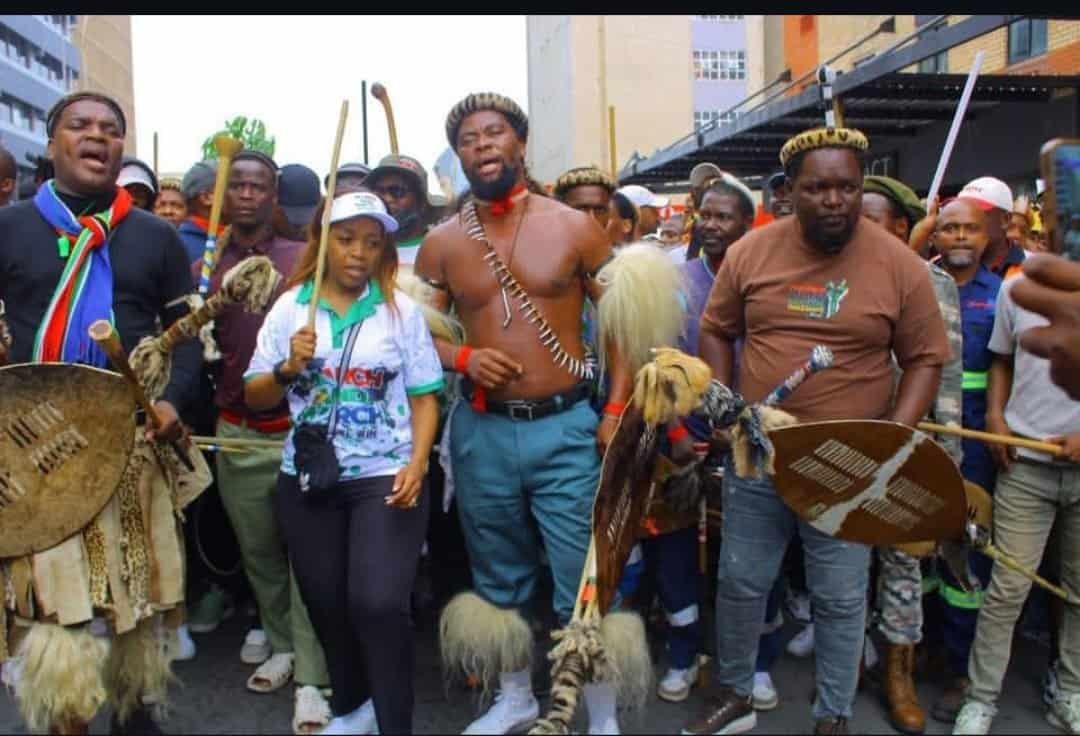
Among them was March and March leader Jacinta Ngobese-Zuma, whose movement has organised a series of peaceful anti-illegal immigration marches across South Africa in recent months.
The movement has drawn support from communities frustrated by high unemployment, claiming that foreign nationals are taking jobs through cheap labour practices and dominating sectors such as spaza shops and informal trading.
Ngobese-Zuma credited public pressure and activism for forcing government to finally address the issue.
“Firstly, I just want to appreciate the work that patriots have done to actually push the president into addressing the issue after months,” she said.
She welcomed Ramaphosa’s acknowledgement of concerns surrounding labour exploitation, crime and the growing presence of foreign-owned informal businesses.
“We are happy that he’s acknowledged some of the things, like tuck shops being taken over by foreign nationals. He’s acknowledged the issue of some of the crimes that they do in the country. He also acknowledged the labour market, which has been bombarded with people who are cheap labour coming from all across Africa to replace South Africans and break immigration laws,” she said.
Despite welcoming the recognition of the problem, Ngobese-Zuma questioned whether the president fully understood its scale.
“I don’t think the president was properly briefed. I don’t think he took time to go to Home Affairs or to the border to find out the extent of the damage,” she said.
“The issues that he’s raising as solutions are impractical, and I can tell you now that some of the things, if not all of them, that he said are not going to be implementable.”
Ngobese-Zuma also rejected Ramaphosa’s suggestion that some groups were exploiting public concerns around immigration for political gain.
She insisted that her movement was motivated by concerns over safety and the future of South African communities rather than electoral ambitions.
“I have no desire to be in politics. For me, a safer country for our children is what would make me happy,” she said.
The criticism was echoed by ATM parliamentary leader Vuyo Zungula, who accused Ramaphosa of repeating promises that have been made for years without meaningful results.
“Take what Ramaphosa said last night with a pinch of salt,” Zungula said.
“We pushed him in 2020 to address illegal immigration and listen to what he said. Six years later the promises remain empty, excuses endless, and the situation continues to spiral out of control.”
ActionSA also expressed disappointment, describing the president’s address as weak and reactionary.
In a statement issued shortly after the speech, ActionSA president Herman Mashaba argued that the measures announced were largely a repackaging of failed ANC policies.
“Rather than presenting a clear shift in approach, which we believe must anchor on mass deportations and the urgent capacitation of enforcement capacity, the president merely repackaged the same failed and tired talking points that have characterised the ANC’s decades-long failure to secure South Africa’s borders,” Mashaba said.
He questioned how government intended to implement stricter enforcement measures while the Border Management Authority (BMA) remained underfunded and under-resourced.
Mashaba further accused government of acting only after sustained public pressure and criticism over its handling of illegal immigration.
The Democratic Alliance (DA), however, offered a more measured response.
DA leader Geordin Hill-Lewis welcomed Ramaphosa’s acknowledgement that South Africa’s economic difficulties were not solely caused by foreign nationals but by the country’s inability to grow the economy and create jobs.
“This is the right message at a dangerous moment for our country,” Hill-Lewis said.
He warned against xenophobia and called on South Africans to reject violence against foreign nationals.
“The law must be enforced by the state, not by mobs, vigilantes or politicians who stoke hatred for votes,” he said.
Hill-Lewis said the DA would support lawful efforts within the Government of National Unity to strengthen border security and improve immigration controls.
He also praised reforms being pursued by Home Affairs Minister Leon Schreiber, including efforts to modernise documentation systems and strengthen border management.
Ramaphosa used his address to insist that South Africa was not a xenophobic nation and warned that only the state had the authority to enforce immigration laws.
He cautioned against individuals taking the law into their own hands by demanding identification documents from suspected undocumented migrants.
The president also warned that government would act against groups seeking to exploit public concerns about immigration to incite violence or destabilise the country.
The address comes as 30 June has become a significant date in the immigration debate, with anti-illegal immigration activists, including members of March and March, calling for stronger action against undocumented foreign nationals. The looming deadline has prompted law enforcement agencies to increase their state of readiness amid concerns about possible tensions in some communities.
Through the National Joint Operational and Intelligence Structure (NATJOINTS), authorities have activated a comprehensive operational plan focused on enhanced visibility, rapid deployment capabilities, intelligence-led operations and targeted crime-combating initiatives. Security agencies have also indicated that they are monitoring individuals and groups suspected of inciting violence, spreading misinformation or encouraging attacks on foreign nationals and businesses.
During a briefing last week, NATJOINTS chairperson Lieutenant-General Tebello Mosikili stressed that the enforcement of immigration laws remains the responsibility of the state.
“Violence is not activism,” Mosikili said.
“The responsibility for maintaining public order, combating crime and enforcing immigration legislation rests exclusively with duly authorised law enforcement agencies acting within the confines of the Constitution and the law.”
Despite these assurances, some activists argue that public confidence in law enforcement has been eroded by repeated allegations of corruption involving officials accused of accepting bribes from undocumented migrants. March and March has previously argued that communities are stepping forward because of what they perceive as inadequate enforcement of immigration laws and a shortage of policing resources.
Nevertheless, Monday’s reaction highlighted the growing political divide over one of South Africa’s most contentious issues.
While there appears to be broad agreement that illegal immigration must be addressed, significant differences remain over how government should tackle the challenge and whether Ramaphosa’s latest intervention represents a genuine turning point or simply another set of promises in a debate that has dominated public discourse for years.
For many South Africans struggling with unemployment and economic hardship, the real test will not be the president’s words, but whether the measures announced on Sunday translate into visible action on the ground.