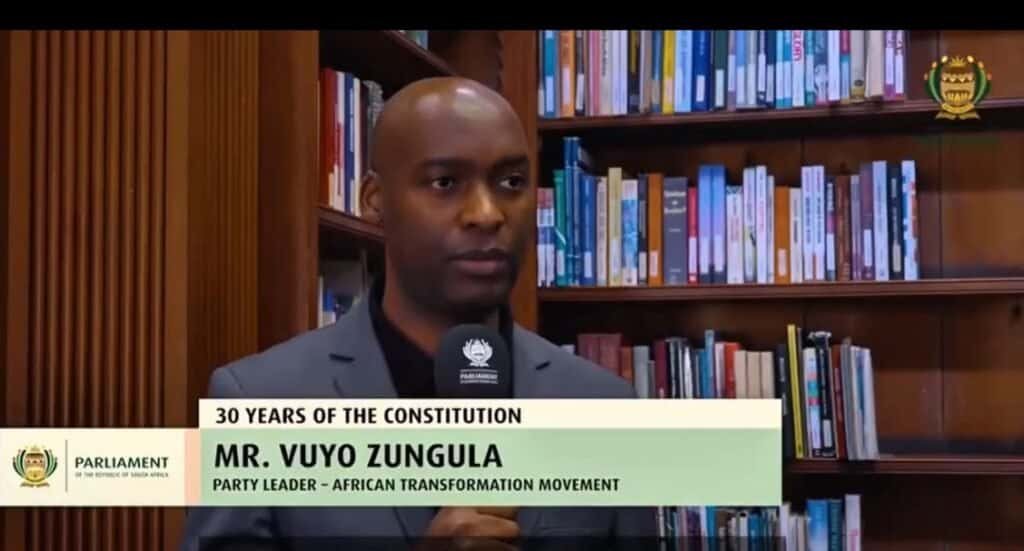
African Transformation Movement (ATM) president and Member of Parliament Vuyo Zungula has called for an amendment to South Africa’s Constitution to reconsider whether naturalised citizens should be eligible to hold public office.
As South Africa marks 30 years since the adoption of its democratic Constitution, Zungula believes the country needs to confront difficult questions about citizenship, political leadership and who should have the authority to govern the country.
In a shared post on social media, Zungula said citizenship and the authority to govern were two distinct matters, arguing that being legally recognised as a South African citizen should not automatically qualify someone to hold positions of political power.
“Our position is clear: the Constitution must be amended to reconsider the eligibility of naturalised citizens to hold public office.
“Citizenship and the authority to govern are two distinct matters. We believe South Africa must have a serious constitutional debate about who should hold political power and preside over the affairs of its people,” he said.
His position introduces a contentious dimension to the national conversation surrounding the Constitution’s 30th anniversary, with questions about the rights of naturalised citizens and the boundaries of political participation likely to attract further debate.
The Constitution, adopted by the Constitutional Assembly on May 8, 1996, and signed into law on December 10 that year, established the foundation of South Africa’s democratic order after decades of apartheid.
It guarantees political rights, equality before the law, human dignity and freedom, while establishing constitutional supremacy and democratic accountability.
However, Zungula’s proposal raises questions about whether the constitutional framework should distinguish between citizens by birth and those who acquired South African citizenship through naturalisation.
Section 19(3)(b) of the Constitution provides that every adult citizen has the right to stand for public office and, if elected, to hold office.
The provision does not expressly distinguish between natural-born and naturalised citizens.
Section 3 further establishes a common South African citizenship, with all citizens equally entitled to the rights, privileges and benefits of citizenship.
Under the existing constitutional framework, naturalised citizens are therefore not automatically excluded from political office.
Zungula’s proposal would require a constitutional amendment, bringing the issue into the broader debate about how the country’s supreme law should evolve over the next three decades.
His intervention comes amid growing political and public debate about immigration, citizenship, national identity and the protection of South Africans’ interests.
The 30th anniversary has already exposed differing political views about whether the Constitution has delivered on its promises.
While government has described it as one of the country’s greatest democratic achievements, opposition parties have raised concerns about persistent poverty, unemployment, inequality, land ownership and the slow pace of transformation.
During parliamentary discussions marking the anniversary, different political parties expressed contrasting views about the Constitution’s successes and shortcomings.
The Economic Freedom Fighters (EFF) criticised the document for failing to adequately address the land question, while the uMkhonto weSizwe Party questioned aspects of its relationship with traditional leadership and the powers of the judiciary.
The African Transformation Movement has also maintained that constitutional provisions must be examined against the country’s changing political and social realities.
Zungula’s latest position is likely to add another layer to those discussions, particularly regarding whether naturalised citizens should enjoy the same political eligibility as citizens by birth.
Any proposed amendment would have to follow the constitutional amendment process, including the applicable parliamentary voting requirements and public participation.
As South Africa reflects on three decades of constitutional democracy, the debate is increasingly shifting beyond celebrating the rights secured in 1996 to questioning whether the country’s supreme law adequately addresses the challenges confronting the nation today.