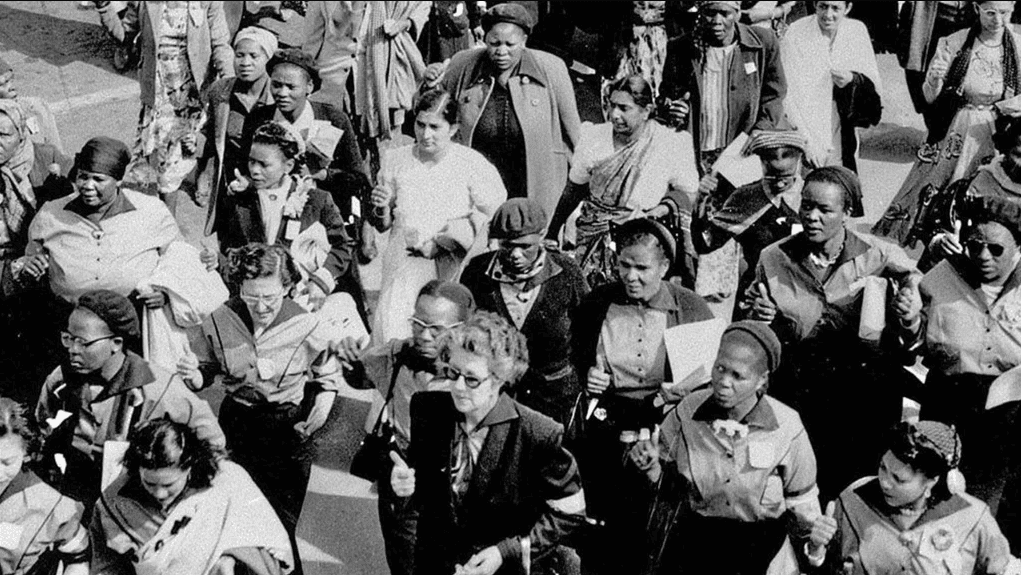
Tribute to all black women – backbones of BLACK GOLD – on the 70th Anniversary of August 09, 1956 Women’s March.
This draws inspiration from the universal picture frame populated by Roberta Flack, the gift of the giver of the soundtrack of black dignity.
Powered by Nina Simone for her inspirational song TO BE YOUNG, GIFTED AND BLACK.
Provoked by that daring generation of change, that changed life outside and inside prison and stood charged as SASO-BPC Treason Trialists for propounding the liberating ideas of Black Consciousness (January 31, 1975 – December 21, 1976).
At that trial, the martyr of hope Steve Biko, (18 December 1946 – 12 September 1977) was a defence witness.
I was 16 years of age, in 1973 to be indexed by apartheid era ID to carry a dom pass to produce on demand by any police authority figure. The founding pillars of this Black Consciousness movement were themselves in their twenties.
Be Real Black For Me – was a song that lingered. The song was sung by a woman that did not miss earful attention for me to hear it in my teen years.
The black woman’s name was Roberta Flack.
Roberta Flack’s affirmation of blackness did not end with the song: BE REAL BLACK FOR ME.
Flack extended her message by asking: why did artists not paint angels black too?
This was in the song “Angelitos Negros”.
The lyrics of the song were taken from a poem by Brazilian poet Andres Eloy Blanco titled “Little Black Angels” that Flack took to recite in song.
In agreement, we, black people, began to bless day as much as we did night.
Blackness stopped being a curse. Nor was whiteness ordained as a blessing. Both mattered for completion of the picture of the universe.
As a boy, in the 1970s, looking, hunting, dreaming, hungering and thirsting for the aesthetics of liberation, womanhood, motherhood, and black thought, another woman stormed into my life. The scent of her song sailing into my nostrils was the breath of awareness awakening a sense of black pride.
The woman was Nina Simone. This was after the secretary of Debonairs Softball Club, Star Walaza, I was deputy to, gifted me with a vinyl record of Simone’s album titled Black Gold.
A renowned song from that album: To Be Young, Gifted and Black. Donny Hathaway also poured his utmost soul in the song.
Of all the good songs from that album, To Be Young, Gifted and Black was one that stole a special place in my heart pulling its strings. It brought joy inside my tears, lifted my spirits, swelled my mind with joyous imaginings of how freedom should look like. The beat and melody made me understand that there was something of value, beauty and dignity in blackness.
I extolled the sunlight of day as much as I revered the darkness of the night. Possessed by that liberating perspective, blackness ceased being a curse. Whiteness did not pass to be a blessing. I blessed daytime as much as I did nighttime.
Blessing the night to put to labour of thirst for liberation to sleep. The healing power of this test helped to amass energy by sunup to wake up to yet another labouring walk to freedom. Acquired awareness not only invigorated aspiration to be free but also to be human again.
Skin lightening creams and lotions to bleach black skins to approximate whiteness, gave way to acceptance for blacks to stay comfortable in the castle of their skins. That goodness was whiteness and whiteness closer to godliness, proved a myth that ceased to be worshiped.
European/Christian/White names parents gave their children, similarly yielded in deference to African/Indigenous/Black names.
High fives, black proud forest of clenched fists raised aloft punched the sky. The earth became familiar with the slogans:
I am black and I am proud;
Black is beautiful; Beautiful – meant being you to the full.
The Supreme Being knows Us,
Loves us just the way we are,
No need to go on changing,
Trying to be like colonisers, dispossessors, oppressors.
Firm in our hands we put a firm grip on ourselves to reclaim our souls, Ubuntu Bethu, Botho Ba Rona, the Usness of Us, Mbulelo Mzamane fondly called it.
Heads began wearing Afros for our hair, bellbottom trousers, Dashiki shirts came in for our wear. This was not a fashion statement to come and go. It was a statement of black experience to stay without end.
Thinking Heads were kept high. Even skies above ceased to be measures of our limits but took notice of the infinite confidence of blackness ringing changes of proud presence stamping its feet down here on the ground.
The spring in our feet began to walk tall. Conscious womanness kept pace to familiarise its sons and daughters with emphatic upbringing.
High-heeled shoes leaped with the rising tide of black consciousness sweeping through the country.
Beads worn as necklaces, accessorised for authentic liberation looks. Despite conditions of oppression, Blacks were a soulful picture of a happy people looking forward to coming back to themselves assured that the Supreme Being, that mustered the universe, knows black people.
The black theology of liberation assured us Creator knows us. We are not misfits of the master plan that creation brought with it.
The year was 1973. It was on the eve of the collapse of Portuguese colonial rule in Mozambique. The South African Students Organisation (SASO), alongside the Black Peoples Convention (BPC) held “Viva Frelimo” rallies on September 25, 1974.
Against these rallies being banned, Muntu ka Myeza was unshakeable, towering and trusted with every word as publicity secretary vowing: “Kruger or no Kruger, we are going ahead.”
For the banned rallies that ka Myeza was the face and voice of, treason charges were formulated against the SASO/BPC 9:
- Saths Cooper
- Zithulele Cindi
- Mosioua Lekota (late)
- Nchaupe Mokoape (late)
- Strini Moodley (late)
- Muntu Myeza (late)
- Pandelani Nefolovhodwe
- Nkwenke Nkomo
- Kaborone Sedibe
The Trial lasted 18 months: January 31, 1975 – December 21, 1976
Black families lost their sons, boys, fathers and their husbands to see their girls, women and wives dance alone to the unyielding song of life.
This is the crucible fire of defiance out of which black women are made. This is the road by black women. This is the loneliness that black women have endured. Their untold agonies included husbandless and unassisted child-rearing struggles, due to detention, assassination, imprisonment and exile – stay untold.
Out of that pain black women, sons and daughters have acquired the fighting manners never to give up to be real black for the good cause to be human again.
This is the quest for true humanity that was Steve Biko’s parting shot, in I Write What I Like: “In time, we shall be in a position to bestow on South Africa the greatest possible gift – a more human face.”
Biko would be sadder to know the country’s face is far from being a picture approximating true humanity.
Nevertheless, it is out of the black experiences of black women that strong families, strong communities and strong villages were built against all odds to be proud sons and daughters of the soil we proudly are today.
Long live the spirit of black women, Long Live.
Not since having heard Flack sing the song, my wishes for black women have not ceased that they BE REAL BLACK FOR ME, REAL BLACK, as proof of being the undisputed daughters of the soil.
This is dedicated to the 70th Anniversary of the historic Women’s March August 09, 1956.

Oupa Ngwenya is a writer and corporate strategist.