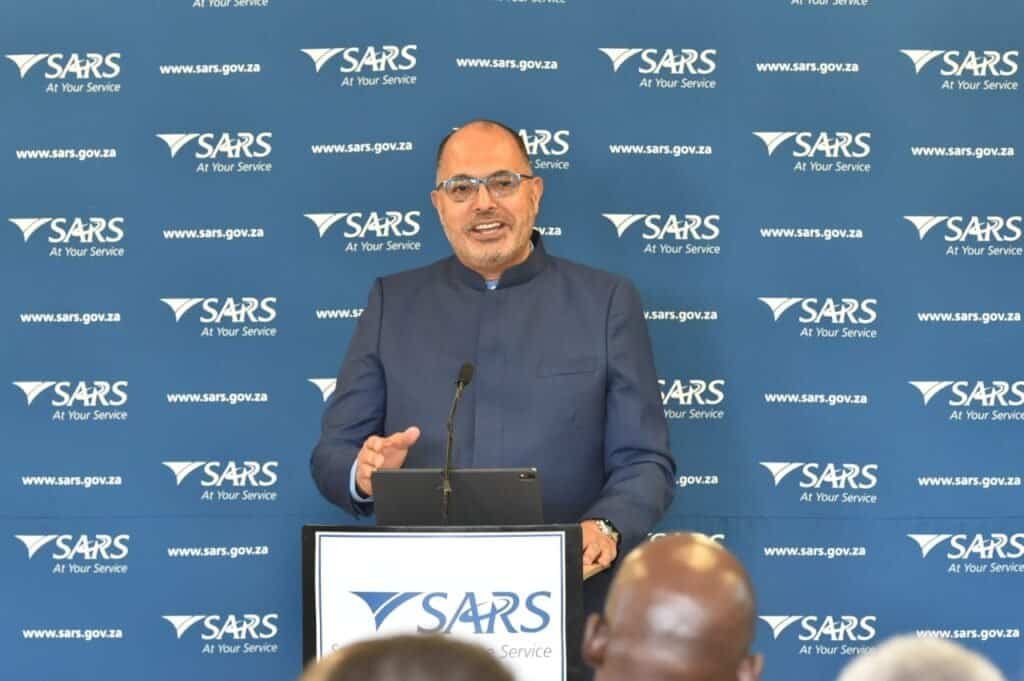
A standing ovation for South African Revenue Service (SARS) Commissioner Edward Kieswetter punctuated Wednesday’s 2026 Budget Speech, highlighting one of the few moments of cross-party applause in an otherwise fiercely contested debate over Finance Minister Enoch Godongwana’s fiscal plan. While the minister received broad recognition for outlining measures aimed at stabilising South Africa’s finances, opposition parties were quick to denounce the budget as “austerity-driven” and disconnected from the realities facing the majority of citizens.
During his address in Parliament, Godongwana unveiled a budget aimed at narrowing the consolidated deficit to 4.5% of GDP, down from 4.8% projected in 2025. Key measures include adjustments to personal income tax brackets and rebates to offset inflation, R2.67 trillion in spending for 2026/27, and expanded allocations for social grants, health, education, peace, and security.
But it was SARS Commissioner Kieswetter who stole the spotlight when he received a standing ovation from the Minister, members of the National Assembly, and MPs across party lines. “It was special, I must say,” Kieswetter told journalists after the speech. “When I stood up I realised I represent more than 14,000 hardworking men and women at SARS. It’s nice to be the face that is recognised, but I want South Africans to appreciate the SARS employees who are hardworking.”
The applause comes at a bittersweet moment, as Kieswetter prepares to step down from SARS in the coming months, ending a tenure marked by efforts to stabilise the agency, increase revenue collection, and restore public trust. His leadership has been credited with improving gross tax revenue collections, which are now R21.3 billion higher than the estimates in the 2025 Budget, largely due to higher-than-expected net VAT, corporate income tax, and dividends tax.
Treasury has used these gains to withdraw previously proposed R20 billion in tax increases, providing relief to households without undermining fiscal sustainability. Government also projects that the debt-to-GDP ratio will stabilise at 78.9% in 2025/26, and fall slightly to 77.3% in 2026/27.
Despite these measures, opposition parties were quick to criticise the fiscal framework, warning that it entrenches inequality, fails to address unemployment, and places undue burdens on ordinary South Africans.
The Economic Freedom Fighters (EFF) rejected the budget outright, calling it a “fictional exercise” in creative accounting that serves elite interests. Spokesperson Sinawo Thambo argued that the growth projections of 1.8% over the medium term are unrealistic in the face of ongoing deindustrialisation and slow economic growth.
“The National Treasury is captured by the white capitalist establishment,” Thambo said. “This budget maintains a framework that benefits the few, while Black workers and ordinary citizens continue to bear the brunt of austerity.”
The EFF criticised planned fuel levy increases, scheduled to take effect on April 1, describing them as regressive and insisting that any such increases must first be debated in Parliament. While welcoming inflation-linked adjustments to personal income tax brackets and modest social grant increases, the party demanded that grants be doubled and called for a universal basic income grant.
The uMkhonto weSizwe Party (MK Party) issued a similarly critical assessment, arguing that the ANC-led budget has sold out the liberation mandate. The party said that fiscal consolidation and debt stabilisation have consistently been prioritised over transformative policies such as land reform, industrialisation, and robust local government support.
“Education remains the largest allocation, but real per-learner funding is stagnant,” the MK Party noted, adding that university subsidies and teacher employment have not expanded structurally. The party also highlighted the limited allocation to municipalities, which it said is insufficient to restore infrastructure or institutional capacity, and warned that incremental reforms to local government grants will not address systemic failure.
Industrialisation and state-owned enterprises were also key points of critique. According to the MK Party, operational baselines for SOEs remain constrained, while private participation expands in rail, ports, water, and energy, confirming a trend of underfund, allow decline, then privatise.
In contrast, RISE Mzansi offered a more measured reaction, acknowledging the stabilisation of national debt while noting that fiscal discipline cannot replace effective service delivery. Party leader Songezo Zibi stressed that the success of the budget will be measured by its impact on everyday South Africans, including jobs, food security, reliable local services, and functional infrastructure.
RISE Mzansi welcomed additional funding to the South African Police Service, the South African National Defence Force, and the Border Management Authority but expressed concern that funding for specialised courts will only be considered later in the year. The party also noted that 63% of municipalities remain in financial distress and underscored the importance of reinvesting utility revenue into local infrastructure.
The Democratic Alliance (DA) embraced the absence of major tax increases as a victory for the coalition government. Dr Mark Burger of the DA described the budget as a “proper DA win,” noting that South Africans were “finally being given a bit of relief” and that tax stability could restore confidence in the economy.
The political reactions underscore the sharply divided views on how South Africa should navigate its economic and social challenges. While Treasury emphasises fiscal stability, critics argue that austerity measures, delayed reforms, and uneven municipal support threaten to exacerbate inequality and slow growth.
Key elements of the 2026 Budget include R2.67 trillion in total spending, R292.8 billion allocated to social grants, and expanded funding for health and education. Defence and security budgets are also increasing, with R2.7 billion added to improve South African Air Force capabilities and R1 billion each allocated to the police and the South African National Defence Force through the CARA fund to combat organised crime.
The budget also sets aside contingency funding for disasters, infrastructure, and PRASA’s rolling stock fleet renewal programme, signalling government intent to maintain essential services while managing public finances prudently.
As Kieswetter prepares to leave SARS, his acknowledgement of the work of more than 14,000 SARS employees resonated across party lines. “It’s nice to be the face that is recognised, but I want South Africans to appreciate the SARS employees who are hardworking,” he said. Observers noted that the applause for Kieswetter reflects broader public respect for SARS staff and their contribution to maintaining government revenue during challenging economic times.
With parliamentary committee deliberations scheduled to follow, parties across the spectrum are expected to table amendments, propose alternative fiscal measures, and debate allocations to social services, infrastructure, and security. South Africa’s economic trajectory, many analysts say, will depend on how effectively these measures translate into tangible improvements in employment, service delivery, and social equity.
The 2026 Budget Speech thus leaves South Africa at a crossroads: balancing fiscal discipline with social needs, responding to public dissatisfaction with service delivery, and confronting entrenched inequalities, while also preparing for the departure of one of the country’s most visible public servants, Edward Kieswetter, whose leadership of SARS has left an indelible mark on the nation’s revenue administration.