These in-space tests encompass research and development achievements from China’s leading universities and cover key areas of space station operations
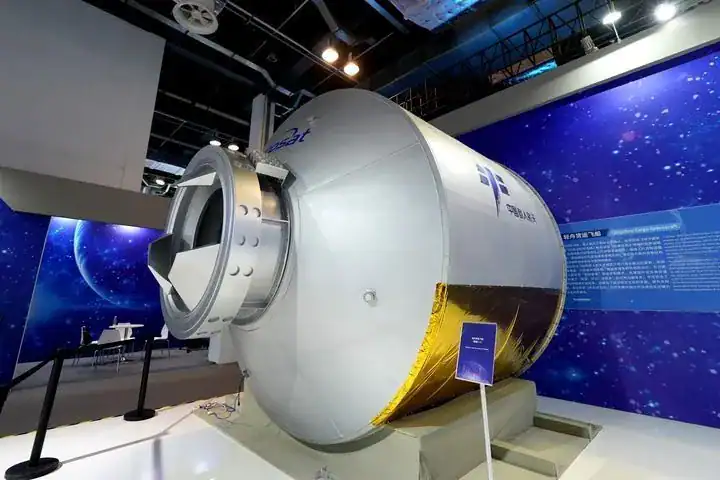
The Chinese Academy of Sciences has released the latest batch of orbital test results for the Qingzhou experimental spacecraft, launched on 30 March this year. The spacecraft was developed under the leadership of the Innovation Academy for Microsatellites at the Chinese Academy of Sciences. As reported by Science and Technology Daily, a partner of TV BRICS.
The test data revealed breakthrough progress in three key areas: ultra-high-precision spacecraft health monitoring, crew medical support and mission cost reduction. These achievements aim to strengthen the technological foundation for the safe and efficient operation of the national space station, promote the application of new space technologies, and facilitate the rational utilisation of extraterrestrial resources.
In the field of spacecraft health monitoring, Harbin Institute of Technology demonstrated a laser measurement device capable of detecting object deformation with micrometre-level precision. The device operates reliably even in highly disruptive environments, thereby enabling continuous monitoring of spacecraft health. The on-chip micro-optical gyroscope developed by Shanghai Jiao Tong University is no larger than a grain of rice and achieves navigation-grade measurement accuracy without active temperature control – providing a new miniaturised solution for high-precision navigation in deep-space exploration and bionic spacecraft.
In the field of healthcare, experts from Shenzhen University have distinguished themselves: their electromyography (EMG) monitor, developed on the basis of a self-developed neural chip, has for the first time enabled the continuous collection and transmission of astronauts’ in-orbit muscle activity data. This overcomes the limitations of traditional methods, which require manual intervention and are incapable of continuous monitoring.
Cost-effectiveness has also been enhanced through technological advancements. The Institute of Mechanics at the Chinese Academy of Sciences has developed a flexible gripper inspired by spider legs. The device is capable of successfully capturing objects without causing destructive impacts or generating secondary debris, paving the way for orbital debris removal, spacecraft rescue and cargo transport. Furthermore, a space refrigerator equipped with an improved vapour compression system has been tested; results indicate that it operates stably in a zero-gravity environment and provides a low-cost solution for sample storage.
African Times published this article in partnership with International Media Network TV BRICS