Debates and decisions made in the Two Sessions on policies and market access could benefit Africa’s development
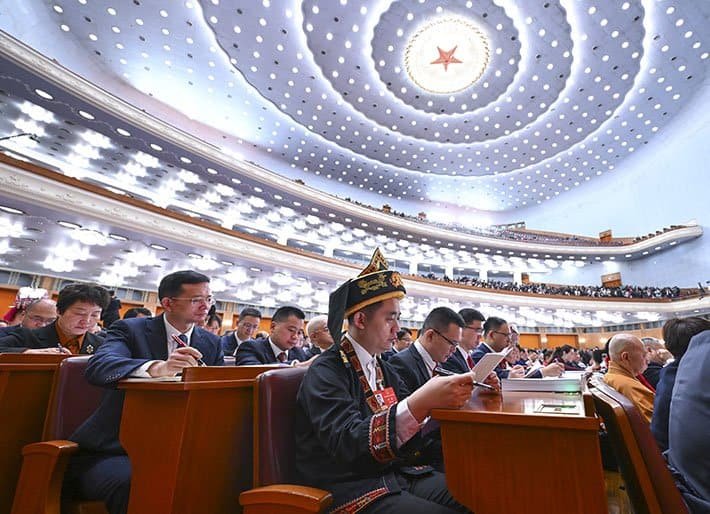
A very significant event in China’s political calendar is underway in Beijing and, as usual, it is more than optics. The fourth sessions of the 14th National People’s Congress (NPC) and the 14th National Committee of the Chinese People’s Political Consultative Conference, the country’s top legislative and advisory bodies, will set the course for China’s direction over the year and beyond.
Commonly known as the Two Sessions and held annually, the meetings represent an institutional expression of China’s consultative and inclusive political process and reflect in concrete terms its “whole-process people’s democracy,” where institutional procedures are organically linked to substantive delivery through tangible and practical outcomes. Rooted in China’s national conditions and social realities, the NPC and CPPCC have evolved into central pillars of the country’s governance and important platforms for political consultation and policy coordination in China’s contemporary governance process.
Central pillars of governance
The NPC and CPPCC National Committee have significant responsibilities: to scrutinise policy details and relate them to the broader picture of the country’s economic roadmap for the next five years, while maintaining periodic oversight of its implementation.
The strength of China’s consultative and inclusive political process lies in its role as a central operating mechanism of national political life. It draws on the country’s vast pool of expertise and experience, ensuring that diverse insights and perspectives help to forge consensus on governance and development.
The Two Sessions, a critical mechanism within China’s consultative framework, stand as a testament to the country’s institutional capacity to forge national consensus and translate it into governance efficiency and practical outcomes that expand prosperity for the broad spectrum of the Chinese people.
At the opening of the NPC session on 5 March, Premier Li Qiang delivered the 2026 Government Work Report on behalf of the State Council. Among the wide range of economic and development priorities outlined were the 2026 GDP growth target and the policy measures intended to support the country’s economic goals. He projected growth at 4.5-5 percent and pledged that policymakers would “strive for better outcomes in actual implementation.” While some may interpret this as a lowering of ambition, it may in fact reflect a more calibrated and strategic approach to macroeconomic management.
Setting a range rather than a fixed growth target reflects China’s candid recognition of mounting external headwinds rather than any attempt to obscure them. With trade frictions with the US still unresolved, Washington’s policy posture remaining unpredictable, and global demand uncertain, fixing a single numerical target could risk sending the wrong signal if conditions worsen. A growth range therefore preserves policy flexibility while maintaining stability and credibility. More importantly, the range signals a shift from a singular focus on growth speed towards the pursuit of high-quality development, giving further impetus to the cultivation of new quality productive forces.
What it means for Africa
As the world’s second-largest economy, accounting for about 30 percent of global growth and roughly 70 percent of global poverty reduction, China’s governance decisions naturally draw attention far beyond its borders.
In a world of growing uncertainty, China offers stability and a roadmap to shared prosperity beyond its borders. From serving as the workshop of the world to becoming humanity’s most stable market, the country, through a range of policy measures, gives practical effect as a major global opportunity.
A major agenda of this year’s Two Sessions is the approval of China’s 15th Five-Year Plan, which aims to consolidate the country’s unified national market, offering the world the prospect of an unprecedentedly large single market. The high-quality opening of the Chinese market will be complemented by deliberate policies to stimulate domestic consumption, including measures to substantially boost household incomes.
China has been Africa’s largest trading partner for 17 consecutive years. Its bilateral trade with the continent reached a record high of $348 billion in 2025, representing an increase of about 17.7 percent over 2024. Exports from Africa to China grew by 5.4 percent, reaching $123 billion.
Prospects for further narrowing the trade balance remain strong. Beginning in May, China will fully implement the mechanism allowing zero-tariff entry for products from 53 countries, excluding Eswatini, into the Chinese market.
China’s 15th Five-Year Plan opens a wide array of opportunities for Africa, particularly through concessional market access. If properly utilised by African countries, it could support structural transformation efforts by expanding the diversity and range of exports. With rising household incomes in China and government efforts to structurally recalibrate domestic consumption as a key economic driver, African high-quality products could carve out a niche in the world’s largest single market, with significant implications for accelerating industrialisation across the continent.
Africa is increasingly positioned as the next industrial frontier and a potential workshop of the world. But none of this will happen automatically. Just as China has, over time, calibrated its economic trajectory through deliberate policy measures, achieving results that have continuously elevated its global standing, it is only through similarly deliberate policy choices and instruments that Africa can realise its economic potential within the current international landscape of opportunities.
China’s market and policy framework serve as a critical bridgehead for Africa’s transition to sustainable growth and inclusive development. Issues surrounding these prospects are expected to be clarified during the ongoing Two Sessions of China’s top legislative and advisory bodies. For this reason, Africa should approach this major political event with careful attention rather than mere casual interest.
The author is Director of Centre for China Studies, Abuja, Nigeria. African Times has published this article in partnership with ChinAfrica Magazine