This unique method not only records the geometric shapes of heritage sites with millimetre-level precision, but also identifies their mineral composition and hidden damage
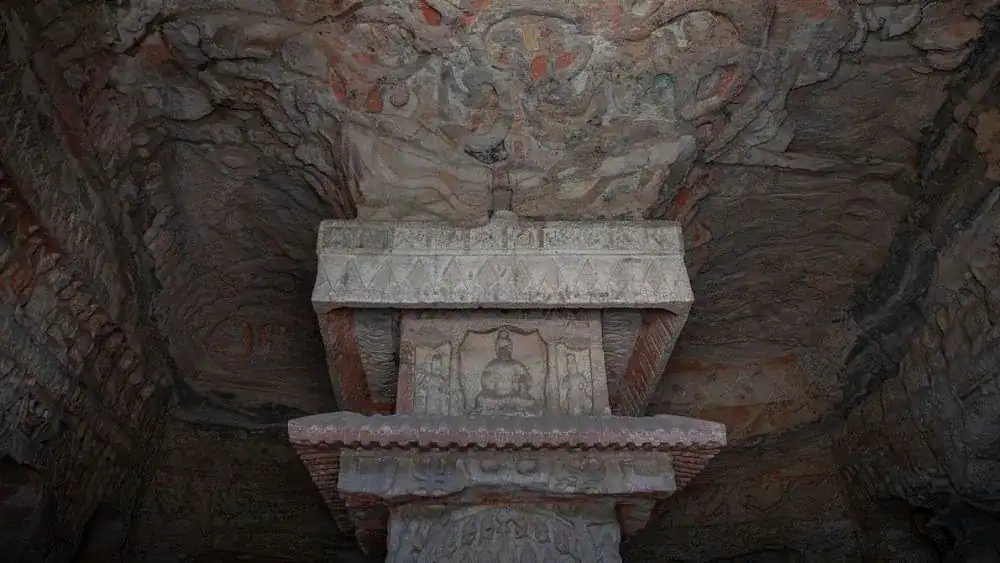
Chinese scientists have successfully employed 3D hyperspectral imaging technology for the first time to create comprehensive digital archives of two ancient Buddhist grottoes at the Yungang Grottoes in Shanxi Province. This was reported by Science and Technology Daily, a partner of TV BRICS.
According to Li Lihong, a researcher at the Yungang Grottoes Research Institute, the technology can simultaneously record the geometric shapes, materials and distribution of defects in the heritage sites, creating a “spectral fingerprint” for every point on the surface.
Caves No. 7 and No. 8, carved between 471 and 494 AD, constitute the first pair of twin caves at Yungang. They blend Greek-style columns, Indian Gandhara Buddhist statues and traditional architectural elements from the Central Plains, bearing witness to the exchange between Eastern and Western civilisations and holding great significance in the history of the Yungang Grottoes. However, due to their complex curved surfaces and vast surface area, it had long been impossible to create a complete digital replica using standard equipment.
The scientists independently developed equipment – equipped with a cold light source and a broad-spectrum light source capable of stabilising measurements during temperature fluctuations – and devised a method to combine the data with three-dimensional geometric structures. This method compensates for distortions caused by uneven surfaces and “captures” data from areas inaccessible to direct observation.
Ultimately, by 2025, they had completed the surveying of 1,465 square metres, generating a total of 29.2 TB of data. This not only ensured millimetre-level accuracy in topographical measurements but also yielded “spectral fingerprints” of mineral composition, salts and trace moisture.
Using this method, scientists have, for the first time, documented ancient pigment residues, traces of restoration and signs of early damage that are invisible to the naked eye. Based on the accumulated data, a spectral database, a pigment library and a catalogue of defects are being compiled. By 2026, the project will be expanded to include Caves 38–45, establishing a “holographic digital archive” covering the main caves of the Yungang Grottoes, thereby ensuring that this treasure of humanity is preserved in the digital world for posterity and remains accessible to future generations.
African Times published this article in partnership with International Media Network TV BRICS