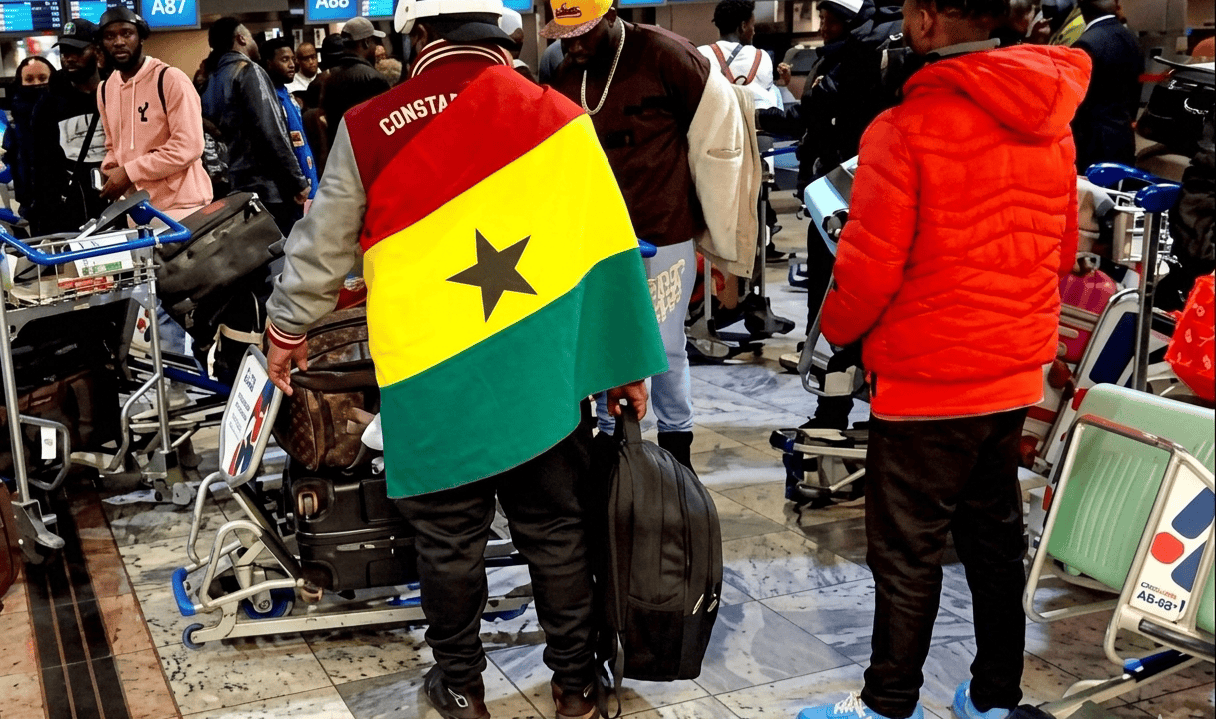
Confusion surrounded the planned repatriation of a group of Ghanaian nationals from South Africa on Wednesday after individuals expected to depart from O.R. Tambo International Airport reportedly failed to appear on an official registration list compiled over the weekend.
The development comes amid rising tensions linked to anti-immigrant protests in parts of South Africa, where foreign nationals have increasingly found themselves at the centre of heated public debate around undocumented migration, employment and service delivery.
Initial reports indicated that about 300 Ghanaian nationals were expected to board a repatriation flight back to Ghana. However, the departure was delayed after the flight manifest was amended, and some passengers were still being processed.
Earlier reports by public broadcaster South African Broadcasting Corporation (SABC) News stated that the group scheduled to leave from OR Tambo International Airport would no longer be departing as initially planned because their names did not appear on the final registration list.
The situation unfolded against the backdrop of growing anti-immigrant sentiment on social media and in some communities, with debates intensifying over the legal status of foreign nationals living and working in South Africa.
Speaking in an interview with a broadcaster on Tuesday, Fred Duhoe, spokesperson for the Ghanaian Foreign Affairs Ministry, defended the presence of Ghanaians in South Africa, arguing that migration has always formed part of human history.
Duhoe said movement across borders for work, tourism and economic opportunities was normal and pointed to the long-standing visa waiver agreement between South Africa and Ghana.
According to the spokesperson, the agreement allows citizens from both countries to travel and remain in each other’s countries for a specified period.
The spokesperson also said there are more than 3,000 South Africans currently living in Ghana, many of whom are seeking access to the Ghana Card, the country’s national identity document for residents and foreigners who intend to stay long term.
The official argued that many Ghanaians living in South Africa had entered the country legally and had integrated into society by establishing businesses, marrying South Africans and employing locals.
Duhoe said some Ghanaian nationals in South Africa may be in the process of renewing or regularising their documents and questioned whether delays in documentation processes should justify what was described as “inhumane treatment”.
The remarks also referenced broader African unity initiatives, including the African Continental Free Trade Area, arguing that hostility towards African migrants undermines efforts to strengthen economic integration on the continent.
Duhoe further stated that intra-African trade remains below 20%, describing the figure as inadequate compared to other regions globally.
The comments came after South African authorities reportedly claimed that only a small number of those scheduled to depart possessed valid documentation.
Responding to reports that only 10 out of the 300 passengers allegedly had legal documents to remain in South Africa, Duhoe said they were not privy to the information cited by South African authorities.
“I am not with the South African authorities, and I do not have what you just said,” Duhoe said during the interview.
The official added that, based on information available through Ghana’s High Commission in Pretoria, many Ghanaian nationals residing in South Africa do possess documentation and have been living in the country legally for years.
Duhoe also questioned whether Ghana should retaliate against South Africans living in Ghana if documentation disputes arose there, insisting that such actions would not benefit African unity.
“Are you saying Ghana should also do same to South Africans living in Ghana and send them back home? No, it doesn’t help any of us on the continent,” Duhoe said.
Meanwhile, Benjamin Quashie, Ghana’s High Commissioner to South Africa, reportedly spoke about the first group of citizens expected to board a flight back to Ghana from OR Tambo International Airport on Wednesday morning.
The unfolding situation has also triggered strong reactions online.
One Ghanania confirmed that he came to South Africa using a tourist visa and later applied for asylum, hence he has stayed in the country for almost two decades.
Some South Africans took to social media platform X to express frustration over illegal immigration, while others criticised the handling of the repatriation process.
One user claimed that only 10 of the 300 passengers allegedly had valid documentation, while another described the situation as “disorganised”.
The repatriation process remains under scrutiny as uncertainty continues around passenger verification, documentation and the final departure arrangements for the affected Ghanaian nationals.