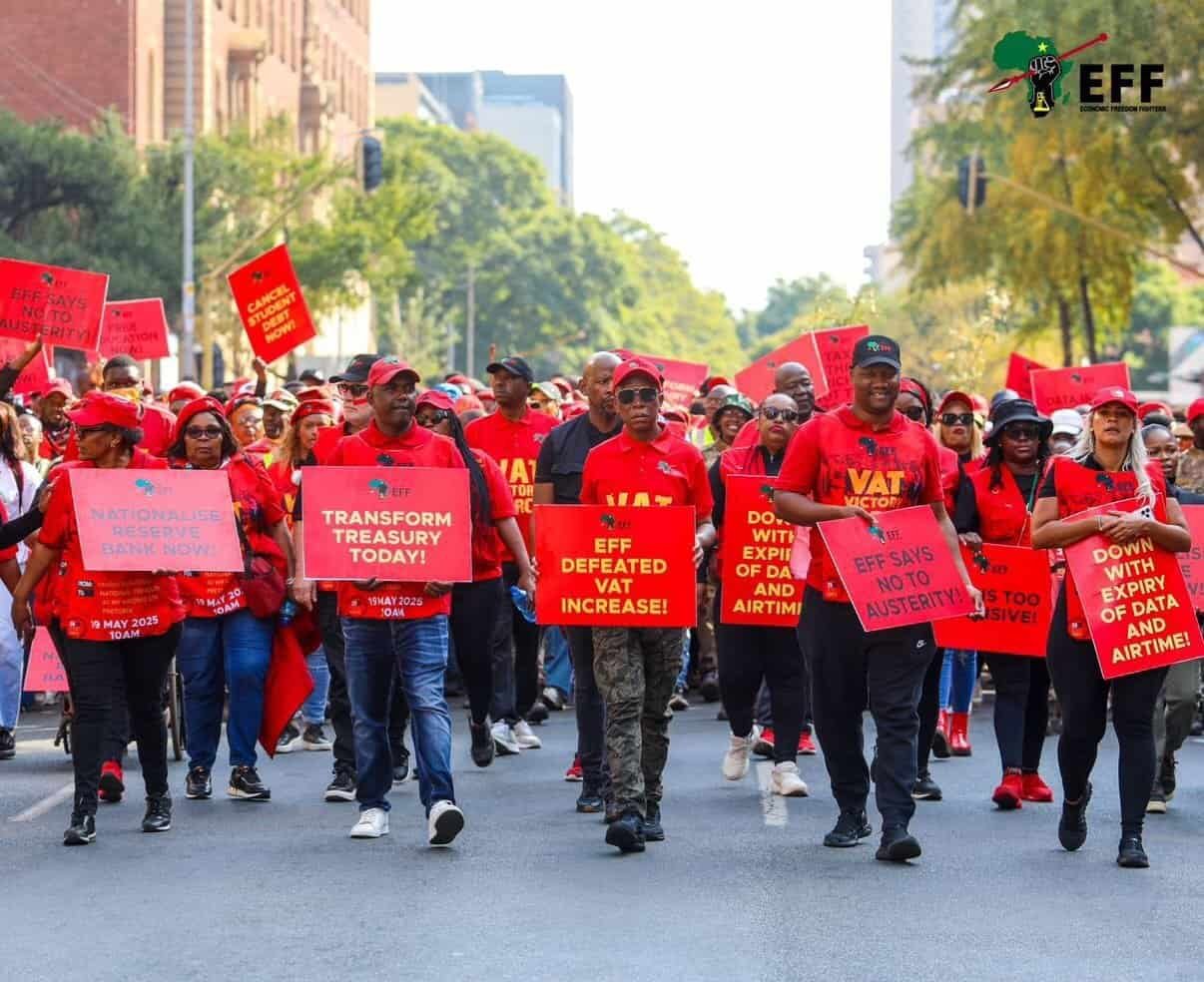
The Economic Freedom Fighters (EFF) has welcomed a judgment by the Western Cape High Court declaring that the power to change South Africa’s Value Added Tax (VAT) rate lies with Parliament and not the finance minister alone — a ruling the party says affirms its long-standing argument about democratic oversight over taxation.
The court found that a provision in the Value Added Tax Act 89 of 1991 allowing the Minister of Finance to unilaterally alter the VAT rate is unconstitutional. The decision stems from a legal challenge linked to the 2025 Budget, when Finance Minister Enoch Godongwana proposed raising VAT by 0.5 percentage points in 2025 and a further 0.5 percentage points in 2026.
Godongwana had relied on Section 7(4) of the VAT Act, which historically allowed the minister to adjust the tax rate through an announcement during the budget process, subject to later parliamentary approval. The High Court ruled that the section amounted to an impermissible delegation of legislative authority from Parliament to the executive.
In its response on Friday, the EFF said the ruling vindicated its position that taxation powers should rest squarely with elected representatives in the Parliament of South Africa.
EFF national spokesperson Sinawo Thambo described the judgment as a victory for democratic accountability and constitutional governance.
“The principle that there should be no taxation without representation must be protected,” Thambo said in a statement. “The power to impose or increase taxes on South Africans must be exercised by their elected representatives and not by a single individual acting within the executive.”
The court’s order declared Section 7(4) unconstitutional but suspended the declaration of invalidity for 24 months to allow Parliament time to amend the legislation and correct the defect. During that period, lawmakers will need to design a mechanism ensuring that any future VAT adjustments are subject to proper parliamentary oversight and approval.
The EFF argued that the now-invalidated provision effectively allowed the finance minister to impose regressive taxation without sufficient democratic scrutiny. The party has long opposed VAT increases, maintaining that the tax disproportionately affects low-income households.
Although the case was heard in the High Court, the constitutional validity of legislation ultimately falls under the authority of the Constitutional Court of South Africa, which will need to confirm the order before it takes full effect.
The judgment could also have broader implications for fiscal policymaking. The EFF says the ruling strengthens its ongoing legal challenge against the 2025 fuel levy increase, which the party argues was introduced as a revenue substitute after the VAT hike proposal encountered legal resistance.
According to Thambo, the party will use the 24-month legislative window to push for stronger safeguards over fiscal decisions, including greater parliamentary scrutiny of government borrowing.
The EFF has already introduced amendments to the Public Finance Management Act aimed at requiring parliamentary approval for foreign loans obtained by the executive. The party argues that this would prevent the government from committing the country to long-term debt agreements without sufficient democratic oversight.
In its statement, the EFF also criticised the influence of international financial institutions on South Africa’s fiscal policy, accusing the National Treasury of adopting policy approaches shaped by bodies such as the World Bank and the International Monetary Fund.
While the government has not yet formally responded to the ruling, the judgment is likely to trigger significant debate within the Treasury and Parliament about how tax policy is formulated and approved.
For now, the court’s message is clear: when it comes to setting tax rates, the executive cannot act alone. The authority ultimately rests with Parliament — and any change to that balance must pass constitutional scrutiny.