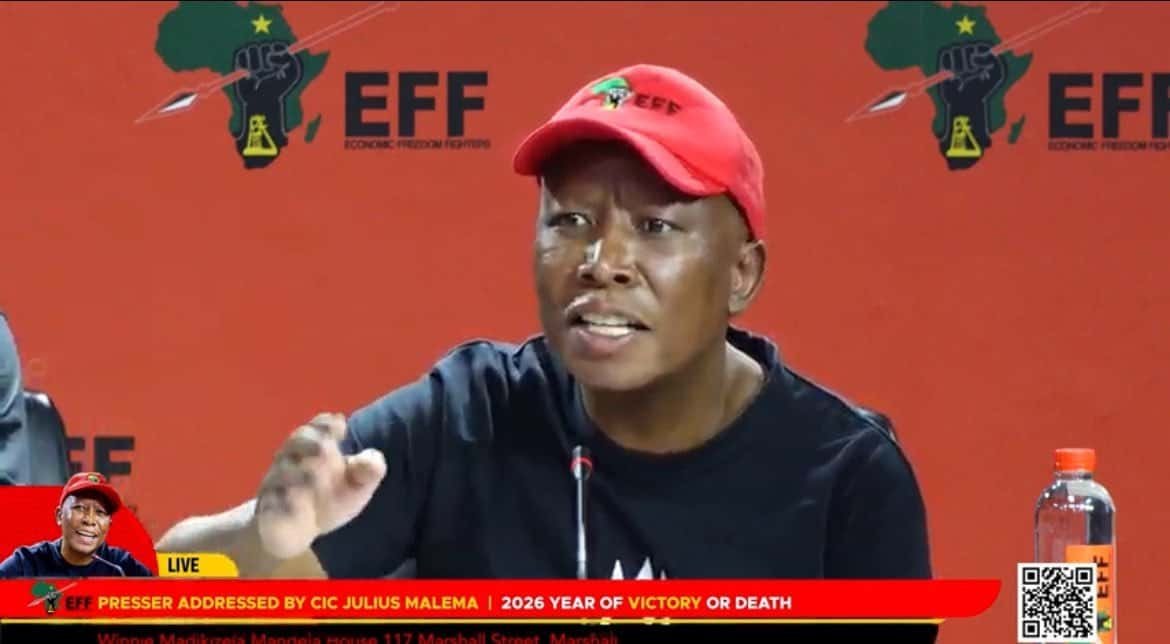
Economic Freedom Fighters (EFF) leader Julius Malema has mounted a strong public defence of his personal and political associations, rejecting allegations that he is linked to criminal networks and announcing legal action against Patriotic Alliance (PA) deputy president Kenny Kunene for defamation.
Addressing a press conference on Thursday at Winnie Madikizela-Mandela House in Johannesburg, Malema was emphatic: “I do not engage in criminal activities. I am not a criminal.”
His remarks come amid growing scrutiny following testimony at the Madlanga Commission of Inquiry, where claims were made about links between political figures, police officials, and individuals allegedly connected to organised crime syndicates.
Central to the controversy is Malema’s long-standing friendship with Johannesburg socialite Zesimdumise ‘Ze’ Nxumalo. Malema did not shy away from the relationship, instead choosing to defend it openly.
“Ze Nxumalo is my friend, and anyone who stays in the North knows him,” Malema said, dismissing attempts to portray the association as suspicious.
He described Nxumalo as a well-known figure with deep social connections, including ties to prominent families. According to Malema, Nxumalo’s background and upbringing placed him in elite social circles, challenging the narrative that he is merely a shadowy figure.
Malema went further, invoking Nxumalo’s family history, stating that he is the son of a respected academic and political figure linked to the early leadership of the Inkatha Freedom Party (IFP). By doing so, Malema sought to frame the relationship as socially and historically grounded, rather than criminally motivated.
Malema also addressed claims about his connection to the late taxi boss Mswazi Msibi, confirming that he had met him through Nxumalo during a taxi strike in Johannesburg.
“I knew Msibi through Ze Nxumalo during a strike. That is the extent of it,” he explained.
This admission is significant, as allegations have suggested that Msibi’s farm was used for high-level meetings involving political and business figures. However, Malema dismissed these claims as fabrications designed to tarnish his reputation.
At the centre of Malema’s anger are allegations made by Kunene, who claimed on a podcast that the EFF leader was part of a so-called “Big Five” cartel involving drugs and the taxi industry.
Malema rejected the accusations outright and confirmed he would be taking legal action.
“I am suing him for defamation. These are baseless lies meant to damage my name,” he said.
The legal threat signals a potential escalation between the two political figures, with Malema clearly intent on confronting the claims in court rather than allowing them to linger in the public domain.
Malema also used the platform to clarify his relationship with suspended senior police official Shadrack Sibiya.
“I am duty-bound. That’s why I do oversight… that’s my duty as a Member of Parliament,” he said, stressing that any interaction with Sibiya was strictly professional.
“I have not done any business with Shadrack Sibiya,” he added.
Malema further addressed his interactions with Police Minister Bheki Cele and former Limpopo premier Cassel Mathale, portraying these as normal engagements within his role as a public representative rather than evidence of any improper relationships.
The controversy has been fuelled in part by testimony from SAPS officer Fannie Nkosi at the Madlanga Commission, who alleged that Nxumalo had links to political figures, including Malema.
According to the testimony, Nxumalo is connected to a network that allegedly spans politics, law enforcement and organised crime, raising broader concerns about influence and accountability in South Africa.
While these claims remain untested, they have intensified public debate about the intersection of politics and criminality.
Despite the controversy, Malema used the press briefing to pivot back to the EFF’s political programme, highlighting the party’s voter registration campaign and preparations for the 2026 local government elections.
He framed the allegations against him as a distraction from the party’s agenda, which includes service delivery, economic transformation and grassroots mobilisation.
“The EFF prioritises engagement with communities and the development of a people-centred manifesto,” he said.
Malema also emphasised that the party’s campaign strategy would focus on tangible improvements in people’s lives rather than “politics of personalities and cheap gimmicks.”
The unfolding saga places Malema at the centre of a high-stakes battle over credibility, where political rivalry, legal threats and allegations of criminal links intersect.
By openly acknowledging his relationships with figures like Nxumalo and Msibi while firmly denying any wrongdoing, Malema appears to be betting on transparency as his strongest defence.
At the same time, his decision to sue Kunene suggests a willingness to take the fight beyond political rhetoric and into the courts.
As the Madlanga Commission continues its work and the legal battle looms, the controversy is unlikely to fade soon, leaving Malema navigating one of the most challenging reputation tests of his political career.