The Economic Freedom Fighters (EFF) have rejected the adoption of the 2025 Medium-Term Budget Policy Statement (MTBPS), accusing the Government of National Unity (GNU) of advancing a fiscally conservative agenda that fails to address South Africa’s deepening socio-economic crisis.
The MTBPS, adopted by the National Assembly on Wednesday alongside the Special Appropriations Bill and the 2025 Adjustment Appropriations Bill, outlines the government’s medium-term fiscal framework, with a focus on debt stabilisation, expenditure control and structural reforms aimed at supporting modest economic growth.
Treasury has defended the MTBPS as a necessary balancing act between fiscal discipline and protecting key social spending. Finance Minister Enoch Godongwana has argued that stabilising public debt and restoring confidence in the economy are critical to safeguarding long-term funding for health, education and social grants. Government has also prioritised infrastructure investment, energy reforms and logistics recovery, while introducing a lower inflation-targeting framework intended to ease the cost of living over time.
However, the EFF dismissed the budget framework as disconnected from the realities faced by poor and working-class South Africans.
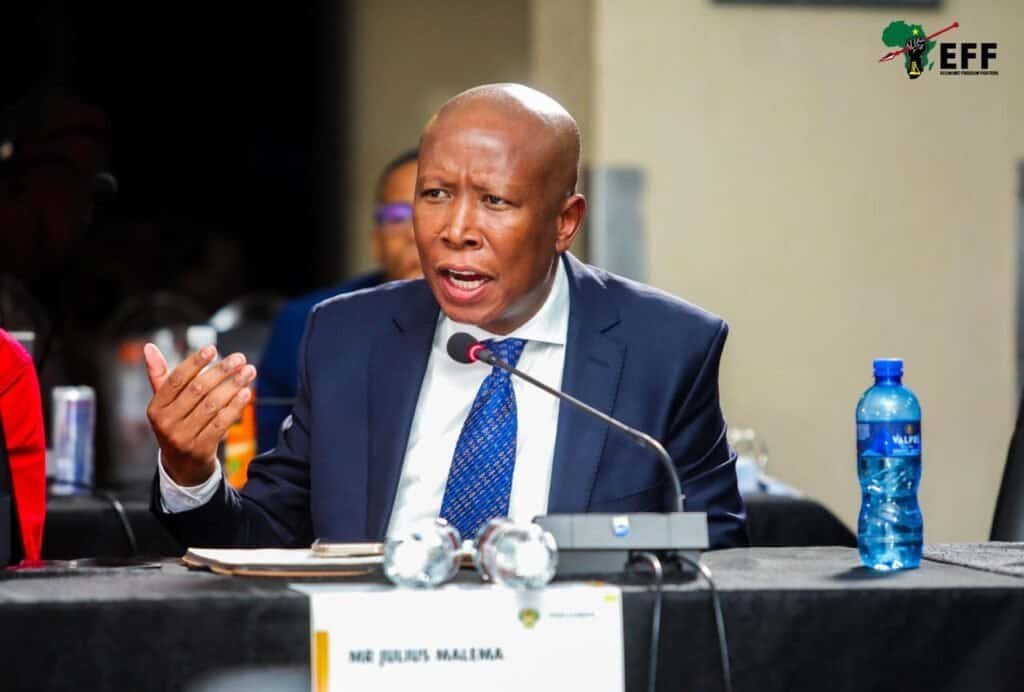
EFF national spokesperson Sinawo Thambo said the MTBPS offered no meaningful response to unemployment, rising living costs and economic inequality.
“What this MTBPS confirms is that South Africa is set for yet another year of economic stagnation, where the poor will continue to suffer while the government protects the interests of capital,” Thambo said.
He accused the GNU of entrenching neoliberal economic policies that prioritise market confidence over people’s needs.
“The crisis of unemployment, poverty and inequality will persist under this coalition government because it refuses to break from policies that benefit a small elite at the expense of the majority,” Thambo said.
The EFF also criticised the process followed in adopting the MTBPS, arguing that Parliament and the public were sidelined. The party maintains that public submissions were not meaningfully considered before the policy statement was finalised and adopted.
According to Thambo, the budget process had been reduced to a “tick-box exercise” that undermines democratic accountability.
“You cannot claim to govern in the public interest while shutting out the public from decisions that directly affect their lives,” he said.
A major point of contention for the EFF is the government’s fiscal stance, which it says amounts to austerity. While Treasury insists that spending restraint is required to stabilise debt and avoid future fiscal shocks, the EFF argues that this approach suppresses growth and worsens unemployment.
Thambo also criticised the MTBPS for failing to respond adequately to global geopolitical developments, including shifting power dynamics and economic pressures facing developing countries.
“There is no serious attempt to position South Africa within the Global South or to advance economic sovereignty through alternatives such as strengthened BRICS cooperation,” he said.
The party further opposed the Special Appropriations Bill, which allocates R754.5 million to cover funding shortfalls following the withdrawal of external donor support for health programmes. The EFF argues that the need for emergency funding exposes the state’s failure to adequately invest in healthcare using domestic resources.
In addition, the EFF rejected the Taxation Laws Amendment Bill and the Tax Administration Laws Amendment Bill, saying their technical nature excludes ordinary South Africans from understanding the tax system and how revenue is raised.
Despite opposition from the EFF and other parties, the GNU maintains that the MTBPS provides a stable fiscal platform to support gradual economic recovery. Treasury has warned that abandoning fiscal consolidation could place future social spending at risk.
But Thambo said the EFF would continue to oppose what it views as an anti-poor budget framework.
“We reject this fiscal direction because it offers no hope to the millions of South Africans who are unemployed, indebted and struggling to survive,” he said.