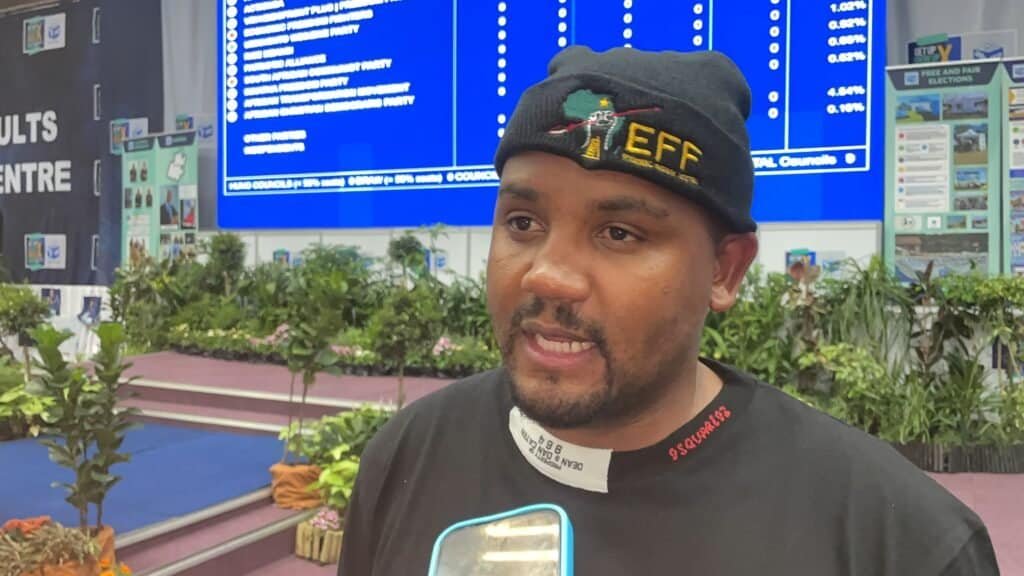
Economic Freedom Fighters (EFF) Gauteng provincial leader Nkululeko Dunga has called on political parties to put their egos aside and approach potential coalition negotiations as equals, saying no party should consider itself more important than another if it has failed to secure an outright majority.
Dunga said political parties must recognise that they are all minorities if they have not obtained more than 50% of the vote and should therefore be prepared to engage one another on equal terms to establish functioning municipalities.
Speaking to African Times at the Gauteng Results Centre on Thursday, Dunga said the emerging election results suggested that coalition arrangements could once again shape local government in the province, as they did after the 2021 local government elections.
“We must put egos aside and where it necessitates conversations to happen at an equal equilibrium between political parties because everyone is a minority. It doesn’t matter whether you have 18% or 2%, at this point, if you’re not given a mandate of above 50%, unfortunately for you, you are a minority, and we are all equal,” Dunga said.
His remarks come as political parties await the final results of Wednesday’s local government elections, with early indications pointing to the possibility of further coalition negotiations in Gauteng.
However, Dunga cautioned against drawing conclusions from the results displayed on the leaderboard at the results centre, saying it was too early to determine the outcome.
He pointed out that voting stations had only closed at 9pm on Wednesday, with most counting processes taking place after 10pm. Some voting stations were also still operational when he spoke to African Times.
“At this present moment we are awaiting the results because only then do they tell a true reflection of what would have been the ultimate outcome and the message that the people of Gauteng would like to express to all political parties, including the EFF,” he said.
While waiting for the results, Dunga raised concerns about isolated incidents involving presiding officers allegedly wanting to leave certain voting stations without completing the required electoral procedures.
He said some officials had allegedly attempted to leave without ensuring that results slips were properly completed and signed.
The EFF had raised these concerns with IEC officials in the province, he said.
On the possibility of working with other political parties, Dunga said coalition governance was not a new phenomenon in South Africa and should not be treated as an unfamiliar political arrangement.
He argued that cooperation between parties had been part of the country’s political history, including during the post-apartheid period under former president Nelson Mandela, although the terminology used at the time may have differed.
Dunga said the reality of different political parties having different ideological orientations meant they would have to find common ground on issues affecting communities.
He identified access to water and electricity, waste collection, road maintenance, pothole repairs and economic development as fundamental responsibilities that should unite parties in local government.
He said there should be little disagreement among political parties about the need to ensure municipalities deliver these basic services.
For the EFF, he added, the priority should be the establishment of functional governance structures, whether or not the party forms part of the governing arrangement.
Dunga pointed to previous coalition and governance arrangements in which the EFF had supported the formation of municipal administrations without necessarily taking up positions within those structures.
He cited instances where the party had supported the Democratic Alliance (DA) taking the reins of government in certain municipal structures, arguing that the objective was to ensure that governance structures were established and service delivery continued.
He said the EFF had subsequently become part of governing arrangements in other municipalities, while in some Gauteng areas it continued to support existing governance structures despite not being part of the administration.
Dunga said the party believed municipalities should establish governance structures in accordance with the Municipal Systems Act and relevant legislative requirements, including prescribed timeframes.
He stressed that negotiations should not be driven by political egos or demands for dominance but by the need to establish administrations capable of delivering services.
The comments signal the approach the EFF intends taking should the final Gauteng results require parties to negotiate coalition arrangements.
The 2021 local government elections left several municipalities across Gauteng without outright majorities, resulting in negotiations and coalition agreements involving different political parties.
The latest results could once again require parties to navigate competing political interests while trying to establish stable administrations.
For Dunga, however, the starting point should be recognising that no party without an outright majority has an exclusive claim to power.
His message to political parties is that electoral support should translate into cooperation where necessary, with residents’ needs taking precedence over political differences.
As the counting and verification process continues, the final results will determine which parties have the numbers to negotiate and where coalition arrangements may become necessary.