The findings open up new opportunities for studying the class of musical performers during the period from around 1069 to 664 BC
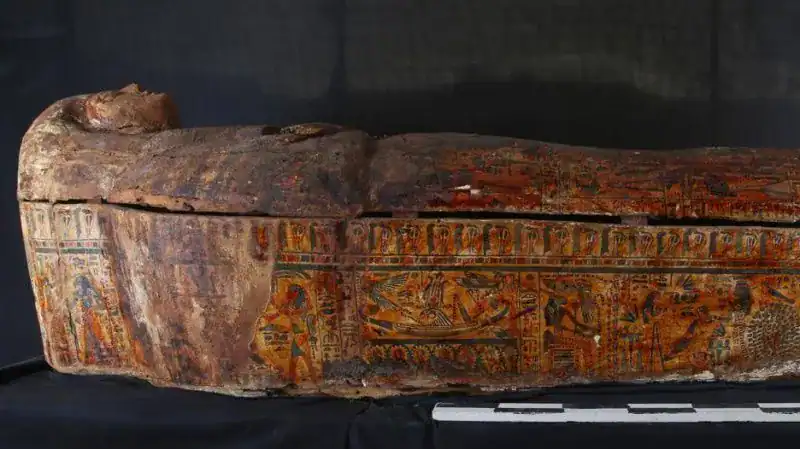
An Egyptian archaeological expedition has discovered a collection of painted wooden sarcophagi with mummies, as well as a group of rare papyri from the Third Intermediate Period of Ancient Egypt (the period of the 21st–25th dynasties, 1069–664 BC). This was reported by Daily News Egypt, a partner of TV BRICS.
The discovery was made during excavations in the southwestern corner of the courtyard of the tomb of Seneb in the Qurna area on the west bank of the Nile, opposite Luxor. A rectangular chamber carved into the rock was found, which was used as a burial repository. Inside, archaeologists found 22 painted wooden sarcophagi arranged in several layers. The ancient Egyptians stacked the sarcophagi in ten horizontal rows, separating the lids from the bases to maximise the capacity of the chamber.
The expedition also discovered a collection of ceramic vessels, which are believed to have been used to store materials related to the mummification process.
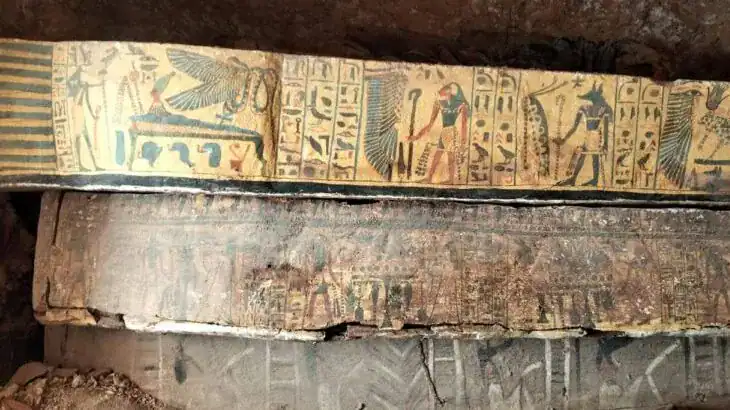
Hisham El-Leithy, Secretary General of the Supreme Council of Antiquities, said that researchers are working to unravel the mystery of this cache and are trying to establish the identities of those buried there. Most of the sarcophagi bear professional titles rather than personal names. The most common designations are “Chanter” or “Chantress of Amun (the ancient Egyptian sun god)”.
Eight papyri of varying sizes were found inside a large pottery jar. Some of them still have their original clay seals. Their contents will be revealed after restoration and translation work is completed.
According to expedition leader Zahi Hawass, former Minister of Antiquities of Egypt, the discovery sheds light on the Third Intermediate Period, opens up new opportunities for studying the class of temple singers of those years, and provides valuable information about that era.
The excavations are continuing. Scientists are trying to find the original tombs from which the sarcophagi were removed.
In other BRICS countries, important archaeological discoveries have also been made in recent months, aimed at broadening our understanding of history.
At the centre of the Russian capital, a hoard of ancient coins was discovered – more than 20,000 white metal coins dating from the 16th–17th centuries. The discovery was made during restoration work when the floors of the second floor of the building in the historic estate of Averky Kirillov Chambers on Bersenevskaya Embankment were opened. During the work, fragments of polychrome tiles, a bone whistle and a pectoral cross were also found. This was reported on the Moscow Government website.
The world’s oldest rock paintings, an outline of a human hand dating back 67,800 years, have been found in Indonesia, according to Xinhua, a partner of TV BRICS. The discovery was made in the limestone cave of Liang Metanduno on Muna Island. It will allow scientists to determine the period of human migration to the prehistoric continent of Sahul.
An archaeological find in Ethiopia has refuted one of the theories about the origin of humans, reports Fana Media Corporation, a partner of TV BRICS. A fossilised skull of an ancient human dating back 1.5 million years was discovered in a well-known palaeoanthropological research area of the country. According to researchers, the facial features of the fossil closely resemble those of ancient humans who later migrated from Africa to Europe and Asia about 1.8 million years ago, calling into question earlier hypotheses that such populations may have returned to Africa from Asia.
African Times published this article in partnership with International Media Network TV BRICS