South Africans stranded in the United Arab Emirates (UAE) are describing scenes of fear and chaos as escalating conflict in the Middle East disrupts air travel and leaves thousands unable to return home.
“We urgently need help. Please help us; we are scared. I just saw two bombs explode not far from where I am,” said one South African citizen currently in the UAE, speaking on condition of anonymity.
The violence forms part of a widening regional conflict involving the United States, Israel and Iran, with attacks now affecting countries beyond the main battlegrounds. Airports in the UAE have been hit, triggering widespread flight cancellations and airspace closures.
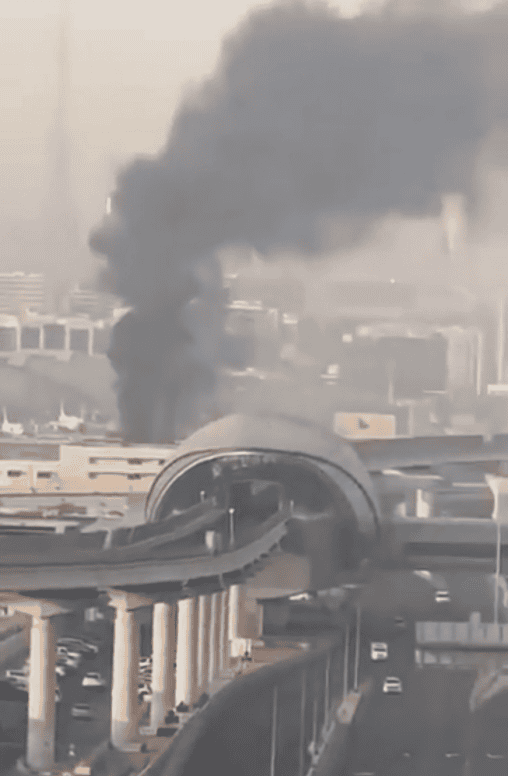
Authorities in Abu Dhabi confirmed that a drone targeting Zayed International Airport was intercepted. However, falling debris reportedly killed one person and injured several others. In Dubai, an “incident” at Dubai International Airport, one of the busiest travel hubs in the world, left at least four staff members injured.
The disruptions have grounded thousands of flights, leaving travellers stranded and uncertain about when it will be safe to leave.
“We see missiles, and it feels like we are in a war zone,” the South African citizen said. “They are going to cut our communication lines off and we have been threatened with arrest. I have never seen something like this.”
The Department of International Relations and Cooperation (DIRCO) confirmed it is aware of the situation and is engaging affected citizens.
DIRCO spokesperson Clayson Monyela said airspace closures across parts of the Middle East have made it impossible to move people in or out of certain countries by air.
“We are in touch with South Africans using various communication platforms. Our systems do work. Every country’s diplomatic mission has evacuation plans. Various interventions and options are being explored,” Monyela said.
In an advisory issued to citizens in the region, DIRCO urged South Africans to immediately register with their nearest embassy so authorities are aware of their whereabouts.
However, the department also warned that its ability to assist may be limited in some areas.
“It could be assumed that no face-to-face consular assistance will be possible in an emergency, and the South African government may not be able to help you if you get into difficulty, depending on your location,” the advisory read.
Citizens have been encouraged to assess their own safety and follow instructions from local authorities while the situation remains volatile.
The crisis has drawn political reaction at home. The Patriotic Alliance expressed concern over the escalating violence and its impact on civilians, including South Africans abroad.
“The widening of attacks beyond the primary parties shows how ordinary families, workers and travellers are the first to suffer,” said party spokesperson Steve Motale.
The party condemned attacks that endanger civilians and called for urgent international efforts to de-escalate the conflict and return to negotiations.
Meanwhile, diplomatic efforts are also underway. The Iranian embassy in South Africa has committed to working with DIRCO to assist South Africans caught in Iran and other affected areas.
Iran’s ambassador to South Africa, Seyed Mostafa Daryabari, said the safety of foreign nationals remains a priority amid the escalating crisis.
“We are deeply concerned about South African citizens who have found themselves in an unfortunate situation between these forces. Their safety is a priority,” he said.
The latest escalation follows reported strikes by the US and Israel on Iran, as well as the killing of Iran’s Supreme Leader, Ali Khamenei, an event that has intensified tensions and raised fears of a broader regional war.
Political analyst Naeem Jeenah said the developments signal a dangerous shift in global power dynamics.
“The assassination has angered Iran, and there are indications that retaliation will be significant. The Iranians had already outlined how they would respond to attacks by the US or Israel,” Jeenah said.
Civil society organisations have also weighed in. Africa4Palestine condemned the attacks on Iran, describing them as acts of aggression and expressing solidarity with affected civilians.
The group warned that continued escalation could have devastating consequences not only for the region but also for global stability, including trade routes, energy security and international travel.
For South Africans stranded in the UAE and across the Middle East, however, the immediate concern remains survival and safe passage home.
Many say they have struggled to get timely assistance and are growing increasingly desperate as the situation deteriorates.
“We understand flights are grounded, but we are asking to be taken somewhere safe,” said the stranded citizen.
As the conflict deepens, uncertainty remains over when airspace will reopen or whether evacuation efforts will be possible in the coming days.
For now, South Africans in the region are being urged to stay vigilant, remain in contact with diplomatic missions and prioritise their personal safety in what is fast becoming one of the most volatile crises in recent years.