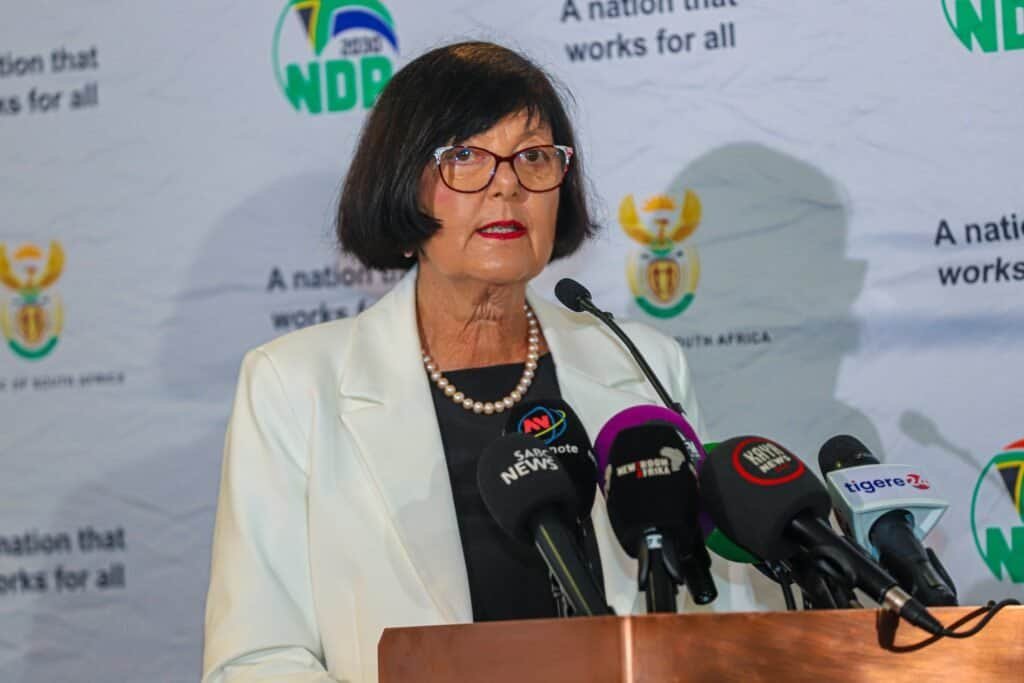
South Africa recorded its lowest festive-season road crashes in five years, with early data showing a modest but significant decline in fatalities and accidents, Transport Minister Barbara Creecy announced on Thursday, even as she warned that reckless driving and alcohol abuse continue to claim thousands of lives and require tougher laws.
Presenting the 2025/26 Festive Season Road Safety Campaign report in Tshwane, Creecy said preliminary figures pointed to a 5% reduction in both road crashes and fatalities compared with the same period last year. A total of 1 427 people died in 1 172 crashes during the festive season, marking the lowest number of crashes in five years and matching the fatality figures recorded in the 2023/24 season.
“While any reduction is welcome, the loss of even a single life on our roads remains unacceptable,” Creecy said, describing road deaths as a “national shame” that is neither inevitable nor unavoidable.
Five provinces recorded declines in fatalities, with the Eastern Cape showing the highest percentage reduction, followed by the Free State. However, Gauteng, the Western Cape, Mpumalanga and the Northern Cape all saw increases, underlining what Creecy called the uneven progress in road safety across the country.
The data also highlighted a familiar and troubling festive-season pattern. More than 40% of crashes and fatalities occurred between 15 and 28 December, a period when many travellers had already reached their destinations and were engaged in social activities rather than long-distance travel. Weekends proved especially deadly, with most crashes happening between 7pm and 9pm and again between midnight and 1am.
“These are the hours associated with drinking, fatigue and poor judgement,” Creecy said.
Pedestrians once again featured prominently among the victims. The highest number of pedestrian deaths were recorded in the City of Cape Town, Johannesburg, eThekwini, Nkangala District and Tshwane. Small motor vehicles accounted for 55% of all crashes, followed by light delivery vehicles at 20%. Minibus taxis and trucks were involved in 7% and 6% of crashes respectively.
Law enforcement was significantly stepped up during the festive season. Creecy said joint operations by national, provincial and local authorities resulted in 1 632 roadblocks, with about 1.8 million vehicles stopped and checked. More than 450 000 traffic fines were issued, while 525 motorists were arrested for excessive speeding.
A total of 173 695 drivers were tested for alcohol, with 8 561 returning positive results. This represented a staggering 144% increase compared with the same period last year. The highest alcohol reading was recorded in KwaZulu-Natal, where one driver was found to be 14 times over the legal limit. In the Northern Cape, police arrested a motorist clocked at 222km/h in a 120km/h zone.
In a further sign of pressure on officers, 89 motorists were arrested for attempting to bribe traffic officials to avoid arrest.
Alongside enforcement, the department rolled out 2 547 education and awareness programmes nationwide, targeting drivers, pedestrians and passengers at taxi ranks, malls, bus terminals and other busy public spaces. A sustained media campaign on radio, television and social media reinforced messages around seatbelt use, speeding and drunk driving.
Beyond the festive season, Creecy said annual figures for 2025 showed encouraging progress. Preliminary data indicates that road deaths and crashes for the year were the lowest in five years, with 11 418 fatalities from 9 674 crashes. This compares with 12 581 deaths from 10 633 crashes in 2021. Compared with 2024, crashes fell by 6.4% and fatalities by 6.2%.
Creecy credited the improvement to coordinated efforts by traffic officers, police, emergency services, provincial MECs, municipal officials, traditional leaders and organised transport sectors, saying the country was, for the first time in many years, on track to achieve a 50% reduction in road deaths by 2030.
However, she signalled a major policy shift ahead, particularly on alcohol. South Africa’s drinking-and-driving laws, formulated nearly three decades ago, were no longer fit for purpose, she said.
“In today’s South Africa it is totally unacceptable that there is a law that allows people to drink and then drive,” Creecy told the briefing. “I cannot explain this to anyone who has lost a child, a parent or a sibling.”
She announced plans to amend section 65 of the National Road Traffic Act to introduce a zero-tolerance approach. “The time has come for a clear-cut, unambiguous policy that says drinking and driving is not allowed,” she said.
Creecy said enforcement would also be intensified on weekends and public holidays, with a stronger focus on pedestrian safety, noting that nearly half of all road deaths involve people walking along or crossing roads.
“If nothing else,” she concluded, “we owe this to the memory of the many South Africans who have lost their lives on our roads.”