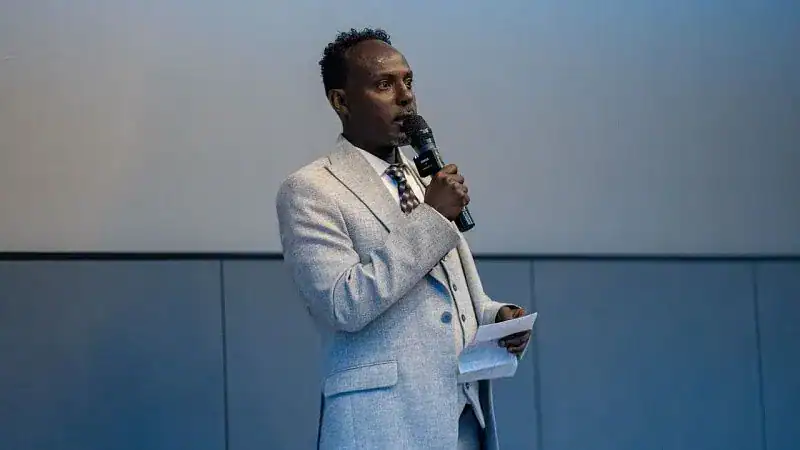
Yirgashewa Teshome is an Ethiopian writer, filmmaker and the founding director of the Ethiopian International Film Festival (ERTHOPIAN), an annual event held in Addis Ababa that has become a key platform for African and international cinema. He holds a bachelor’s degree in Economics and a master’s degree in Regional and Local Development Studies from Addis Ababa University and has been a driving force behind the festival since its inception.
In 2024, Yirgashewa Teshome served as a juror at the BRICS Film Festival during the 46th Moscow International Film Festival, shortly after Ethiopia’s accession to the BRICS group, reflecting the deepening cultural and creative ties between African nations and other members of the group.
In 2024, you served as a jury member at the BRICS Film Festival in Moscow. How did this experience influence your understanding of cultural dialogue within the BRICS framework?
Serving as a jury member in Moscow was a profound milestone and a transformative experience, particularly as it coincided with Ethiopia’s historic entry into the BRICS family. It moved the concept of “cultural dialogue” from an abstract diplomatic term to a lived, artistic reality. For me, and for our nation’s cinema, it was a moment of recognition on the global stage.
I observed that while our languages differ, our cinematic “grammars” share a common soul – one that prioritises human dignity, family, and historical resilience. This experience taught me that the BRICS framework is not merely an economic or political alliance; it is a civilisational bridge. Seeing films from BRICS member countries like Russia, Brazil, India, China, and South Africa alongside our own convinced me that we are building a “multipathway” for stories where no single culture dominates. It reinforced the idea that cultural dialogue within BRICS is about mutual recognition – fostering a respect that transcends traditional ties and allows us to see the world through each other’s eyes without a Western lens.
The experience deepened my understanding of how film serves as a universal language within the BRICS framework. It showed me that despite our diverse linguistic and geographical backgrounds, our stories –rooted in our unique traditions and common struggles – create a powerful bridge. It proved that cultural dialogue is not just about talking; it is about seeing each other’s worlds through the lens, fostering a mutual respect that transcends traditional political or economic ties.
From your perspective, what makes cooperation between BRICS countries especially important for film industries in the Global South, including Africa?
For the Global South, and Africa in particular, BRICS cooperation is a vital path toward cinematic decolonisation. For decades, our stories were often filtered through external perspectives or restricted by distribution channels that did not favour our markets. The cooperation between BRICS countries allows us to tell our own stories and bypass traditional bottlenecks in global distribution, giving African films direct access to the world’s most populous and fastest-growing markets. It gives access to the massive audiences within the BRICS bloc and provides a level of exposure and commercial potential that was previously difficult for independent African filmmakers to achieve. We often face challenges with high-end post-production technology. BRICS partners offer immense technical expertise and modern storytelling tools that help bridge the digital divide, elevating the production quality of African cinema through technology transfer.
How can BRICS film festivals contribute to building sustainable platforms for co-production, distribution, and professional exchange between filmmakers from different member states?
To be truly effective, BRICS film festivals must evolve from “one-week events” into permanent, year-round ecosystems. To make this sustainable, I believe we need to establish three concrete pillars:
We need a dedicated BRICS Co-Production Fund. This financial mechanism would incentivise projects involving talent from multiple member states, significantly lowering the financial risk for independent filmmakers.
We should work toward a “BRICS Cinema Circuit” or a “Green Channel” where award-winning films from one member’s festival are automatically granted theatrical or VOD releases in all other member countries.
Moving beyond screenings, we should host intensive “Industry Days” and create a digital platform where filmmakers can exchange technical blueprints, script-doctoring services, and location-scouting data.
In 2025, TV BRICS became an information partner of the Ethiopian International Film Festival. How do such media partnerships help strengthen cultural visibility and mutual understanding among BRICS countries?
The partnership with TV BRICS for the 20th edition of our festival is a genuine game-changer. As the director of the Ethiopian International Film Festival, I see this as a strategic alliance that converts local success into international prestige – it is the “megaphone” our stories have long deserved.
Media partnerships do more than just report news; they curate understanding. By broadcasting our stories and festival highlights to millions of viewers across the bloc, TV BRICS helps dismantle outdated stereotypes about Africa. It allows a viewer in Sao Paulo, Moscow, or Mumbai to see the vibrant, creative reality of Addis Ababa. This visibility obviously creates “cultural empathy”, which is the first step toward commercial viability; once people see and connect with our culture, they become much more willing to invest in our films.
How can BRICS cultural initiatives, including film festivals, support emerging filmmakers and new voices from developing film markets?
Emerging voices are the lifeblood of our industry, but they are also the most vulnerable. BRICS initiatives can nurture this “new generation” through targeted support. Pairing legendary directors from established markets like India or Russia with emerging Ethiopian and African talents for masterclasses and project development. Creating dedicated “BRICS+ Youth” categories or specific competition segments for first-time directors or student filmmakers will be an important initiative to ensure they aren’t overshadowed by established veterans. In addition to that, utilising the BRICS platform to provide scholarships and training in scriptwriting, cinematography, and digital marketing, ensuring the next generation is technically proficient and globally connected.
Looking ahead to 2026 and beyond, what new directions or collaborations do you hope to develop for the Ethiopian International Film Festival and its international partners?
My goal is to position Ethiopia as the “Cinematic Gateway to Africa” for the BRICS bloc. I hope to take our festival’s winners on a travelling showcase across major cities like Moscow, Beijing, and New Delhi to broaden their reach. My vision includes developing a digital archive and streaming partnership with BRICS institutions to make our cinematic history accessible worldwide. By 2026, I wish to establish a permanent BRICS Film Liaison office in Addis Ababa to facilitate 365 days of collaboration and host a “Pan-African BRICS Film Forum” to set the agenda for South-South cultural cooperation.
What forms of collaboration between BRICS film institutions and African festivals would you consider most promising in the coming years?
The most promising collaborations lie in the intersection of heritage and accessibility: many of Africa’s classic films are at risk of being lost. Using the advanced digital restoration capabilities of BRICS institutions to preserve African cinematic history is a noble and practical collaboration. Establishing direct exchange programmes between African film festivals, schools and prestigious institutions like the Moscow University of Theatrical Arts or Chinese film academies is another promising collaboration. Furthermore, bringing BRICS films to rural parts of Africa and vice versa ensures this exchange isn’t just for urban elites in the cities but for the people. This “Grassroots Cinema” approach will create a truly inclusive cultural movement that reflects the values of the BRICS spirit, protecting our traditional stories for the digital age.
African Times published this article in partnership with International Media Network TV BRICS