South Africa has joined the world in mourning the death of veteran American civil rights leader Jesse Louis Jackson Sr, with President Cyril Ramaphosa describing him as a “global moral authority” whose fight for justice transcended borders.
Jackson, who has died at the age of 84, was one of the most recognisable voices of the American Civil Rights Movement and a steadfast ally of South Africa’s anti-apartheid struggle. In a heartfelt tribute on Tuesday, Ramaphosa extended condolences to the Jackson family, the Rainbow PUSH Coalition, and the many organisations around the world inspired by his leadership.
“Jesse Jackson devoted himself to the cause of justice as a human endeavour without borders,” Ramaphosa said, reflecting on a life that connected Selma to Soweto and Washington to Johannesburg.
Born in Greenville, South Carolina, in 1941, Jackson rose to prominence as a protégé of Martin Luther King Jr. As a young Baptist minister, he worked alongside King in the Southern Christian Leadership Conference, participating in pivotal campaigns for desegregation and voting rights in the United States. After King’s assassination in 1968, Jackson continued the struggle, founding Operation PUSH — later the Rainbow PUSH Coalition — to advance economic empowerment, education and political inclusion for African Americans.
Jackson twice sought the US presidency in 1984 and 1988, breaking racial barriers and mobilising millions of new voters in what became known as the “Rainbow Coalition.” Though he did not secure the Democratic nomination, his campaigns reshaped American politics and broadened representation within the party.
Beyond America’s borders, Jackson became an outspoken critic of apartheid. He championed sanctions and disinvestment from South Africa’s apartheid economy and lobbied political and corporate leaders to isolate the regime. In 1979, following the death of anti-apartheid activist Steve Biko, Jackson visited Soweto in a show of solidarity, defying the apartheid government and amplifying global calls for justice.
“In 2026, we reflect with deep appreciation on Jesse Jackson’s visit to Southern Africa 40 years ago,” Ramaphosa said, noting his outreach to leaders and citizens across Nigeria, Angola, Botswana, Mozambique, Tanzania, Zambia and Zimbabwe. “He declared that justice would ultimately triumph over injustice.”
In recognition of his contribution, South Africa awarded Jackson the National Order of the Companions of O.R. Tambo in Silver in 2013, honouring his role in advancing the global anti-apartheid cause.
International leaders also paid tribute. Former US President Barack Obama described Jackson as “a relentless advocate for equality whose voice carried the hopes of generations.” The African National Congress hailed him as “a trusted friend of the liberation movement,” while the United Nations praised his lifelong commitment to human rights and democracy.
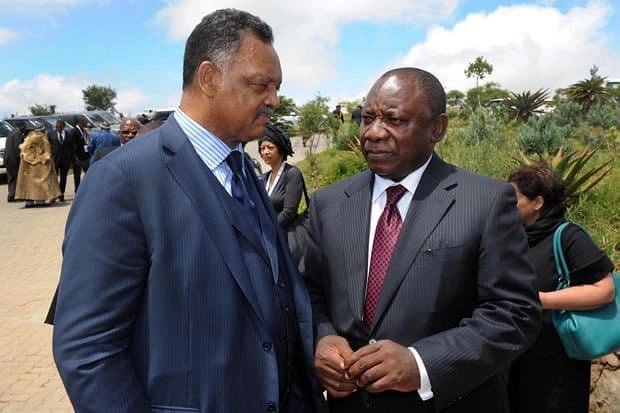
Ramaphosa recalled walking alongside Jackson during the 33rd Gandhi Walk in April 2018, where the veteran activist spoke of his enduring bond with South Africa. “He has fought a good fight and run the race which his Baptist ministry inspired him to run,” Ramaphosa said.
As tributes continue to pour in from across continents, Jackson is remembered not only as a towering figure of the American civil rights struggle, but as a steadfast champion of global freedom — a man who believed, and proved, that the pursuit of justice knows no borders.