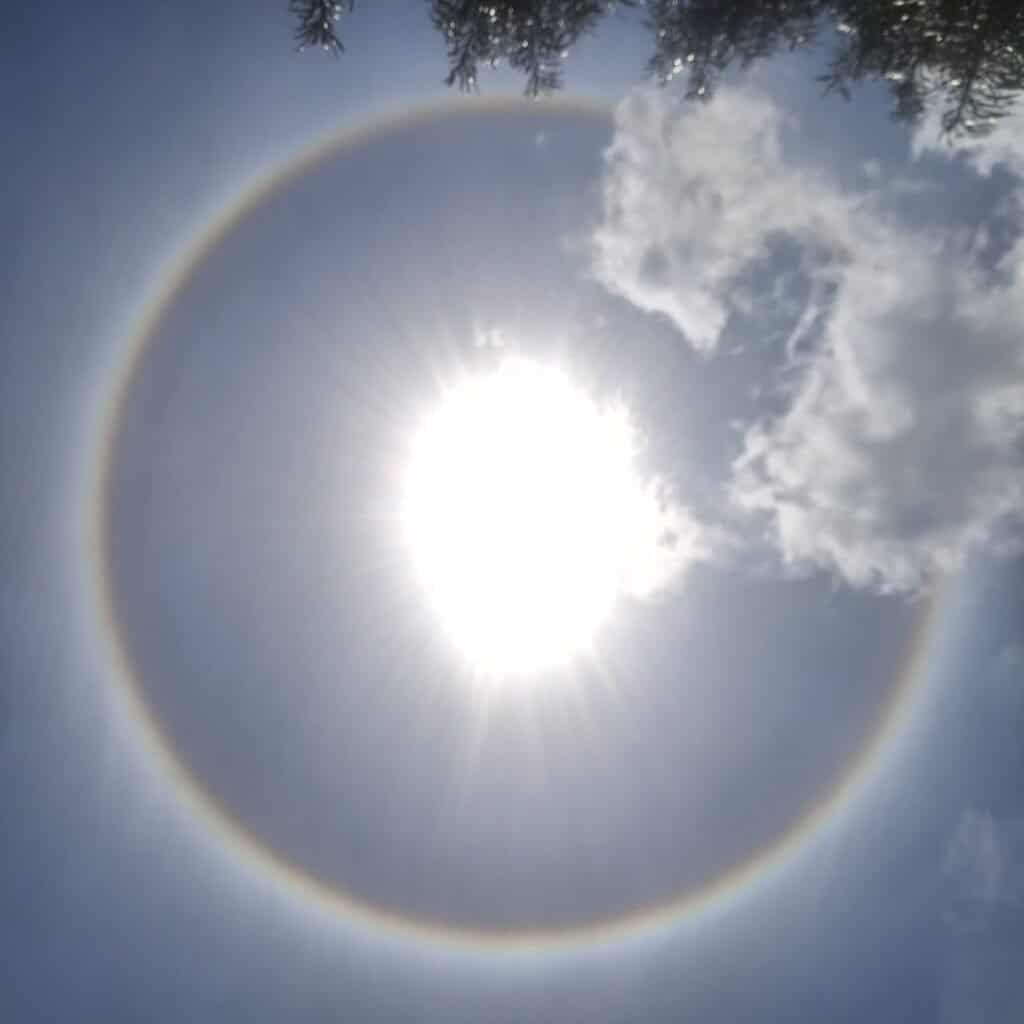
Gauteng residents were treated to a spectacular sight on Monday morning when a mysterious-looking ring of light appeared to circle the sun, leaving many mesmerised and others wondering whether something unusual was happening in the skies.
From Johannesburg to Pretoria and Hartbeespoort, people of all ages stopped what they were doing to look up at the unusual formation, with some pulling out their cellphones to capture pictures, take selfies and share the phenomenon on social media.
For many, the sight was unlike anything they had seen before.
Social media platforms were flooded with photographs of the bright circular formation, with residents asking questions and sharing their amazement at the enormous glowing ring surrounding the sun.
One Ekurhuleni resident who contacted African Times admitted that the sight had initially caused some alarm.
“We thought the world was coming to an end,” the resident said.
However, what appeared to some as an extraordinary sign in the sky was actually a natural atmospheric phenomenon known as a solar halo.
The spectacular ring forms when sunlight passes through tiny ice crystals suspended in high-altitude cirrus clouds, approximately eight to 10 kilometres above the Earth’s surface.
The ice crystals refract sunlight, producing a circular ring that can sometimes display faint rainbow colours.
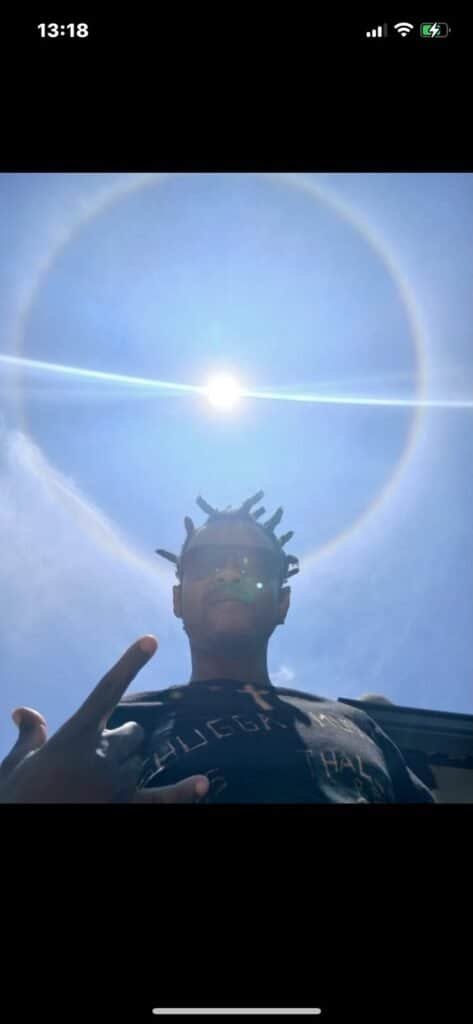
Professor Jennifer Fitchett from Wits University explained that the phenomenon witnessed across parts of Gauteng was known as a 22-degree halo.
“It’s a very unusual phenomenon where we’ve got a thin circle of clouds that completely surround the sun. This is called a 22-degree halo, and it’s created by the same cirrus clouds that we would ordinarily see as very thin stripes across the upper atmosphere,” she said.
Fitchett explained that the formation occurs when ice crystals develop a particular hexagonal shape, allowing sunlight to refract and create the distinctive circular appearance.
“When we have a perfect hexagonal shape of our ice crystals, the sun coming in bounces off those and it refracts to form a perfect circle around the sun,” she said.
While the sight attracted considerable attention, Fitchett said the phenomenon did not necessarily indicate that severe weather was approaching.
She explained that although solar halos can sometimes be associated with rain, they should not be interpreted as a reliable weather forecast on their own.
“We can see that there are cumulus clouds coming in, and they’re getting darker, and so we are likely to have some more rain, similar to the thunderstorms that we had yesterday evening,” she said.
She added that the clouds responsible for the halo were part of local weather systems and did not necessarily indicate a cloud formation covering the entire country.
Fitchett also cautioned against attributing the unusual formation directly to current climate conditions, including the extreme heat events associated with the Super El Niño.
Although South Africa has been experiencing unusual climate conditions, she said the solar halo was a natural cloud formation that occurs from time to time.
“It is not the direct response to any of those, but rather an unusual cloud formation that we do see from time to time,” she explained.
Despite its beauty, the professor warned residents against staring directly at the sun while trying to observe the halo.
She said the intense sunlight could pose a risk to people’s eyes, advising them to take quick photographs using their cellphone cameras rather than looking at the formation for extended periods.
“People do need to be careful because, similar to a solar eclipse, it creates very bright light,” she said.
Her warning came as residents continued sharing photographs of the phenomenon, with many expressing surprise at the unusual spectacle.
For a few moments on Monday, the busy streets of Gauteng had something in common: people looking upwards, capturing the moment and trying to understand the extraordinary-looking circle surrounding the sun.
While some initially feared the worst, the mysterious ring turned out to be a reminder of the fascinating natural displays that can unfold above us without warning.