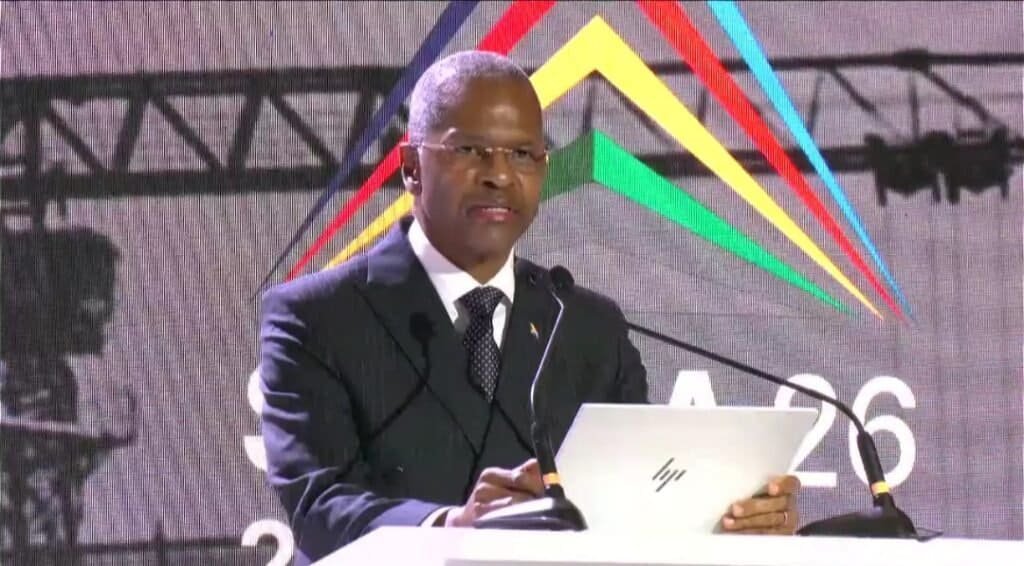
South Africa’s municipalities must urgently overhaul the way they manage infrastructure, finances and basic services if they are to attract investment and drive economic growth, Cooperative Governance and Traditional Affairs Minister Velenkosini Hlabisa has warned.
Hlabisa said municipalities could no longer treat water, electricity, sanitation, waste management and other trading services simply as administrative functions, arguing that the reliability of these services was directly linked to investor confidence, business productivity, employment and the economic competitiveness of cities and towns.
Addressing the Sustainable Infrastructure Development Symposium South Africa 2026 at the Century City Conference Centre in Cape Town on Tuesday, Hlabisa said government needed to move beyond simply building infrastructure and focus on creating municipalities capable of sustaining and managing it.
“We are not simply looking for capital. We are looking for long-term partnerships that combine capital, expertise, innovation and institutional capability to build infrastructure that works and lasts,” Hlabisa said.
His remarks come as municipalities across the country face mounting pressure over deteriorating infrastructure, financial instability, revenue collection challenges and service delivery failures.
Hlabisa said the country had made significant progress since 1994 in expanding access to basic services, with millions of households gaining access to water, sanitation, electricity and refuse removal.
However, he said the next phase of local government could not be measured only by whether infrastructure existed.
The critical questions were whether it was reliable, resilient, financially sustainable and capable of supporting economic growth.
“When municipal services are consistently reliable, businesses can operate with greater certainty, industries can expand, investors can make long-term decisions, and communities can participate more meaningfully in the economy,” he said.
“When municipal services are unreliable, the consequences extend far beyond the municipal balance sheet.”
Hlabisa said unreliable infrastructure affected investment decisions, business confidence, productivity, employment, property values and the competitiveness of regions.
He warned that government could not close South Africa’s infrastructure funding gap alone and called for greater use of development finance, blended finance, public-private partnerships, infrastructure bonds and institutional investment.
But he stressed that attracting money would not be enough.
“Capital follows confidence,” Hlabisa said, arguing that investors required predictable regulation, credible financial information, transparent procurement, reliable revenue models, clear risk allocation and competent project management.
“This means that our objective cannot simply be to find money for projects. We must build investable municipalities.”
He said this required municipalities to strengthen financial management, asset management, revenue collection, technical capacity, project preparation and governance.
Hlabisa also acknowledged some of the most persistent financial problems confronting municipal trading services, including customer debt, non-revenue water, electricity losses, weak billing systems, deferred maintenance and growing municipal obligations.
He warned that financial sustainability could not simply be achieved by increasing tariffs.
Municipalities needed to understand the true cost of providing services, improve billing and collection, reduce losses, protect infrastructure and ensure that revenue from trading services was properly managed.
He said households that could afford to pay should do so, while those genuinely unable to pay should receive appropriate support through municipal indigent programmes.
“The objective is not commercialisation for its own sake. The objective is financial sustainability in service of public value,” he said.
Hlabisa also placed professionalisation at the centre of the government’s local government reform agenda.
He said municipalities needed engineers, planners, financial specialists, procurement professionals, contract managers, asset managers and data specialists capable of managing increasingly complex infrastructure systems.
Technology, he said, should also be used to transform municipal operations through digital billing, smart meters, asset management systems, predictive maintenance and data analytics.
The goal should be to shift municipalities from reacting to infrastructure breakdowns to predicting and preventing failures.
Hlabisa linked the infrastructure challenge to the broader review of the White Paper on Local Government, saying the process offered an opportunity to rethink how municipalities operate in response to urbanisation, population growth, climate change, infrastructure backlogs and changing economic realities.
He stressed that South Africa did not have a single municipal reality.
Metropolitan municipalities, secondary cities, intermediate cities, small towns and rural municipalities have different economic bases, infrastructure needs and institutional capacities.
As a result, investment and financing models should be tailored to different municipal circumstances.
Hlabisa said infrastructure investment should also address South Africa’s spatial inequalities by connecting communities to jobs, markets and economic opportunities.
Reliable municipal services, serviced land, functioning roads and predictable development processes could help unlock township economies, rural economies, industrial areas, logistics corridors and tourism destinations.
He also warned that climate change had become a major consideration for municipal infrastructure planning, with flooding, drought and extreme heat posing risks to infrastructure, municipal finances and economic activity.
Ultimately, Hlabisa said the measure of successful local government should be whether municipalities work.
“A municipality works when infrastructure is reliable, finances are sustainable, officials are capable, councils exercise effective oversight, revenue is collected fairly, suppliers are paid, procurement delivers value for money and communities, and businesses can depend on the services they receive,” he said.
He said fixing municipalities was not merely an administrative responsibility but a central part of South Africa’s economic development strategy.
“When municipalities work, economies work. When infrastructure works, investment works. And when investment works, communities prosper,” Hlabisa said.