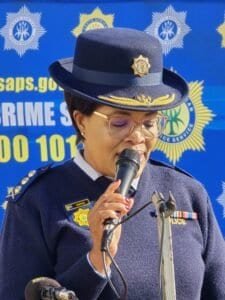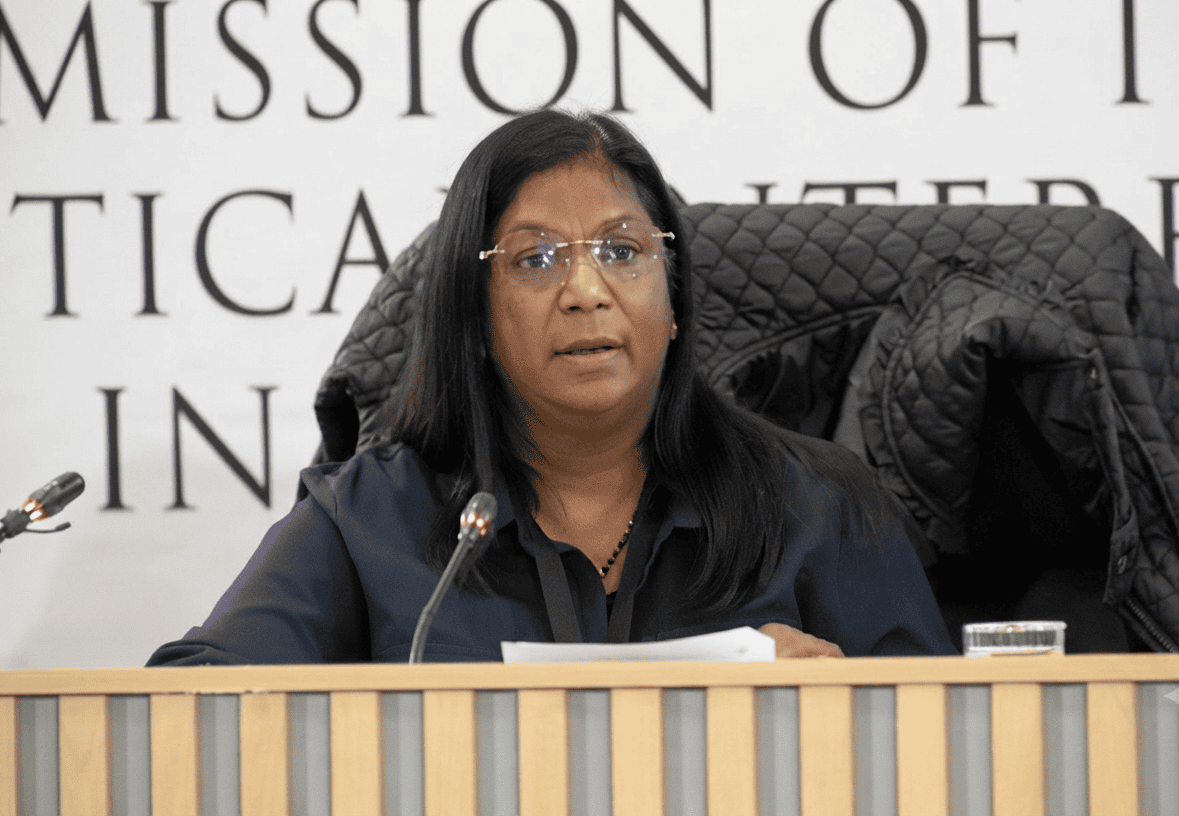
The credibility of the Investigating Directorate Against Corruption’s (IDAC) investigation into senior Crime Intelligence officials came under intense scrutiny at the Madlanga Commission on Thursday, with IDAC head Andrea Johnson apologising to Brigadier Dineo Mokwele after conceding that her earlier criticism of the officer’s appointment was based on incorrect information.
Johnson’s concession marked one of the most significant moments in the Commission’s hearings, as commissioners and evidence leaders repeatedly challenged the legal and factual basis of IDAC’s preliminary investigation into Crime Intelligence.
She withdrew her earlier assertion that Mokwele’s appointment had been a token appointment after admitting she had never examined the brigadier’s qualifications, job application or employment records before making the claim.
Co-commissioner Sandile Khumalo confronted Johnson over her evidence, asking why she had told the Commission that Mokwele did not meet the requirements for the position while simultaneously conceding that she was unfamiliar with her qualifications.
“Do you know what her qualifications are?” Khumalo asked.
“Not all,” Johnson replied.
She further admitted that she had not seen Mokwele’s academic qualifications, her application for the position or documentation showing that the senior officer is currently studying towards a Master of Business Administration degree.
Johnson acknowledged that her assessment was based entirely on information supplied by her investigative team, which she now accepts was inaccurate.
Referring to the official job description for the position, Khumalo pointed out that Mokwele’s qualifications and professional experience appeared to exceed the minimum requirements.
Before examining the official documents, he said, the impression created by IDAC was that Crime Intelligence had effectively appointed “a receptionist from BMW”. However, after reviewing the records, it became clear that Mokwele was significantly more qualified than the position required.
Johnson subsequently apologised to Mokwele and formally withdrew her earlier characterisation of the appointment.
The exchange formed part of a broader day of testimony in which commissioners questioned almost every aspect of IDAC’s investigation into Crime Intelligence, including whether investigators had exceeded their legal powers and pursued individuals without sufficient evidence.
Evidence leader Advocate Mahlape Sello argued that IDAC had effectively transformed what should have been a limited preliminary investigation under Section 28 of its governing legislation into a full-scale investigation.
Sello submitted that when the investigation commenced in June 2025, IDAC’s mandate was limited to determining whether reasonable grounds existed to launch a formal investigation.
Johnson disagreed, maintaining that Section 28 allows investigators to subpoena documents, obtain witness statements and conduct interviews while assessing allegations before deciding whether a full investigation should follow.
However, commissioners appeared unconvinced.
Co-commissioner Sesi Baloyi suggested that IDAC had relied on a vague affidavit submitted by Member of Parliament Fadiel Adams as justification to cast an excessively wide investigative net.
Baloyi described the approach as resembling a “fishing expedition”, suggesting investigators used Adams’ Section 27 affidavit to search broadly for possible wrongdoing rather than investigate clearly defined allegations.
Further criticism centred on IDAC’s understanding of SAPS appointment procedures.
Justice Khumalo questioned whether investigators appreciated that appointments to senior police positions are regulated by national instructions prescribing detailed recruitment and selection processes.
He expressed concern that investigators appeared unaware of those procedures while investigating appointments within Crime Intelligence.
Khumalo was particularly critical of the manner in which IDAC dealt with a civilian appointee during the investigation, saying the unit had targeted the individual in a deeply concerning manner.
Johnson accepted the criticism, telling the Commission that she “sees the point.”
Questions also emerged over the scope of individuals investigated by IDAC.
Khumalo asked what factual basis existed to investigate nine individuals whose names appeared in the Section 28 authorisation despite not being identified in Adams’ original affidavit.
Johnson conceded that because those individuals had not been named in the Section 27 affidavit that triggered the investigation, they should not have been included in the authorisation.
The Commission also examined apparent contradictions between Johnson’s evidence before Parliament’s Ad Hoc Committee and her testimony before the Commission.
Advocate Sello pointed out that Johnson had previously told Parliament she was unaware that Adams had lodged a complaint with the Police Minister.
However, Johnson has now acknowledged receiving correspondence from the minister’s office relating to the complaint.
She explained that when she testified before Parliament, she simply could not recall receiving the letter.
Further questioning revealed that by 9 December 2024, IDAC already possessed criminal case dockets from several police stations where Adams had opened cases.
Johnson acknowledged that anyone within IDAC who examined those dockets would likely have reached the same conclusion as SAPS legal advisers that there was insufficient evidence on which to formulate criminal charges.
She nevertheless admitted that she personally had never read the dockets.
Commissioner Baloyi also questioned why Johnson never challenged investigator Dylan Perumal over a list of names included in the Section 28 authorisation.
Johnson said she only raised the issue with Perumal on Tuesday. According to Johnson, Perumal told her he could not recall ever providing either her or Advocate Ramsamy with the list of names that ultimately appeared in the authorisation.
The sustained questioning exposed growing concerns within the Commission over whether IDAC’s investigation remained within its statutory mandate and whether key investigative decisions were based on verified evidence or assumptions that were never independently tested.