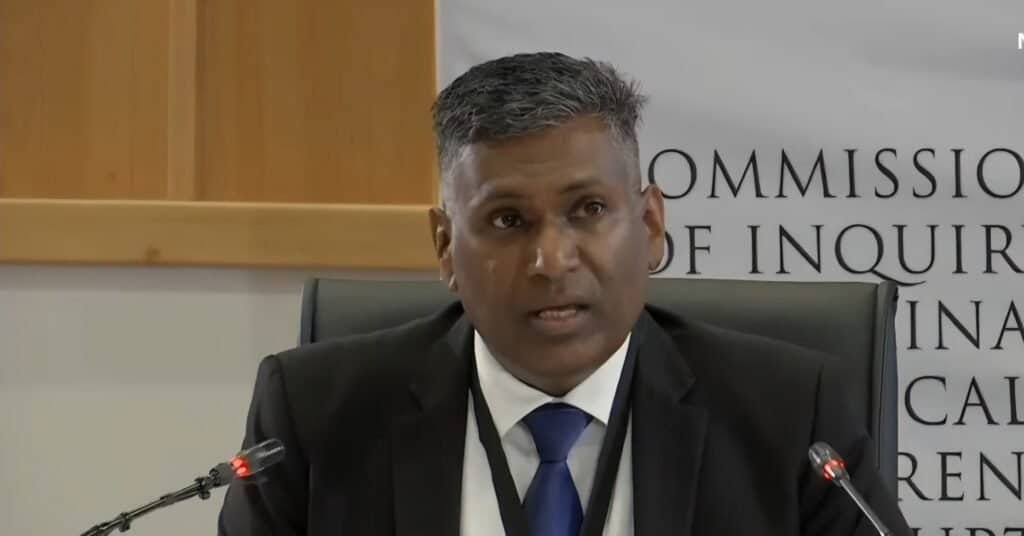
The Judicial Commission of Inquiry chaired by Justice Mbuyiseli Madlanga opened its 2026 public hearings with explosive testimony that laid bare alleged political meddling, abuse of power and deep rot within the criminal justice system — particularly around KwaZulu-Natal’s long history of political killings.
From the outset, Monday’s proceedings at the Brigitte Mabandla Justice College in Pretoria set a combative tone, with senior police officials and a protected undercover operative painting a disturbing picture of interference at the highest levels of government. Central to the allegations was suspended police minister Senzo Mchunu, who stands accused by witnesses of pushing investigators, questioning sensitive probes and attempting to revive or redirect cases for political ends. Mchunu has denied all allegations and has indicated he will testify before the commission.
Major-General Anthony Gopaul, head of crime detection in KwaZulu-Natal, was one of the first witnesses to take the stand. He told the commission that Mchunu repeatedly questioned why politically linked murders were being handled by the now-disbanded Political Killings Task Team (PKTT), rather than by local police stations.
Gopaul testified that Mchunu specifically raised concerns about the February 2025 murder of ANC councillor Phendukani Mabhida in Mandeni. According to Gopaul, the minister phoned him directly to demand answers as to why the PKTT was investigating the matter. “He wanted to know why the case was not being dealt with at the police station where the murder took place,” Gopaul said.
He further alleged that Mchunu went beyond oversight and actively sought to influence investigations. He told the commission that the minister had visited a police station to enquire why no action had been taken against former ANC councillor and current MK Party figure Doeshie Govender and members of his family for alleged criminal activities.
This, Gopaul suggested, occurred against the backdrop of a hotly contested by-election in KwaDukuza, where the ANC feared losing ground to the MK Party. He testified that Mchunu was campaigning in the area at the time and appeared intent on “soiling” Govender and his family to weaken their electoral prospects.
According to Gopaul, Mchunu also pushed for the revival of old cases linked to Govender’s son and sought information that could be politically damaging ahead of the by-election. “There were clear instructions that all political killings should be investigated at local level, not by the PKTT,” Gopaul told the commission, describing this as a move that undermined specialised investigations.
Public reaction to the testimony was swift. South Africans took to social media platform X, with one user writing: “He wants police to investigate these cases because he knows 90% of them are corrupted.” Another said: “Minister Mchunu was abusing his power to destroy institutions and protect his friends.”
After a short adjournment, proceedings took an even darker turn with testimony from an undercover Crime Intelligence operative, identified only as Witness E.

Under heavy protection, Witness E told the commission that rogue elements within SAPS Crime Intelligence were directly involved in the 2017 assassination of former ANC Youth League secretary-general Sindiso Magaqa. He testified that as early as July 2017, he uncovered a plot to kill Magaqa and reported it to his superiors, warning that the conspirators were sourcing a vehicle and an AK-47 rifle.
“No action was taken,” Witness E said. Two weeks later, Magaqa was shot in a targeted attack in uMzimkhulu. He succumbed to his injuries.
The witness alleged that Crime Intelligence officials supplied both the firearm and the vehicle used in the assassination and assisted the perpetrators. He further claimed that when he briefed Mchunu in 2024, he named SAPS members directly linked to the murder. He denied, however, that current Crime Intelligence head Lieutenant-General Dumisani Khumalo or former police minister Bheki Cele were involved.
Witness E also accused Mchunu of embarking on what he described as a “fishing expedition” to find damaging information about senior police figures. He told the commission that Mchunu once asked him whether Khumalo, or even Cele, had been involved in Magaqa’s killing — allegations Witness E said he firmly rejected.
Justice Madlanga questioned Witness E on why he reported the assassination plot to superiors who may themselves have been complicit. The witness maintained that he acted in good faith and genuinely believed he could prevent the killing.
Magaqa, a vocal anti-corruption advocate, was widely respected for challenging tender irregularities and political patronage. His murder became a symbol of KwaZulu-Natal’s violent political underworld — one of more than 200 cases the commission is now scrutinising.
As the hearings continue this week, the Madlanga Commission is expected to hear from additional witnesses and further interrogate the disbandment of the PKTT — a move many believe crippled efforts to stem political violence. What is already clear is that the first day of 2026 has left the commission, and the country, grappling with allegations that strike at the heart of state power and accountability.