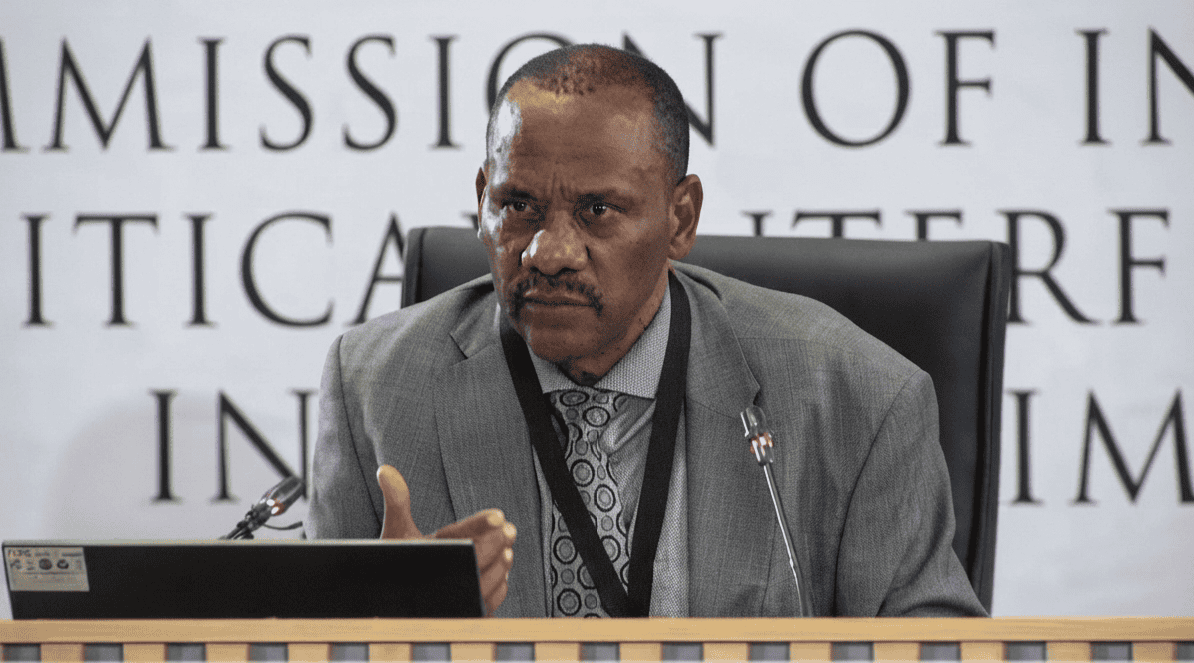
Former Hawks head General Godfrey Lebeya came under intense questioning at the Madlanga Commission on Wednesday over his reliance on alleged police informant Malcolm X and his handling of the investigation into the theft of drugs worth an estimated R200 million from Hawks offices in Port Shepstone.
Lebeya returned to the commission to conclude his testimony, with questions focusing on decisions he made while heading the Directorate for Priority Crime Investigation, commonly known as the Hawks.
A key issue was his relationship with Malcolm X, whom Lebeya described as a police informant.
This contradicts Malcolm X’s previous denial that he was an informant.
Lebeya nevertheless stood by his version, telling the commission that he regarded Malcolm X as a source of intelligence.
The commission questioned Lebeya’s decision to act on information supplied by Malcolm X during the events surrounding the Katiso Molefe takedown operation on 6 December 2024.
Lebeya said Malcolm X called him and reported that people were at an address in Sandton claiming to be Hawks officials acting on his instructions.
According to Lebeya, Malcolm X said he had received information about the operation from a friend but did not identify the person.
Lebeya said the call raised suspicions that the people at the address could be imposters.
He contacted the Gauteng Hawks head and established that no operation had been authorised for the address that day.
However, Lebeya conceded that he did not contact the provincial commissioner or the local police station to establish whether another police unit was conducting an operation.
Malcolm X later sent Lebeya the address of Katiso Molefe.
Lebeya said they spoke for about 27 seconds, but he could not remember exactly what was discussed. He believed he was confirming receipt of the address.
He also said he had never heard of Molefe before Malcolm X sent him his name.
When officers were sent to Molefe’s home, Lebeya said he did not give them Malcolm X’s cellphone number to assist them in verifying the identities of the people at the scene.
His reason was that Malcolm X was an informant.
The commission also questioned whether intelligence based on hearsay should have been acted upon.
Lebeya defended his decision, saying police could not simply disregard information because it was hearsay.
He said such information could instead be followed up and tested through preliminary investigations.
But the questioning also turned to the theft of drugs worth an estimated R200 million from Hawks offices in Port Shepstone in 2021.
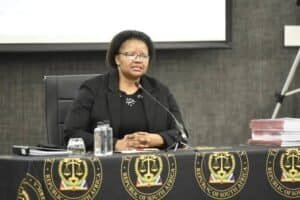
Advocate Seegels-Ncube challenged Lebeya over the investigation and whether enough attention had been given to General Senona, who was responsible for the keys.
“Surely you can put on your detective cap and think to yourself, that the custodian of the keys, must be a person of interest,” Seegels-Ncube told him.
Lebeya responded: “But the theft did not happen by way of a key.”
Seegels-Ncube pushed back, asking how Lebeya could know that the key had not been used.
“Surely in your illustrious career you’ve come across instances where scenes have been staged,” she said.
The exchange placed Lebeya’s investigative judgment under renewed scrutiny, with the commission probing whether obvious lines of inquiry had been properly pursued.
Lebeya also maintained that he had played no role in placing Karl Sander on temporary placement following an anonymous complaint.
He said he only became aware of Sander’s temporary placement when he received documents from the commission while preparing for his testimony.
Lebeya’s evidence is expected to remain under scrutiny as the commission examines the conduct of senior police officials, the use of informants and the handling of investigations involving alleged criminal networks within and around the police.