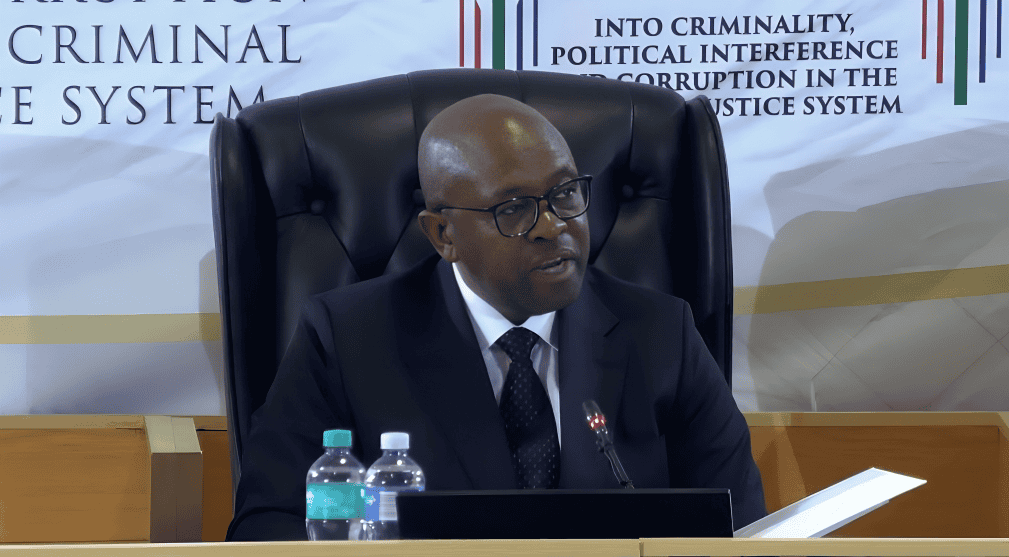
The Judicial Commission of Inquiry into Criminality, Political Interference, and Corruption in the Criminal Justice System, chaired by retired Constitutional Court Justice Mbuyiseli Madlanga, is facing mounting challenges following the resignation of its Chief Evidence Leader, Advocate Terry Motau SC, and the sudden illness of one of its key witnesses, Crime Intelligence boss Lieutenant General Dumisani Khumalo.
Justice and Constitutional Development Minister Mmamoloko Kubayi on Thursday moved to clarify recent remarks made by Advocate Motau regarding his decision to step down. In a strongly worded statement, the Minister dismissed suggestions that budgetary shortfalls influenced the functioning of the Commission.
“Budgetary matters relating to the Commission have been properly managed and communicated, and at no point were formal concerns about the budget raised with the Department,” Minister Kubayi said. She stressed that the Department had gone through due processes with National Treasury, securing R147.9 million for the 2025/26 financial year.
The allocation includes nearly R11 million for personnel, over R100 million for goods and services such as ICT infrastructure, consultants and legal services, and R36 million for capital assets. “The Commission continues to operate from the Brigitte Mabandla Justice College at no additional cost to the fiscus,” the Minister added, noting that certain security-related expenditures would only be disclosed in the Commission’s final report.
Kubayi further emphasised that Advocate Motau had himself been part of the process in determining the fee structure for evidence leaders. She called on him to “provide clarity to the public on the reasons for his decision to resign, rather than placing undue liability on the Department in so far as the budget is concerned.”
Motau explains his departure
Advocate Motau, who played a central role in shaping the Commission’s legal strategy since its inception, explained that his decision was not made lightly. Speaking publicly this week, he cited fears that financial uncertainties could compromise the integrity of the process.
“It became increasingly difficult for me to continue in an environment where there was no absolute certainty that adequate resources would be consistently available. For a Commission of this magnitude, that poses risks to credibility and effectiveness,” Motau said.
His departure is viewed as a significant blow to the inquiry, which is tasked with investigating systemic corruption and political interference across law enforcement and intelligence structures. Legal observers suggest that replacing Motau with someone of equal stature and institutional knowledge will be a difficult and time-consuming exercise.
Key witness taken ill
Further complicating proceedings, the Commission had to adjourn earlier this week after Lieutenant General Dumisani Khumalo, the suspended head of Crime Intelligence, fell ill shortly before resuming his testimony. Khumalo was expected to provide crucial evidence on networks of influence within law enforcement and alleged covert operations linked to senior politicians.
In a statement released by the South African Police Service (SAPS), National Commissioner General Fannie Masemola confirmed that Khumalo was receiving “the best medical care” and reassured the public of his recovery.
“The General felt unwell after arriving at the Brigitte Mabandla Justice College, where he was due to continue with his testimony. I can confirm that he is in good spirits and taking health advice from his physician,” Masemola said.
While no timeline has been given for Khumalo’s return to the witness stand, the Commission has indicated that his testimony will be prioritised once he is medically fit.
Commission under pressure
The twin setbacks of Motau’s resignation and Khumalo’s sudden illness have intensified scrutiny of the Madlanga Commission. Critics warn that delays could erode public confidence in the inquiry, while government insists that the process remains firmly on track.
Minister Kubayi reaffirmed her commitment to transparency and accountability, insisting that the Commission will be “adequately resourced to fulfil its important mandate.”
Despite the turbulence, the Commission is expected to continue hearing testimony from other witnesses in the coming weeks.
However, both the legal leadership vacuum and Khumalo’s absence have raised questions about whether the inquiry can maintain its momentum at a critical juncture.
For now, all eyes remain on how swiftly the Commission can stabilise its operations and reassert its authority in a political environment where its findings could have far-reaching consequences for South Africa’s criminal justice system.