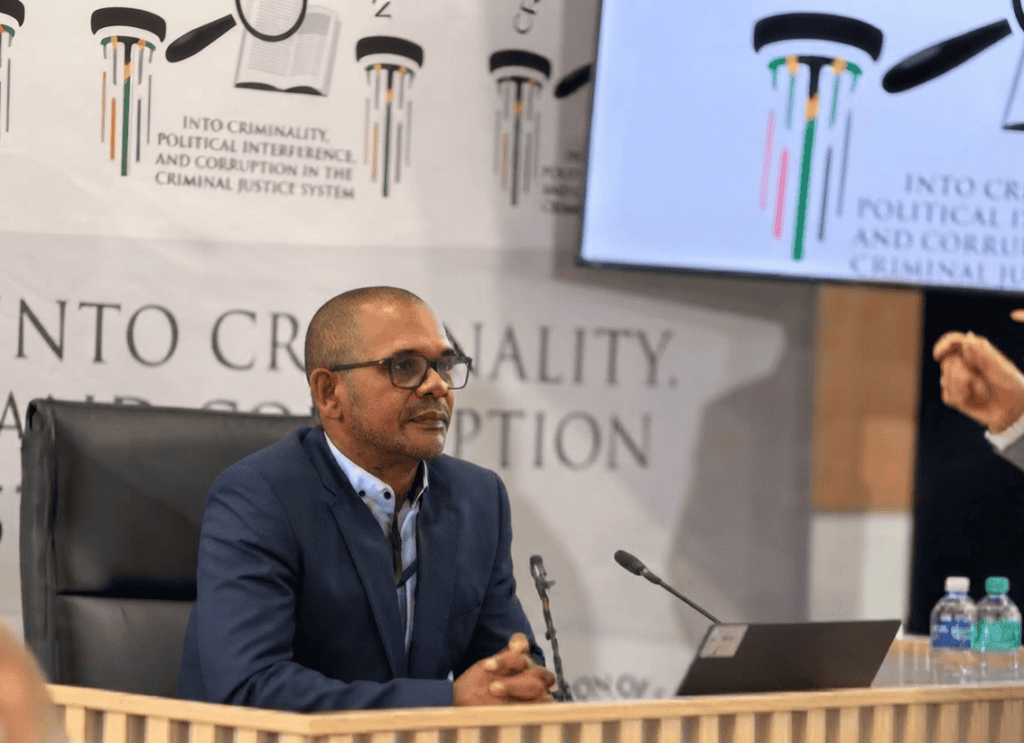
Suspended Member of Parliament and National Coloured Congress (NCC) leader Fadiel Adams will have to wait another week before giving evidence at the Madlanga Commission after the inquiry questioned his failure to submit his affidavit on time.
Adams appeared before the Commission on Tuesday morning, but evidence leader Advocate Matthew Chaskalson asked Chairperson Justice Mbuyiseli Madlanga to postpone his testimony to August 19.
The request followed the late submission of Adams’ sworn statement and supporting annexures, which were only received by the Commission’s evidence leaders after 9 pm on Monday.
The Commission had earlier warned that Adams was unlikely to testify on Tuesday because the evidence leaders needed time to study his statement and consult before questioning him.
The Commission’s spokesperson, Jeremy Michaels, said Adams was scheduled to appear under subpoena at 9.30 am, but the late delivery of his affidavit made it necessary to seek a postponement.
During Tuesday’s proceedings, Adams was questioned about his failure to comply with repeated requests to provide his statement.
Chaskalson told the Commission that the evidence leaders had been requesting Adams’ statement since October 25, 2025.
Adams blamed a faulty laptop for the delay, telling the Commission that the device freezes on a daily basis. He said this had affected his ability to receive and respond to official correspondence and that he only became aware of the Rule 3 notice sent to him in October last year about three months ago.
Justice Madlanga, however, appeared unconvinced by the explanation.
The chairperson questioned whether Adams also experienced difficulties receiving official communication from Parliament because of the alleged laptop problems.
Adams confirmed that he did.
Madlanga then questioned how Adams could effectively perform his duties as a Member of Parliament if his laptop was as unreliable as he claimed.
The chairperson also questioned whether Adams was taking the Commission seriously, saying his explanations for failing to respond to its requests were not believable.
Madlanga further raised concerns about Adams’ responsibilities as a public representative, suggesting that his conduct raised questions about whether he took the people he represented seriously.
Adams’ eventual testimony is expected to be closely watched because of his involvement in a series of allegations concerning Crime Intelligence and the Investigating Directorate Against Corruption (IDAC).
The Commission has previously heard that Adams’ complaints played a role in the investigation into senior Crime Intelligence officials, including Crime Intelligence head Lieutenant-General Dumisani Khumalo. IDAC investigator Brian Padayachee told the Commission in July that a fraud and corruption case against Khumalo arose from a complaint lodged by Adams.
The Commission also heard that IDAC had asked Adams to provide a Section 27 affidavit as part of the investigation. Former IDAC head Advocate Andrea Johnson later faced questions over the circumstances surrounding the affidavit and whether the directorate had acted within its mandate.
Adams has also faced scrutiny over his possession and disclosure of Crime Intelligence information. During previous proceedings, Johnson conceded that Adams should potentially face consequences for possessing Crime Intelligence documents, regardless of whether the material was classified.
His appearance is therefore expected to provide the Commission with his version of events surrounding the documents, his complaints against senior police officials and his interactions with IDAC.
Meanwhile, IDAC State Advocate Drushantha Ramsamy has returned to the witness stand, continuing her testimony before the Commission.
Ramsamy is being led by Advocates Lee Segeels-Ncube and Thabang Pooe.
She has been clarifying evidence relating to the conduct and operations of IDAC, including the actions of its former head, Johnson.
On Tuesday, Ramsamy presented an email showing that Johnson requested a meeting on January 16, 2025. The meeting eventually took place on January 22.
According to Ramsamy, discussions at that meeting included preparations concerning National Police Commissioner General Fannie Masemola ahead of his appearance before Parliament’s Portfolio Committee on Police.
Ramsamy’s evidence forms part of the Commission’s wider examination of allegations surrounding IDAC, senior police officials, political interference and the handling of sensitive investigations.
With Adams’ testimony now postponed until August 19, the Commission will continue with Ramsamy’s evidence as it examines the events and relationships at the centre of its investigation into alleged criminality, political interference and corruption in South Africa’s criminal justice system.