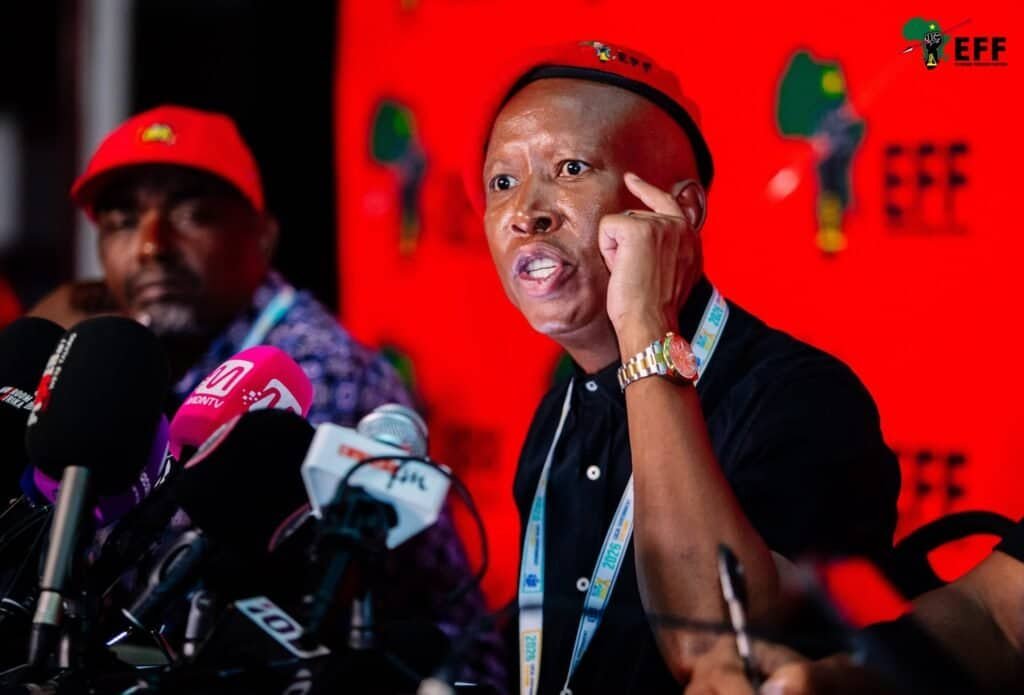
The Economic Freedom Fighters (EFF) president Julius Malema has warned residents of Soweto to brace themselves for what he described as a tough period under a Democratic Alliance (DA)-led Johannesburg administration, accusing the party of being unwilling to accommodate poor communities struggling to pay for municipal services.
Malema said residents who have historically struggled to pay for water and electricity could face increased financial pressure, warning that the DA would insist on payment for municipal services regardless of residents’ economic circumstances.
He was speaking to journalists at the IEC Results Operations Centre in Midrand on Saturday, following the November 4 local government elections, which have left more than 124 municipalities across the country with hung councils, including the City of Johannesburg.
Malema’s remarks came as he reflected on the political implications of the provisional election results and the growing influence of the DA in municipal politics, particularly in major metropolitan areas.
Taking aim at the DA’s approach to governance, Malema singled out Helen Zille, the DA’s Johannesburg mayoral candidate, who he said was likely to pursue a hardline position on municipal revenue collection, property valuations and service payments.
The red berets leader warned that residents of Soweto should not expect the same level of understanding from a DA-led administration when it comes to outstanding municipal accounts. The ANC was the leader of coalition government in the City of Johannesburg in the previous administration.
According to Malema, the DA’s position is that residents must pay for services they consume, irrespective of their financial circumstances.
“She says, hell no. As long as you use my services, you must pay irrespective of your poverty,” Malema said, suggesting that poor households could face service disconnections if they fail to settle their accounts.
He further argued that increases in property values could translate into higher municipal rates and taxes, placing additional pressure on homeowners.
Referring to Zille’s comments about property prices in Cape Town, Western Cape, Malema said the DA’s approach to urban development and municipal management could have serious financial consequences for ordinary residents.
He contrasted this with the EFF’s position, arguing that poverty and non-payment of municipal accounts in historically disadvantaged communities should be understood within the context of apartheid’s enduring economic inequalities.
Malema also accused the ANC of having politically legitimised the DA by entering into a coalition arrangement with the party after the 2024 national and provincial elections.
He argued that the ANC’s decision to work with the DA in the Government of National Unity (GNU) had weakened the traditional political resistance against the opposition party, making it easier for voters to consider supporting the DA in the 2026 local government elections.
“There is no DA that stole votes. Our people voted for DA. To say DA stole votes, you are lying,” he said.
According to Malema, voters were influenced by the ANC’s willingness to share power with the DA at national level, creating the impression that the two parties were no longer political enemies.
He said the EFF was now experiencing the consequences of that political arrangement, particularly as the DA gained support in communities that had previously been associated with the ANC and other liberation-aligned movements.
Despite the EFF’s electoral setbacks in certain areas, Malema rejected suggestions that the party had lost its relevance in South African politics.
He insisted that the party remained a significant national political force, pointing to its previous national election performance and its ability to influence the formation of municipal governments.
“We have a national footprint and it is actually an international footprint. And therefore, we cannot be destroyed by street committees, village ward committees. They can never destroy us,” he said.
Malema maintained that the 2026 local government elections should not be interpreted as a definitive measure of the EFF’s national political standing, arguing that national politics would ultimately be determined by the 2029 general elections.
He said the EFF had secured approximately 2.4 million votes in the 2024 national elections and was still a consequential player in the country’s political landscape.
The EFF leader also celebrated the emergence of hung municipalities, arguing that the results had weakened parties that previously exercised uncontested control over local governments.
He said the EFF had played a significant role in denying some of the country’s established political parties outright control of municipalities.
“When you say we have lost, what do you mean? We lost what? Those who lost are those who were running municipalities and today they have lost control of municipalities,” Malema said.
He added that the EFF was proud of having challenged what he described as the arrogance of political parties that had previously governed without depending on coalition partners.
Malema also appeared to send a warning to parties involved in coalition negotiations, saying the EFF would not hesitate to withdraw from negotiations if other parties adopted an arrogant attitude.
He suggested that the DA could benefit from such a situation, particularly in municipalities where no party had secured an outright majority.
“If the negotiations people still want to become arrogant, you know what we are going to do? We are going to fold our arms. And Helen will take this. She will take it and teach them a lesson,” he said.