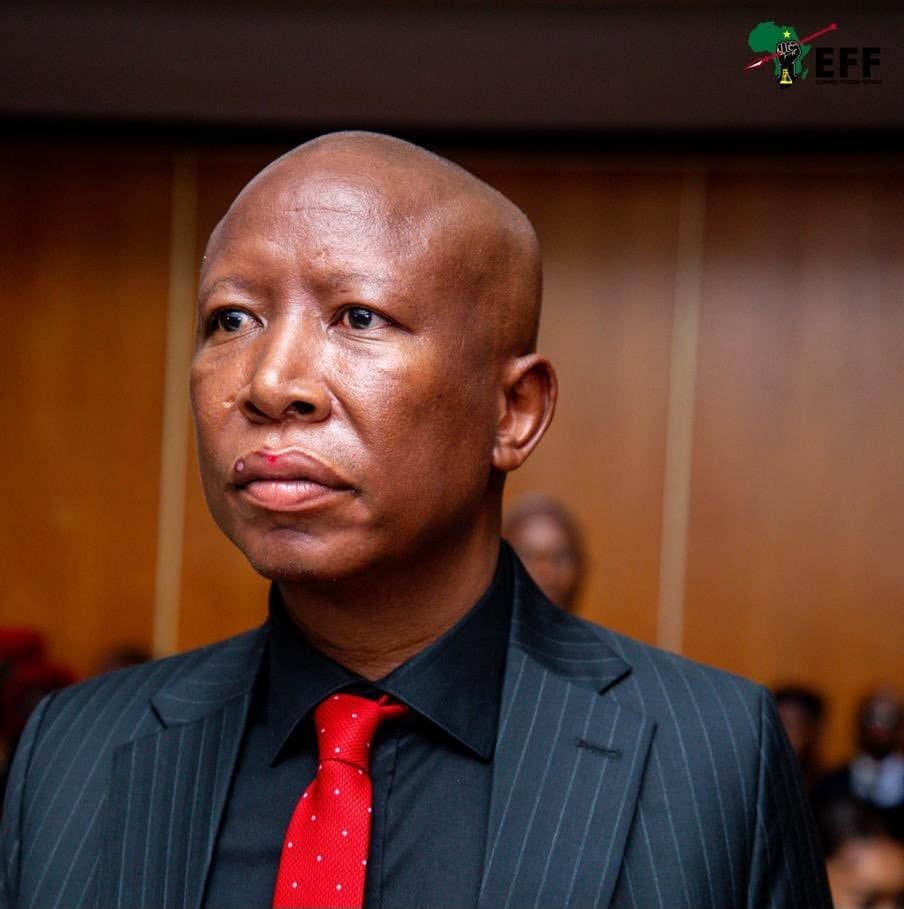
Economic Freedom Fighters (EFF) leader Julius Malema has been granted leave to appeal his five-year prison sentence by the East London Magistrates’ Court, offering temporary relief to his supporters after a tense day of legal proceedings and political drama.
The decision came shortly after a brief adjournment, when Magistrate Twanet Olivier returned to the bench to deliver her ruling on Malema’s application. While Olivier firmly stood by her original judgment to convict the EFF leader on multiple firearm-related charges, she ruled that there are sufficient grounds for a higher court to reconsider the severity of the sentence imposed.
Malema had earlier been sentenced to five years’ direct imprisonment for unlawful possession of a firearm. Additional penalties included two years imprisonment for unlawful possession of ammunition, as well as fines of R20 000 or six months imprisonment for each of the following offences: discharging a firearm in a built-up area, reckless endangerment of people or property, and failure to take reasonable precautions to avoid danger. All sentences were ordered to run concurrently.
The charges stem from a 2018 EFF rally in Mdantsane, where Malema discharged a firearm during what his legal team described as a celebratory moment. The court, however, found that his actions amounted to reckless conduct that endangered the public.
In her remarks, Olivier emphasised that the case was not politically motivated. “Please remember, it is not a political party who has been convicted here, it is not the Economic Freedom Fighters that have been convicted, it is a person, an individual who so happens to be the commander in chief of a political party, nothing more nothing less,” she said.
She further explained the rationale behind granting leave to appeal the sentence, stating that a trial court is obligated to reassess its decisions when challenged. “When confronted with appeal, the trial magistrate is duty bound to make an honest reassessment of his or her decision in light of the appeal,” she said.
Despite granting leave to appeal the sentence, Olivier dismissed Malema’s attempt to appeal his conviction, maintaining that the evidence presented during trial justified the guilty verdict. The State had strongly opposed the appeal, arguing that there were no reasonable prospects of success before another court.
Earlier in proceedings, prosecutors indicated that they welcomed the five-year imprisonment sentence, describing it as fair and appropriate given the seriousness of the offences. However, following the court’s latest ruling, the State confirmed that it would not oppose Malema’s appeal process and that existing bail conditions would remain in place pending the outcome.
The courtroom atmosphere grew increasingly tense after Olivier exited the bench. Members of the EFF leadership confronted representatives of AfriForum, the lobby group that initiated the private prosecution against Malema. Heated exchanges broke out, with shouting and verbal insults reported inside the court.
Outside, the mood shifted dramatically as news of the successful application for leave to appeal spread among hundreds of EFF supporters gathered at the courthouse. Many broke into struggle songs, interpreting the development as a victory despite the standing conviction and sentence.
When Malema emerged from court alongside his wife and family, senior party leaders and close allies, the crowd erupted in cheers and chants. Supporters who had travelled from various provinces joined those in the Eastern Cape who had held overnight vigils in anticipation of the ruling.
In a statement released on Thursday, the Economic Freedom Fighters criticised the sentencing, describing it as disproportionate and politically driven. The party argued that the National Prosecuting Authority had shown an unusual eagerness to secure imprisonment in a case where no injuries were reported, while often struggling to achieve convictions in violent crimes.
Malema’s defence team, led by advocate Tembeka Ngcukaitobi, had argued during sentencing that there was no intention to cause harm and that the firearm discharge occurred in a symbolic and celebratory context. They also raised concerns about procedural irregularities, including the handling of evidence related to Malema’s co-accused, who was later acquitted.
The EFF further framed the case within a broader political and historical context, claiming that the prosecution forms part of sustained efforts to silence dissenting voices and radical political leadership in South Africa.
As the legal battle now moves to a higher court, Malema remains free on bail, with the outcome of the appeal set to determine whether he will ultimately serve the prison sentence or secure a reduced penalty.