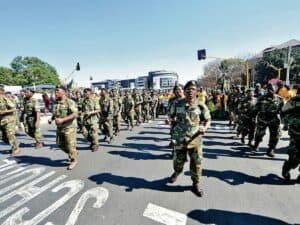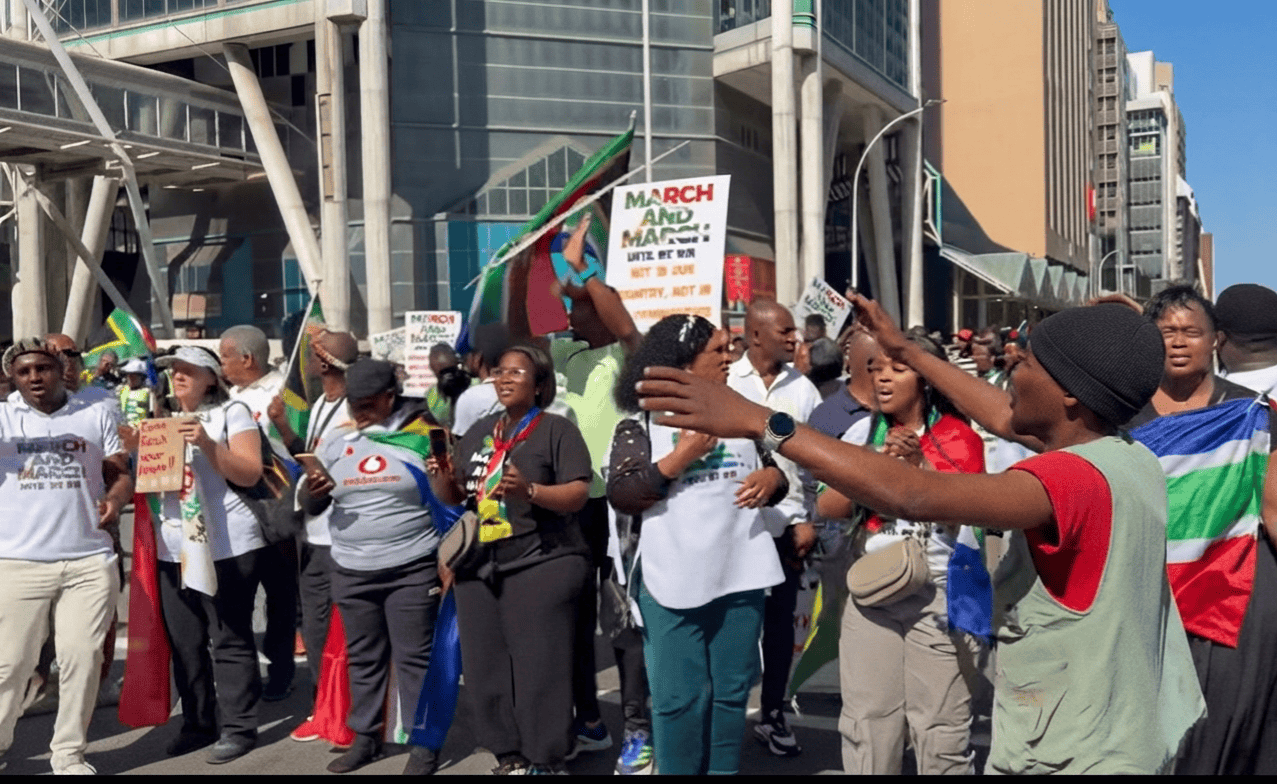
Hundreds of protesters gathered in Durban on Monday as the March and March Movement staged an anti-illegal immigration demonstration within close proximity of the 46th Southern African Development Community (SADC) Summit.
The protest took place near Durban City Hall, a few hundred metres from the venue where SADC heads of state and government were meeting at the International Convention Centre (ICC) for the regional summit.
Police and private security personnel maintained a strong presence around the protest as demonstrators gathered to voice their opposition to illegal immigration and call on SADC leaders to address what they described as the impact of undocumented migration on South Africa.
One of the prominent placards carried by protesters read: “Come fetch your people”, directed at the regional leaders attending the summit.
March and March activist Teresa Nortjie said the demonstration was intended to send a direct message to SADC leaders meeting in eThekwini.
The organisation has repeatedly staged protests against illegal immigration, calling for stronger border controls and action against people living and working in South Africa without the required documentation.
The protesters planned to submit a memorandum to SADC leaders, using the high-profile gathering to place migration at the centre of their demands.
The demonstration comes as President Cyril Ramaphosa officially opened the 46th Ordinary Summit of SADC Heads of State and Government in eThekwini.
In his opening address, Ramaphosa welcomed leaders from across the region and emphasised the importance of regional cooperation, integration and shared prosperity.
He said SADC, which consists of 16 member states and more than 400 million people, should work towards transforming borders into bridges and strengthening economic ties between member states.
“Regional integration must be seen and felt in the daily lives of our people,” Ramaphosa said.
He also called for stronger border management and the removal of barriers that prevent the movement of goods, services, capital and skills across the region.
Ramaphosa’s comments on regional integration came against the backdrop of the protest outside the summit venue, where March and March members were demanding that SADC countries take responsibility for their citizens who are in South Africa illegally.
The organisation’s demonstration highlights the tension between South Africa’s domestic concerns about undocumented migration and the broader regional integration agenda promoted by SADC.
Migration has remained a politically sensitive issue in South Africa, with concerns about undocumented migrants often linked to pressure on public services, employment, housing and crime.
However, claims linking migrants generally to crime remain contested, and government agencies have repeatedly stressed the need to distinguish between lawful migration and criminal activity.
The protest was conducted under the watch of law enforcement officers, with police deployed to monitor the gathering and maintain security around the summit.
The heavy security presence reflects the heightened security arrangements in Durban as the city hosts regional leaders, diplomats and senior government officials.
Ramaphosa used his opening address to underline the historic significance of Durban, noting that the city hosted the launch of the African Union 24 years ago.
He also marked the anniversary of the signing of the SADC Declaration and Treaty in Windhoek, Namibia, on 17 August 1992.
The President said the region’s history was rooted in solidarity against colonialism, minority rule and apartheid and argued that SADC’s current challenge was to give economic and social meaning to that political liberation.
He said the region needed to accelerate industrialisation, infrastructure development, energy and water security, food production and digital connectivity.
Ramaphosa also called for stronger cooperation on border management as part of efforts to make it easier for goods, services, capital and skills to move across the region.
For March and March protesters, however, regional integration cannot come at the expense of South Africa’s ability to manage its borders and enforce its immigration laws.
Their presence near the summit venue ensured that the issue of illegal immigration was visible as SADC leaders began discussions on deeper regional integration and cooperation.
The movement’s message to the regional leaders was clear: countries must take responsibility for their citizens and South Africa must be allowed to enforce its immigration laws.
As the summit continues, migration, border management, regional economic integration and security are expected to remain among issues requiring cooperation between SADC member states.
The protest also placed domestic political pressure on South Africa’s government at a time when it is seeking deeper regional economic cooperation while facing growing public concern about undocumented migration.
For March and March, bringing the protest to the doorstep of the SADC summit was an attempt to ensure that the concerns of South Africans about illegal immigration could not be ignored by the leaders gathered in Durban.