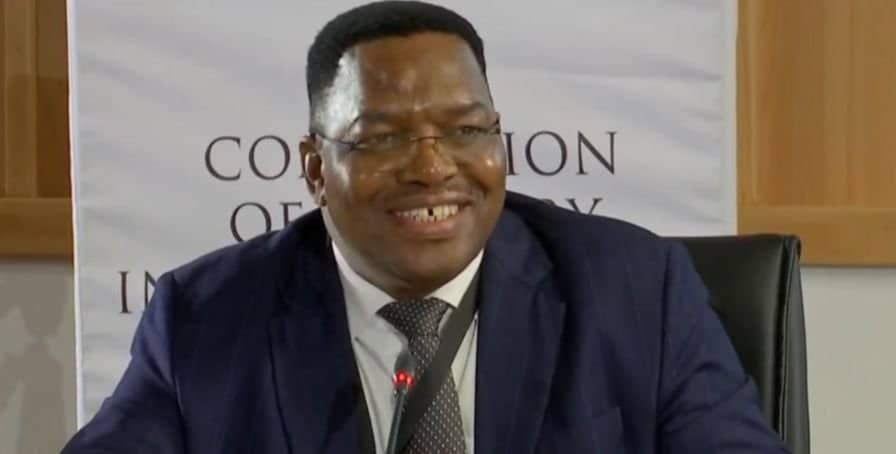
At its resumed sitting at the Brigitte Mabandla Justice College, the Madlanga Commission has heard probing testimony from National Police Commissioner General Fannie Masemola, particularly concerning the Political Killings Task Team (PKTT), operational authority, and high-profile cases linked to the University of Fort Hare.
Appointed by President Cyril Ramaphosa in August 2025, the Commission’s mandate is to investigate allegations of criminality, political interference, and corruption involving senior police and political figures.
General Masemola told the Commission that the PKTT was deliberately designed with a clear command structure to ensure both accountability and effectiveness. He explained that “the operational command of the PKTT was structured to ensure clear lines of authority and effective coordination of activities.
This was achieved by organising the command through tactical joint operation centres commanders and the respective zone or unit leads, these leaders were responsible for managing operations within their designated areas and ensuring that actions were aligned with the overall objective of the PKTT.” Oversight, he said, was provided by a National Steering Committee made up of senior officials from key law enforcement agencies. That committee “convened regularly to assess progress, address challenges and ensure that the team’s effort remain focused on its defined mandate,” Masemola stated.
One of the core tensions Masemola laid bare was his disagreement with suspended Minister of Police Senzo Mchunu, who in December 2024 issued a directive to disband the PKTT. Masemola described this order as “a total encroachment” into his constitutional mandate. He argued that setting policing priorities lies with the Minister, but deploying resources, staffing, and managing operations falls under the National Commissioner. “To go as far as saying ‘disband now, not even tomorrow’ — that’s direct interference,” Masemola told the Commission.
Among the cases highlighted was the murder of Fort Hare University bodyguard Mboneli Vesele. Vesele was shot dead in January 2023 while in a vehicle outside the residence of Fort Hare Vice-Chancellor Prof. Sakhele Buhlungu in Alice, Eastern Cape.
Investigations revealed that 13 people connected with the institution, including the Vice Chancellor, were allegedly on a hit-list. Some were killed, others wounded, and some survived.
To date, 12 suspects have been arrested in relation to the Fort Hare murders and attempted murders. Among them are former University employees and alleged hitmen.
Two more suspects — Bafana Chiliza and Nkosiyazi “Dipopoz” Maphumulo — were arrested in Zakkariya Park, Johannesburg, on 21 June 2025. The third outstanding suspect in the group, Siphiwo “Spijojo” Jejane, remains at large.
Masemola emphasized that many of these cases are still in court. Although arrests have been made, convictions have not yet followed in many instances. He pointed out that the PKTT only took over a number of these dockets in 2024, which means that rapid finalization is not realistic. “It doesn’t mean that because they have made a lot of arrests, but the cases will still be at court and not finalized … the trial of this type of cases take long …” Masemola told Justice Madlanga.
The University of Fort Hare, located in the Eastern Cape, is one of South Africa’s historic institutions of higher learning. Established in 1916, it has been an important site in the struggle for racial equality and education under apartheid; many prominent African leaders studied there. It remains a key university for both research and teaching in multiple fields, including social sciences, humanities, and education.
Its Vice-Chancellor, Prof. Sakhele Buhlungu, has been central in this recent case because of his role and the threat to the institution’s leadership and staff. The murder of his bodyguard and others linked to the murder plot exposed serious concerns over law enforcement, corruption, and political interference in areas beyond just policing.
Among the pressing questions for the Madlanga Commission are: When will the remaining suspects, particularly those still at large, appear in court? What is the evidence regarding political or judicial interference in both the Fort Hare and other PKTT-related dockets? How will the Commission’s findings ensure that operational authority is respected, and ministers do not overstep mandates?
Justice Madlanga also asked Masemola hypothetically whether he would obey a ministerial instruction that he believed to be outside the minister’s functions. Masemola replied that he would require explanation. If it were acceptable, he might comply; otherwise, he would refuse. This underlines the tension between political oversight and police operational independence.
The Madlanga Commission is now examining fundamental issues of state power: the separation of political oversight versus operational command in law enforcement; the slow pace of investigations and prosecutions in high-profile murders; and the degree to which politics have infiltrated criminal justice processes.
The Fort Hare University murders stand as a tragic example, and Masemola has made clear that while arrests have been made, much work remains in courts, and institutional reform to guard against interference will likely be among the Commission’s recommendations.