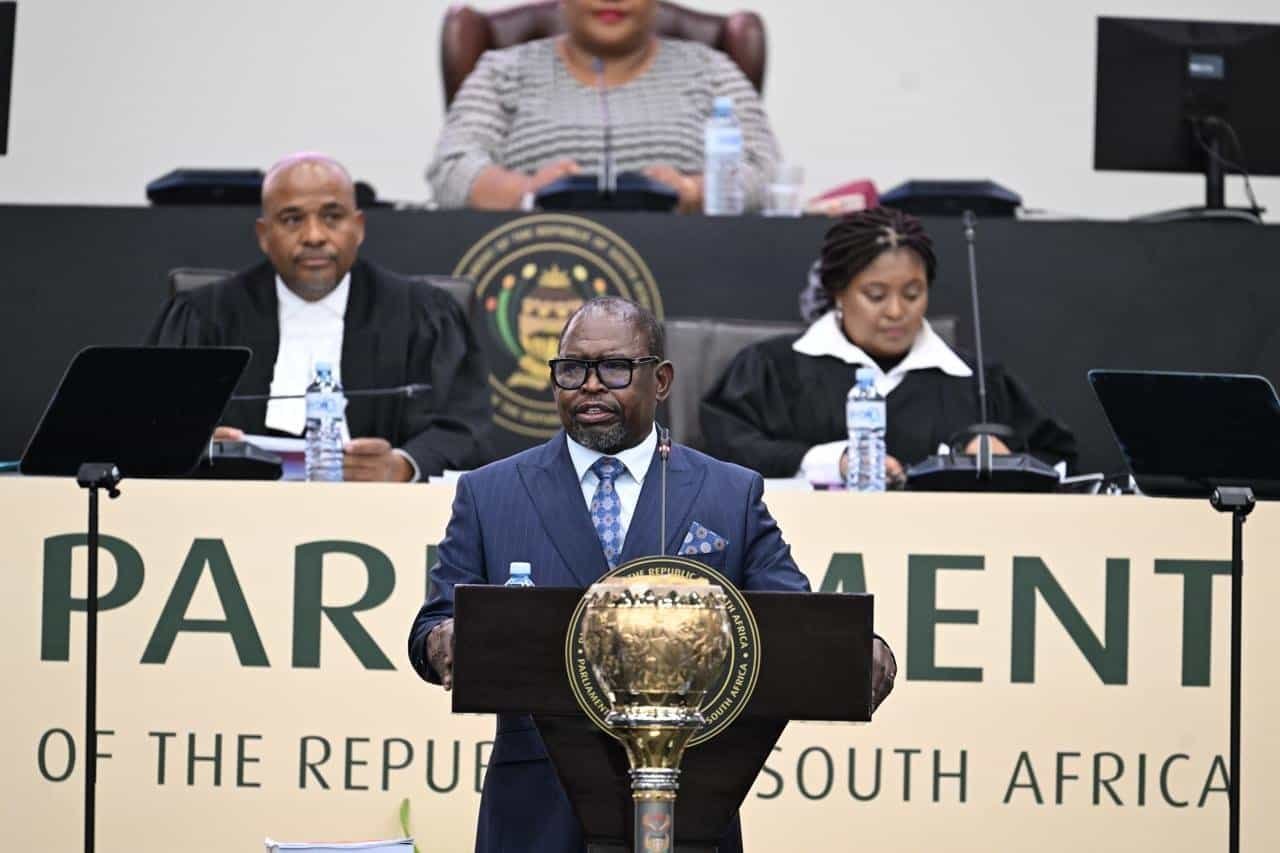
Finance Minister Enoch Godongwana has struck a cautiously optimistic tone in the 2026 Budget Speech, announcing a narrower budget deficit, no major tax hikes for individuals, and increased spending on social services, security and infrastructure.
Delivering the budget on Wednesday, Godongwana said the country’s consolidated budget deficit has improved to 4.5% of GDP, down from the 4.8% projected in 2025, signalling gradual fiscal consolidation despite ongoing economic pressures.
The improved fiscal position has allowed the government to withdraw a previously proposed R20 billion in tax increases that had been provisionally included in the 2025 Budget.
“Over the past three years, our tax system has demonstrated resilience despite slow economic growth,” Godongwana told Parliament.
Gross tax revenue for the 2025/26 financial year has been revised upward by R21.3 billion, driven by stronger-than-expected collections from VAT, corporate income tax and dividends tax.
Tax relief for individuals
In a move expected to bring relief to millions of South Africans, the minister announced adjustments to personal income tax brackets and rebates to account for inflation.
This effectively avoids a “bracket creep” scenario, where taxpayers pay more tax simply due to inflation, marking a shift after two consecutive years without such adjustments.
The decision not to increase personal income tax, combined with the withdrawal of the proposed R20 billion tax hike, is likely to be welcomed by households already under pressure from the rising cost of living.
However, Godongwana cautioned that some tax increases remain unavoidable.
Excise duties on tobacco and alcohol will rise in line with inflation. This includes increases in cigarette taxes, alcohol duties and fuel levies, which will see modest increases at the pump for both petrol and diesel.
Massive spending programme
Government spending is set to reach R2.67 trillion in the 2026/27 financial year, reflecting continued investment in social services and economic support.
A key feature of the budget is the continued prioritisation of the “social wage,” which accounts for more than 60% of non-interest spending over the medium term.
This includes funding for education, healthcare and social protection, which together make up over 70% of the social wage.
Social grants remain a central pillar of this support, with R292.8 billion allocated for 2026/27.
Several grant increases were announced:
• Old age, disability and care dependency grants will increase by R80 to R2,400
• The war veterans grant will rise to R2,420
• Foster care grants will increase to R1,300 by October
• Child support grants will rise by R20 to R580
The Social Relief of Distress (SRD) grant will also continue in its current form.
These measures will support approximately 26.5 million beneficiaries, while government services will reach 84% of the population through public healthcare and 13.6 million learners through the education system.
Education and health take centre stage
Education remains the largest area of spending, accounting for 23.7% of consolidated expenditure over the medium term.
Early childhood development (ECD) is a major beneficiary, with an additional R12.8 billion allocated over three years to expand access to 300,000 more children.
The National School Nutrition Programme will also continue to feed nearly 10 million learners, with allocations adjusted to keep pace with food inflation.
In the health sector, R26 billion has been earmarked to support HIV/AIDS programmes, including prevention of mother-to-child transmission and the provision of antiretroviral treatment.
An additional R21.3 billion will be used to address staffing shortages and fund essential services.
Godongwana acknowledged the funding gap created by the withdrawal of US support through PEPFAR, saying provinces will need to reprioritise resources to sustain critical programmes.
Crime and security boost
In line with priorities announced by Cyril Ramaphosa during the State of the Nation Address, the budget includes increased funding for peace and security.
Spending in this category will rise from R268.2 billion in 2025/26 to R291.2 billion by 2028/29.
This includes additional allocations to support the deployment of the South African National Defence Force alongside police to combat illegal mining and gangsterism.
The budget provides:
• R2.7 billion to strengthen defence operations
• R1 billion to the police service
• R1 billion to the SANDF through the Criminal Assets Recovery Account
The Border Management Authority will receive nearly R1 billion to expand its workforce and improve border security.
In a move aimed at strengthening institutional independence, R883.8 million has been shifted to the Office of the Chief Justice, allowing it to manage its own budget from April.
Infrastructure and special allocations
The budget also includes a special appropriation bill allocating R8.5 billion from the contingency reserve.
Key allocations include:
• R5.8 billion for PRASA’s rolling stock renewal programme
• R1 billion for South Africa’s subscription to the International Finance Corporation
• R700 million for digital communications
These investments are aimed at boosting infrastructure development and supporting economic recovery.
Struggles at local government level
Despite increased allocations, the government acknowledged ongoing challenges at municipal level.
Local government will receive R182.3 billion, including R86.9 billion to provide free basic services to 11.2 million households.
However, Godongwana painted a stark picture of dysfunction in the sector, noting that 63% of municipalities are in financial distress and audit outcomes remain poor.
“Local government is the sphere where communities experience the state most directly, yet many municipalities are unable to deliver services as they should,” he said.
National Treasury is working on reforms to improve financial planning, strengthen oversight and modernise the local government fiscal framework.
Balancing act amid pressure
The 2026 Budget reflects a careful balancing act between fiscal discipline and social support, as the government attempts to stabilise public finances while addressing deep socio-economic challenges.
While the narrowing deficit and improved revenue outlook signal progress, the minister acknowledged that risks remain, including slow economic growth, infrastructure backlogs and pressure on public services.
For millions of South Africans, the combination of tax relief, increased social grants and continued public spending offers some reprieve.
But with municipalities under strain and structural challenges persisting, the success of the budget will ultimately depend on implementation—and whether government can translate spending into meaningful improvements in people’s daily lives.