
The leader of the republic shared Mozambique’s plans to boost the economy and strengthen cooperation with BRICS countries in an exclusive interview with TV BRICS CEO and Editor-in-Chief Janna Tolstikova
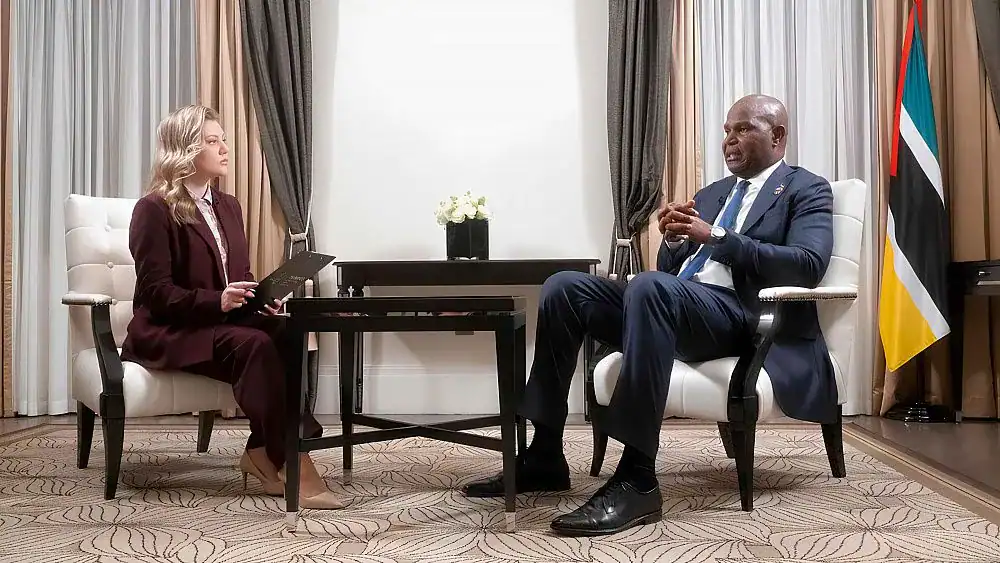
In 2025, Mozambique and Russia marked the 50th anniversary of their diplomatic relations. There are many platforms and formats devoted to fostering dialogue between Russia and African countries. One of them is the Russia–Africa Summit. How important is this summit in your view?
It is very important. As you rightly noted at the beginning of your question, in 2025 Russia and Mozambique marked 50 years of diplomatic relations. But it should be emphasised that these diplomatic relations did not begin on 25 June 1975. They began much earlier.
Russia is a country that greatly helped us in our struggle for national liberation, and when we achieved independence, as you can see, on the very day we proclaimed independence, 25 June 1975, we established diplomatic relations with Russia as an independent country. So, as you correctly noted in your question, last year, in 2025, we marked 50 years.
And this summit is very important to us, extremely important, because we believe that political and diplomatic relations between Russia and Mozambique are excellent, but now we need to turn our attention to trade and economic relations. That is why we came here: to consolidate the excellent relationship we have with Russia while focusing on trade and economic ties and investment in Mozambique.
And we believe that, at this stage, we need to work on this so that we can truly open a new chapter and further strengthen our trade and economic relations with Russia within South–South cooperation.
How would you assess Mozambique’s relations with the countries of the Global South and its cooperation within BRICS today?
At present, we consider relations with other countries of South–South cooperation, especially BRICS, extremely important. We have excellent relations with Brazil, Russia, India, China, and South Africa.
That is why we came here to Russia for the Russia–Africa Summit, but we are also doing excellent work with the other BRICS countries and within South–South cooperation, because our economy is currently heavily concentrated in the extractive industries and the gas sector.
And we want to broaden or diversify our economy. That is why we are focusing on trade and economic relations, because we want investment in agriculture, infrastructure, transport, logistics, energy, as well as the blue economy, digitalisation, artificial intelligence and technology as a whole. We are also focusing on human capital development. Russia and the other BRICS countries play a very important role because they offer scholarships to Mozambican students.
We have many Mozambican students in Russia and in other BRICS countries, and for us, human resources and human capital are extremely important for our economy and for trade relations between our countries.
Previously, you emphasised the importance of science for Mozambique, calling on universities to move beyond simply transmitting knowledge and focus on developing practical solutions. A Strategic Plan for Higher Education for 2026–2035 is being prepared with this goal in mind. Which BRICS countries and other African countries are currently Mozambique’s most effective partners in scientific and academic cooperation, and in which fields?
Yes, as I said, developing human capital is extremely important. We have a long-standing tradition with Russia because, immediately after our independence, and this is important to mention, we had many Russian teachers in Mozambique, particularly in the exact sciences – mathematics, physics and chemistry – who taught in schools, secondary schools and even universities.
We continue to maintain this relationship by sending students to Russia. But to address your question directly, from a strategic perspective, we also continue to send students to other countries, particularly BRICS members. At the level of our continent, we also believe that we have strategic relations, especially with Algeria.
Algeria is one of the countries to which we send many students for training in various fields. Another extremely important aspect is that we know many African countries also send their students to Russia. This is very important because it is impossible to develop a country without human capital. Human capital plays an extremely important role, especially today, when we are talking about digital transformation, technological development and artificial intelligence. This is a time when we need to invest heavily in human capital, and we in Mozambique, within this strategy, believe that Russia plays an extremely important role, as do the BRICS countries. We also have excellent relations with African countries.
Mozambique has offered visa-free entry to citizens of 29 countries since 2023. Which new tourism markets, including those in Asia and the BRICS countries, would Mozambique like to develop over the coming years?
We are currently doing excellent work in Mozambique. For example, this year we are holding an international tourism conference in Mozambique, which plays an extremely important role in the development of our country. Tourism is one of the areas in which we are investing.
And just yesterday President Putin spoke about this, noting that Russia is one of the countries from which many tourists travel to other parts of the world, particularly to Türkiye.
But Africa is a paradise. Our culture, identity and way of life are areas in which we need to invest significantly in our relations with Russia. We also believe that air connectivity is extremely important, and we are working on this and will need to continue working with African countries, and particularly with Mozambique.
As you know, Mozambique is a very beautiful country. It has around 2,700 kilometres of coastline, extraordinary islands, crystal-clear waters, an exceptional culture and outstanding cuisine.
That is why we believe that, with all of this properly developed and combined with the excellent and historic relationship we have with Russia, there is no doubt that we will increase the number of Russian tourists coming to Mozambique, as well as Mozambicans travelling to Russia.
Mozambique aims to consolidate its role as an energy hub for Southern Africa by exporting affordable and clean energy. Two flagship projects in this regard are the Cahora Bassa Hydroelectric Power Station and the proposed 1,500-megawatt Mphanda Nkuwa Hydropower Project. What is needed for green energy to become as important an export sector for Mozambique as natural gas? And which partners would be essential to achieving this goal?
This is a very important question. Our vision for Mozambique is indeed to become an energy hub in Southern Africa. And this is for a very simple reason. As you rightly said, we currently have our main hydroelectric power station, Cahora Bassa, which already exports electricity to countries in the region, including almost all of our neighbouring countries.
At present, before developing Mphanda Nkuwa, we are working to increase the capacity of HCB. We have a second phase, but we also have this new project you referred to, Mphanda Nkuwa, which is expected to produce around 1,500 megawatts. Mozambique also has hydroelectric power plants. This is clean energy, but we also have gas, which forms part of the energy transition.
Mozambique has large gas reserves, but before that, it is important to point out that Mozambique has already been exporting gas to neighbouring South Africa for more than 20 years. At present, we are building a power plant of around 450 megawatts in southern Mozambique, in Inhambane. A transmission line to Maputo, our capital, is already complete, and it will also allow us to export electricity to South Africa.
Our vision is that, with gas from Rovuma, we will increase the construction of more gas-fired power plants so that we can also export electricity to the region.
Another extremely important point is that, because of Mozambique’s geographical location, we also have great potential to generate electricity through solar panels and wind power. Wind energy is another opportunity in the region, particularly when we talk about clean energy. It is also important to note that Mozambique has large coal reserves and other resources that can be used to generate electricity.
We are carrying out exploration and research. As is known, there are many power plants around the world that generate electricity using uranium and other sources. So we are conducting exploration and research to determine whether we have such deposits. If we do, we can also develop other power plants and increase our electricity-generation capacity for the region.
And for this we need investment. That is why we came to Russia: precisely to find investors who can invest in our vision and in the resources we have. We have assets in Mozambique and a large market in the region. What we really need is investment so that we can realise this potential and become an energy hub in Southern Africa.
Mozambique has recorded growth in agricultural production in recent years, reaching 15.7 per cent in the 2024/2025 agricultural season compared with the previous season. Food security is now a global concern. How realistic is the prospect of Mozambique becoming a food supplier to the wider region?
Mozambique has the capacity not only to guarantee food security at the level of the Southern African Development Community (SADC) but also across the continent and the world.
Mozambique has around 36 million hectares of arable land. Just consider it: this is a vast area of land capable of producing all kinds of crops to supply the world. And of these 36 million hectares of arable land, Mozambique is currently using only around 15 per cent, which means that another 85 per cent remains to be developed. That is why we came to Russia – to promote this potential so that investment can be attracted to the agricultural sector.
What we want is mechanised agriculture. In particular, we have Gaza Province in the south, Manica Province and the entire Zambezi Valley in the central region, and Niassa in the north. We believe these should become the main food-production hubs, not only for Mozambique’s own food security, but also for the region, the continent and the world.
That is why we would like to use this interview to invite major farmers, major producers and major investors in agriculture, not only from Russia but also from BRICS countries, to invest in agriculture in Mozambique.
We are ready to provide all the necessary support. Another extremely important advantage Mozambique has is its geographical location. Mozambique has three main development corridors. We are talking about railways, roads and ports: a port in the south, a port in the centre and a port in the north. Production can take place along the Nacala Corridor, stretching from Niassa, Nampula and Cabo Delgado to Nacala; along the Beira Corridor, covering Manica and the entire Zambezi Valley; and in the south, from Gaza Province to Maputo, including Inhambane.
There is therefore logistics infrastructure for moving products and exporting them to the world because these development corridors are close to ports. And ports are the main logistics hubs for anyone producing in Mozambique on an industrial scale. Exporting to any part of the world is easy because there are roads, railways and nearby ports. Therefore, any production – whether cereals, fruit or any other product – can easily reach any market in the world from Mozambique.
This is extremely important. We have, for example, China, Russia, Brazil and India, which are major global markets and are home to a large share of the world’s population. Production can be carried out in Mozambique. Today, there is a great deal of discussion about organic products. In Mozambique, particularly in the Zambezi Valley, Gaza, Manica and Niassa, which are our main agricultural production areas, no fertiliser is needed for cultivation.
Therefore, organic products can be produced and supplied anywhere in the world, contributing to better health globally, without the need for fertiliser.
In 2025, Maputo National Park was designated a UNESCO World Heritage Site. A year earlier, Gorongosa National Park received an international award for ecosystem restoration. To what do you attribute Mozambique’s success in preserving the planet’s biodiversity?
This is a very important question. As I said earlier, in my personal opinion, modesty aside, Mozambique is one of the most beautiful and extraordinary countries in the world and one of the most natural. That is why, in the first part, I spoke about beach tourism – around 2,700 kilometres of coastline, wonderful islands and crystal-clear waters – but Mozambique also has inland tourism.
That is why we have the parks you mentioned, including Maputo National Park, which has been recognised as a World Heritage Site, as well as Gorongosa National Park, which is a global reference point. But these are not our only parks. Mozambique has around seven parks and conservation areas that are truly remarkable.
We have Bazaruto, Massingir, Zinave, Gorongosa, Maputo National Park, Niassa National Reserve and also Quirimbas in Cabo Delgado. Mozambique is therefore a paradise.
That is why we invite tourists to come and visit these wonders. This recognition by UNESCO and by the international community, both for Maputo National Park and Gorongosa National Park, reflects what these parks truly represent.
I will give you just one example from Maputo National Park and its conservation area. It is one of the few places in the world where, within the same park, a person can see the Big Five on land and, at the same time, observe the largest marine animals. So it truly is a paradise.
You have to see it to believe that it deserves the title of a World Heritage Site. Fortunately, in these conservation areas we are already beginning to attract some of the world’s major hotel and lodge operators.
For example, in Massingir, Gaza, the Aman group is already investing in a flagship lodge. In Bazaruto, construction is also due to begin through another group recognised regionally and internationally, Singita, on a major lodge.
Mozambique is already beginning to emerge with the construction and arrival of major international investment brands in tourism, and we believe this will be very important.
African Times published this article in partnership with International Media Network TV BRICS


