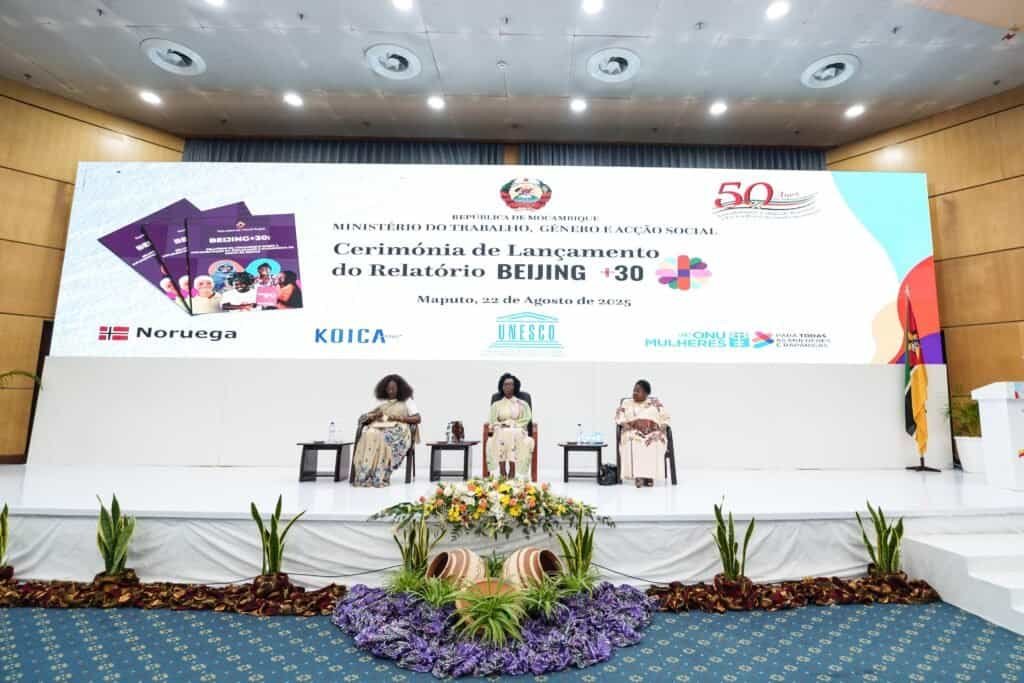
Mozambique has made “remarkable progress” in advancing gender equality and women’s empowerment, the Minister of Labour, Gender and Social Action, Ivete Alane, said Friday at the launch of the country’s Beijing+30 National Report and the commemoration of the 30th anniversary of the Beijing Declaration and Platform for Action.
Speaking at the ceremony, Alane praised the milestones achieved in the past three decades, noting that progress was the result of sustained commitments and partnerships involving government institutions, civil society, the private sector and international partners.
Gains in Education, Governance and Health
The minister highlighted notable achievements in education, with girls now representing 49.9% of total enrolment across all levels of schooling, signalling Mozambique’s steady move towards gender parity.
In governance, Mozambique has gained international recognition for reaching gender parity in the Council of Ministers in 2022, ranking third in the Southern African Development Community (SADC) and fifth in the African Union.
Health outcomes have also improved significantly, particularly in maternal care. Institutional births rose from 87% in 2019 to 93% in 2023, supported by expanded access to reproductive health services, family planning, and the establishment of maternity waiting homes.
Strengthening Legal Protections
Alane stressed the importance of legal reforms in tackling gender-based violence, citing the adoption of the Law on the Prevention and Combat of Premature Unions, revisions to inheritance law, and amendments to the penal code. These reforms, combined with the expansion of integrated support services for survivors, have strengthened women’s and girls’ protection from violence, harassment and abuse.
Economic empowerment has also been prioritised, with new programmes designed to stimulate women’s employment and entrepreneurship.
Acknowledging Progress – and Remaining Challenges
While celebrating these advances, Alane acknowledged that Mozambique still faces structural barriers, particularly in ensuring women’s access to basic services, decent employment and the eradication of gender-based violence and child marriage.
“These achievements fill us with pride, but also with responsibility,” she said. “Investing in women is investing in Mozambique’s future.”
She reaffirmed the government’s commitment to implementing policies and programmes that promote women’s empowerment, with particular focus on conflict-affected regions where vulnerabilities remain acute.
In her turn, Marie Laetitia Kayisire, representing the UN Resident Coordinator, hailed Mozambique’s leadership in integrating gender equality into public policies and legislative reforms. She stressed, however, that commitments must be matched with adequate financing, effective monitoring and active participation of women at all levels.
The Beijing+30 agenda sets six priority areas for action up to 2030:
- Digital Revolution – ensuring equal access to technology.
- Freedom from Poverty – strengthening social protection, education and care systems.
- Zero Violence – enforcing laws and services with zero tolerance for gender-based violence.
- Equal Decision-Making Power – guaranteeing women’s leadership representation.
- Peace and Security – recognising women’s vital role in peacebuilding.
- Climate Justice – placing women at the centre of ecological transition.
Over the next five years, Mozambique will identify two of these six priorities as national commitments, to be announced at the 80th UN General Assembly in New York in September 2025.
A Call to Action
Both the government and the United Nations stressed that the Beijing+30 celebration is not only a reflection on past achievements but also a call to accelerate action.
“The challenge is great, but our determination must be greater,” Alane said. “Only then can we build a fairer, more inclusive and more prosperous Mozambique, where women and men enjoy equal opportunities.”
As the world approaches the final stretch towards the 2030 Sustainable Development Goals, Mozambique positions itself as a regional leader determined to champion bold action, strong partnerships and transformative change for gender equality.