Indian Prime Minister addresses closed session of BRICS Summit in New Delhi
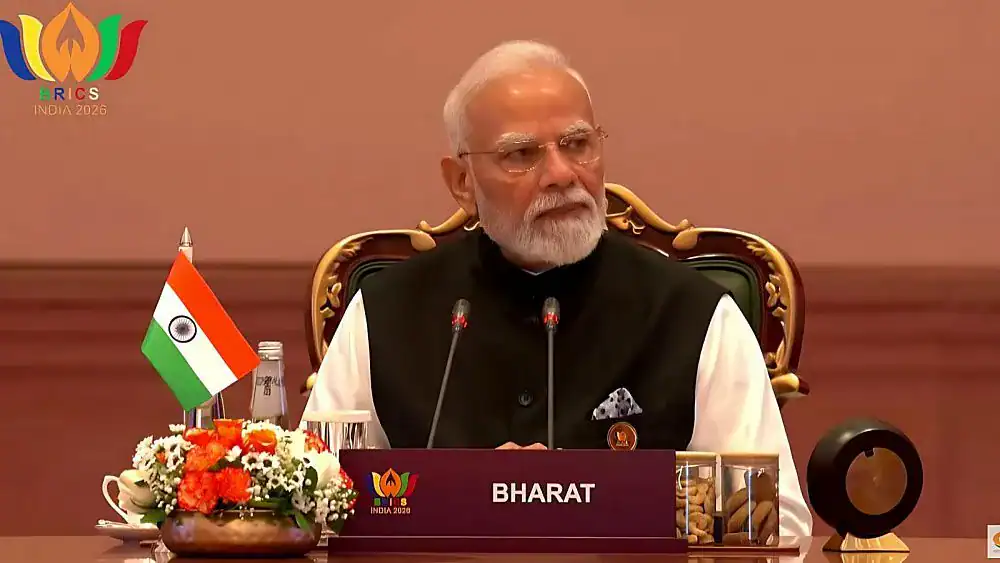
Prime Minister of India Narendra Modi addressed a closed session of the BRICS Summit for the group’s member countries, dedicated to inclusive global governance and strengthening multilateralism.
In his speech, Modi proposed creating a BRICS Continuity and Implementation Mechanism, which, through the “troika” format – the previous Chair, the current Chair and the incoming Chair – would ensure continuous work on all initiatives and meeting outcomes. He also proposed a secure digital repository in which the responsible party, deadlines and implementation status would be specified for each initiative.
“The current structure of global governance resembles a pyramid: power and decision-making are concentrated at the top, while the lower tiers consist of nations that are affected by these decisions yet unable to shape them. […] We must transform this pyramid into a platform for partnership, where every country’s voice is heard, every participant has a share of responsibility, and human development is at the centre of all our efforts,” Modi said.
The Indian Prime Minister noted that the current Summit was historic, as BRICS is marking the 20th anniversary of its establishment. According to him, over these years the group has strengthened its unique role on the global stage, respecting one another’s views and moving forward on the basis of consensus.
“To this end, I propose that we jointly develop 10 proposals for reforming global governance, which we could present at the next Summit as a BRICS reform roadmap. In preparing this roadmap, attention should be paid to three key areas: representation, responsiveness and rule-making,” he added.
The Indian Prime Minister also separately emphasised the need to reform the United Nations Security Council (UNSC), stating that negotiations on the issue should have clear timelines and concrete outcomes.
Among practical initiatives, Modi proposed establishing a Seafarers Emergency Support Network, which would bring together maritime administrations and diplomatic missions to provide assistance in emergencies.
Russian President Vladimir Putin noted that partnership within BRICS is consistently built on the principles of equality, good-neighbourliness and mutual respect for one another’s interests, which is why the group’s authority and influence in the world continue to grow. This was reported on the Kremlin website.
According to him, the global balance of power is shifting in favour of new centres of growth in the Global South and East. Putin pointed to the need to reform the International Monetary Fund (IMF), the World Bank and the World Trade Organisation (WTO), taking into account the emergence of new centres of influence. He also recalled Russian initiatives advanced during its BRICS Chairship – payment and settlement and depository infrastructure, a new investment platform and the BRICS Grain Exchange.
“Indeed, amid the emergence of a multipolar world order, it is more important than ever to work together to strengthen genuine multilateralism and involve a greater number of countries in global governance mechanisms and in the work of key international political and economic institutions. […] Entire breakthrough sectors have emerged, such as the platform economy, financial technologies and digital trade. All of them require their own separate institutions and regulatory rules, and our group could well play one of the leading roles in creating them,” Putin said.
President of China Xi Jinping continued the Russian leader’s point, stating that one of the main areas of BRICS work is the development of innovation and technological cooperation. In his view, the group’s countries play a leading role in shaping global rules in cyberspace, outer space and the deep sea. His speech was reported by Xinhua News Agency, a TV BRICS partner.
“First, we should be pioneers in advancing innovation-driven development. We must firmly keep the initiative in our own hands, strengthen cooperation in artificial intelligence, encourage open source and the exchange of experience, and take practical cooperation to a new level. We welcome the active participation of BRICS countries in the World Artificial Intelligence Cooperation Organisation,” the President said.
Egyptian President Abdel Fattah El-Sisi confirmed that BRICS is becoming particularly important as a group capable of playing a significant role in strengthening South-South cooperation. The Egyptian leader expressed appreciation to India for its efforts to translate the priorities of its Chairship into practical projects.
“We must continue to build on what has been achieved within BRICS and harness the potential of our countries by implementing concrete projects and programmes that support the Sustainable Development Goals, diversify sources of growth, increase productivity and reduce development and technology gaps. […] Egypt appreciates the efforts to reform the international financial architecture, develop innovative and accessible financing instruments, and strengthen the role of the New Development Bank,” El-Sisi said, according to MENA, a TV BRICS partner.
He reaffirmed the importance of expanding cooperation on climate change, facilitating developing countries’ access to climate finance, and supporting a fair and realistic approach to building a low-carbon economy.
The President also expressed Egypt’s aspiration to assume the BRICS Chairship in the near future, reaffirming the country’s commitment to continuing close and constructive work with member states in order to advance cooperation across all areas.
Iranian President Masoud Pezeshkian, speaking at the Summit, reaffirmed his country’s commitment to making an active contribution to the group’s joint projects aimed at supporting sustainable development, strengthening economic ties and expanding humanitarian cooperation. This was reported by Mehr News Agency, a TV BRICS partner.
The President outlined the principles of inclusive global governance: first, equal respect for the sovereignty of all states in the world; second, reform of global governance structures, including the UN Security Council and international financial institutions; and third, turning multilateralism into practical measures, such as trade in national currencies and independent payment mechanisms.
Pezeshkian noted that Iran is ready to work together with its BRICS partners to translate these principles into concrete mechanisms and initiatives aimed at supporting developing countries and strengthening their role in global processes.
More than 350 meetings were held during India’s Chairship, while teams from member countries had the opportunity to take part in events in around 30 Indian cities.
Following Modi’s speech, representatives of all BRICS countries will take the floor. At the end of the meeting, the leaders will adopt a declaration. The session is being held behind closed doors.
The Summit began today, 12 September, in New Delhi and will last two days, until 13 September.
African Times published this article in partnership with International Media Network TV BRICS