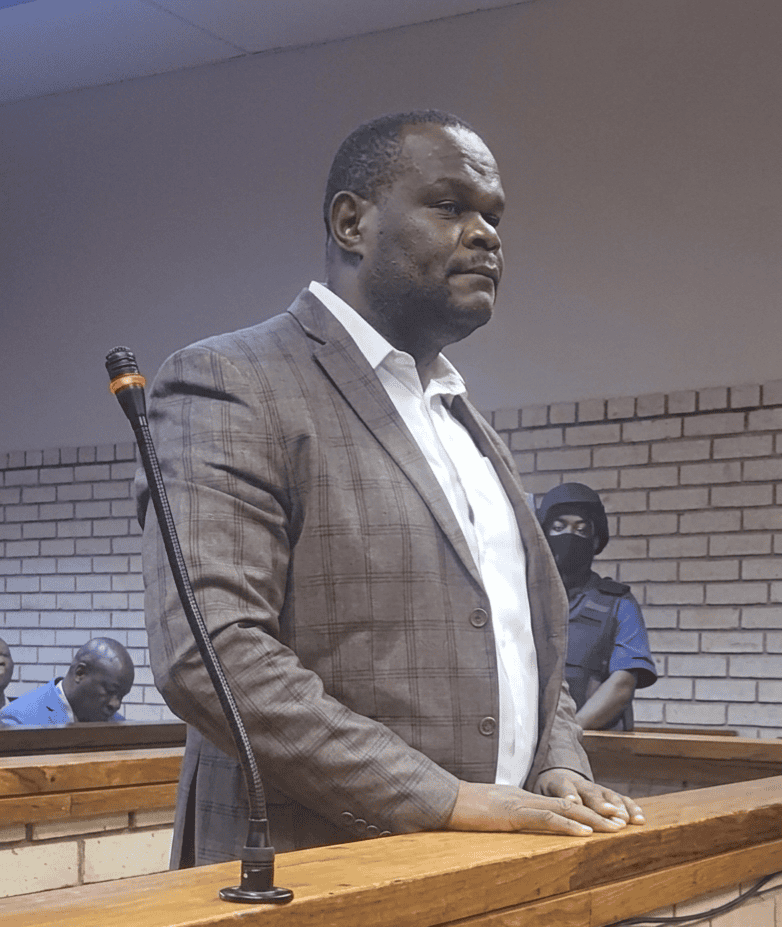
Suspended South African Police Service (SAPS) sergeant Fannie Nkosi has been denied bail by the Pretoria North Magistrate’s Court, with the court ruling that his release would not be in the interests of justice.
Delivering judgment on Wednesday, Magistrate Thandi Theledi concluded that Nkosi posed a significant risk to ongoing investigations and could potentially evade trial if granted bail. Nkosi, who remains in custody, faces a string of serious charges linked to alleged misconduct during his tenure in the Gauteng Organised Crime Unit.
“The interests of justice do not permit his release. Bail is denied,” Theledi said, bringing an end to Nkosi’s bid to secure his freedom while awaiting trial.
Nkosi was arrested on 2 April 2026 following a police raid at his home in Pretoria North. During the operation, authorities recovered a range of items, including unlicensed ammunition, a state-owned stun grenade, six closed case dockets, R50,000 in cash, and seven licensed firearms that were allegedly not properly secured.
The charges against him include unlawful possession of explosives, multiple counts of failing to safeguard firearms and ammunition, defeating the administration of justice, failure to comply with South African Bureau of Standards (SABS) requirements for firearm storage, and theft.
In her ruling, Theledi was highly critical of Nkosi’s explanations regarding the items found in his possession. She noted that his account lacked detail and was not supported by any corroborating evidence.
“His application is characterised by bare denials and unsubstantiated assertions. He has failed to provide satisfactory explanations for his possession of police equipment, dockets, and ammunition,” she said.
The magistrate further highlighted the seriousness of Nkosi being found in possession of official police dockets despite being suspended from duty. “Possession of dockets after suspension is a serious breach of trust,” she stated, adding that Nkosi’s explanation that he had obtained them lawfully was unconvincing.
The court also rejected Nkosi’s denial that he possessed a stun grenade, pointing to photographic evidence presented during proceedings. “He denies being in possession of a stun grenade despite photographic evidence,” Theledi noted.
Prosecutors argued that Nkosi had demonstrated a pattern of conduct suggesting he could evade justice, describing him as someone with alleged links to criminal networks. The State warned that if released, he could interfere with witnesses or tamper with ongoing investigations.
Theledi agreed with this assessment, stating: “There is a likelihood that if released, he will tamper with investigations and witnesses.” She added that Nkosi had failed to provide any assurances to the court that he would refrain from such conduct.
The magistrate also raised concerns about the broader implications of granting bail in the case, particularly given Nkosi’s role as a police officer. “Nkosi’s conduct is inconsistent with someone who is a police officer. If released, he could further undermine the criminal justice system,” she said.
She emphasised that the charges against Nkosi involve an alleged abuse of office and carry serious consequences for public trust. “The allegations against him involve serious charges and abuse of office. His release would undermine public confidence in the justice system,” Theledi ruled.
Nkosi’s defence had argued that there was no concrete evidence showing he would interfere with witnesses or investigations. His legal team proposed bail of R10,000, noting his monthly salary of approximately R16,500 and asserting that he remained a suitable candidate for release.
However, the court found these arguments insufficient, concluding that the risks outlined by the State outweighed the defence’s submissions.
Nkosi has pleaded not guilty to all charges. He recently came into the public spotlight after testifying as Witness F at the Madlanga Commission of Inquiry, where he made allegations related to policing and criminal networks.
The court’s decision means Nkosi will remain behind bars as the case proceeds. The matter has been postponed to 21 May 2026 for further investigation.
As the case unfolds, it is expected to draw continued attention, particularly given its implications for accountability within SAPS and the integrity of specialised police units tasked with combating organised crime.