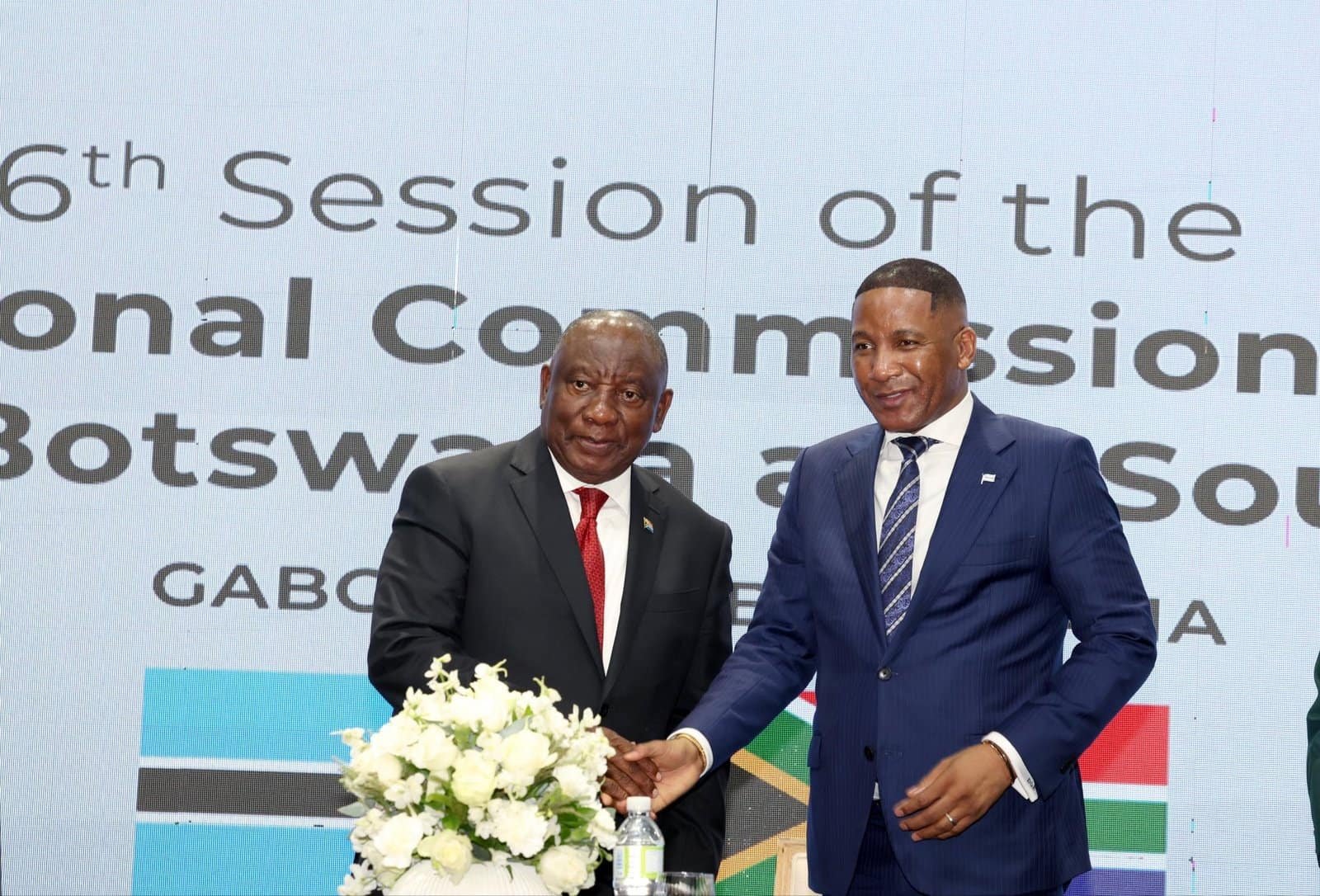
South African President Cyril Ramaphosa used the sixth session of the South Africa-Botswana Bi-National Commission in Gaborone to reaffirm the deep historical ties between the two neighbouring countries while laying out an ambitious agenda centred on trade, energy, infrastructure, migration and regional security.
Addressing Botswana President Duma Gideon Boko, ministers and senior officials on Thursday, Ramaphosa described Botswana as “home among our Brothers and Sisters”, invoking the long-standing solidarity between the two nations dating back to the anti-apartheid struggle.
The gathering took place against the backdrop of mourning in Botswana following the death of former president Festus Mogae, whom Ramaphosa praised as one of Botswana’s finest leaders. He said Mogae’s legacy should inspire both nations to deepen cooperation and strengthen regional unity.
Ramaphosa’s remarks carried a strong tone of gratitude towards Botswana for the role it played during apartheid, reminding delegates that Botswana gave refuge to South African freedom fighters and championed the liberation struggle internationally.
“We will never forget your acts of bravery, principle and support,” he said.
The South African leader also praised Botswana’s democratic credentials, describing the country as a beacon of stability on the continent and commending Boko’s administration for pursuing economic transformation through Botswana’s 12th National Development Plan.
At the heart of the discussions was a renewed push to expand bilateral trade and investment between the two economies. Ramaphosa acknowledged that trade between the countries remains uneven and said South Africa wants to import a wider range of products from Botswana.
He revealed that several South African companies are keen to expand investments in Botswana, particularly in sectors expected to generate employment, transfer skills, and boost state revenues.
Agriculture emerged as another key area of focus. Ramaphosa said South Africa wants to work closely with Botswana to strengthen food security and grow the agricultural sector. However, he also addressed tensions surrounding Botswana’s import restrictions on certain South African agricultural products.
In a notable development, Ramaphosa proposed that the two countries instruct their agriculture and trade ministers to formulate solutions to these disputes by December 2026.
The speech also underscored growing competition over Africa’s strategic minerals, which are increasingly in demand for electric vehicles, battery storage and digital technologies.
Ramaphosa argued that African countries should stop exporting raw minerals without adding value locally.
“As owners of these minerals, we should beneficiate these products ourselves, creating opportunities for our peoples,” he said, while praising Botswana’s diamond beneficiation efforts as an example of economic self-determination.
Energy cooperation featured prominently in the address, with Ramaphosa emphasising the need for closer collaboration on electricity generation, petroleum resources, coal and renewable energy investments.
He highlighted the proposed Mmamabula-Lephalale Rail Link Project as a strategic infrastructure priority capable of unlocking major economic opportunities for both countries. The project is expected to improve the movement of coal and other commodities between Botswana and South Africa while enhancing regional trade integration.
Water security also formed part of the bilateral agenda, with discussions expected around the proposed Lesotho-Botswana Water Transfer Project and the Ramotswa Transboundary Aquifer initiative.
Ramaphosa further welcomed Botswana’s plans to establish a One Stop Border Post at Tlokweng/Kopfontein, saying it would reduce congestion and facilitate smoother movement of people and goods.
But while advocating for greater regional integration, Ramaphosa also addressed the increasingly contentious issue of migration in South Africa.
Without directly naming recent incidents, he acknowledged growing tensions between local communities and foreign nationals, driven in part by economic hardship and high levels of undocumented migration.
Ramaphosa said South Africa had condemned citizens who took the law into their own hands and insisted that law enforcement agencies had been instructed to protect everyone living in the country while upholding the rule of law.
At the same time, he welcomed calls for a broader regional and continental discussion on migration, arguing that African nations must jointly address the root causes driving people across borders.
The South African president also turned attention to conflicts destabilising parts of the continent, including the ongoing violence in the eastern Democratic Republic of Congo, the civil war in Sudan and political instability in South Sudan.
He stressed the need to strengthen African-led peacekeeping mechanisms, warning that global instability and growing threats to multilateralism continue to undermine international peace and security.
With South Africa set to assume the chairmanship of the Southern African Development Community later this year, Ramaphosa said Pretoria would continue championing regional integration, peace and economic development.
As the commission continues, ministers from both countries are expected to table detailed reports outlining cooperation priorities and implementation strategies aimed at advancing one of southern Africa’s most significant bilateral relationships.