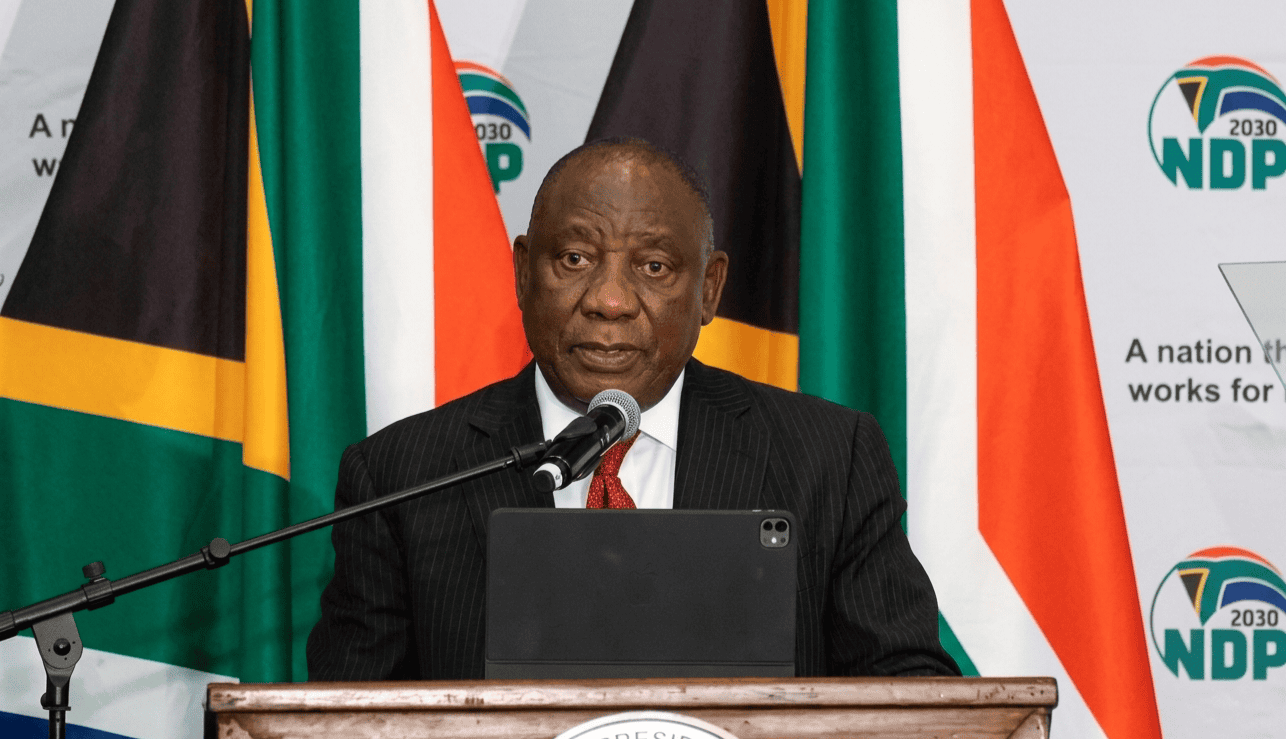
President Cyril Ramaphosa has called for urgent, coordinated action to fix failing municipalities and address South Africa’s deepening water crisis, warning that poor service delivery continues to place an increasing burden on citizens.
Delivering the opening address at the Extended President’s Coordinating Council (PCC) meeting at Birchwood Hotel on Thursday, Ramaphosa described the gathering as a “historic get-together” that, for the first time, included all mayors and municipal managers alongside national and provincial leaders.
He said the expanded format marked a critical step in strengthening cooperative governance across South Africa’s three spheres of government.
“This is the first time that the PCC holds an extended meeting that brings together all the mayors and municipal managers of our local government tier,” he said. “You are all participating in a historic get-together.”
The PCC brings together national ministers, premiers and local government representatives and was created to ensure coordination between national policy, provincial implementation and municipal delivery. Ramaphosa stressed that South Africa’s governance system is designed to operate through cooperation rather than isolated decision-making.
“Our architecture of government is set up where national government sets policy, provincial government coordinates implementation, and local government delivers execution,” he said.
He added that the PCC exists to ensure alignment between national priorities and provincial and municipal plans, ensuring that government functions as a “coordinated state, not three disconnected spheres.”
Ramaphosa acknowledged that municipalities remain under severe pressure, citing weak revenue bases, insufficient technical skills, poor financial management and governance instability as key challenges.
“As a consequence of these systemic problems, many municipalities have weak financial management, poor revenue collection and insufficient accountability,” he said.
The President warned that these failures have led to deteriorating service delivery, with frequent water and electricity disruptions and poorly maintained infrastructure.
“It is ordinary South Africans who bear the costs of this,” he said.
Ramaphosa said the focus of the meeting must not be on repeating problems, but on implementing solutions. He highlighted the upcoming White Paper on Local Government as a key reform tool aimed at reimagining how municipalities function.
“We must address systemic challenges in the structure and functioning of local government,” he said.
A major priority, he noted, is unlocking infrastructure development in energy, water, roads and public transport. He said progress made nationally in reducing load shedding and improving logistics must now be reflected at municipal level.
“Municipalities must be at the frontline of delivery, ensuring industrial parks have power, township streets are lit, and businesses can operate with confidence,” he said.
He also called for the removal of bureaucratic delays that hinder investment and economic growth, and urged the professionalisation of local government. Appointments, he said, must be based on merit, with stronger accountability and transparency.
These reforms, he added, are supported through Operation Vulindlela and coordinated via the District Development Model.
Turning to the water sector, Ramaphosa said it remains one of the most urgent challenges facing the country. While access to piped water has improved significantly—from 61% of households in 1996 to over 82% in 2022—service reliability has declined.
He noted that households experiencing water interruptions longer than two days increased from 24% in 2012 to 34% in 2024.
He attributed the crisis to ageing infrastructure, illegal connections, weak maintenance, inadequate metering, and institutional instability. Municipal water losses are particularly severe, with metros losing an average of 34% of water before billing, and some nearing 50%.
Municipal debt to water boards has also tripled between 2018 and 2025.
Ramaphosa said the government has already begun major reforms through Operation Vulindlela, including new legislation, improved licensing systems, and strengthened monitoring mechanisms. The National Treasury is also implementing reforms in metro service delivery to unlock investment and improve sustainability.
He further announced the establishment of a National Water Crisis Committee to coordinate a unified government response, supported by a National Water Action Plan.
“Cooperative governance must be made practical,” he said. “We are three spheres of government, but one state serving one people.”
He outlined five key principles going forward: accountability, financial integrity, strengthened technical capacity, consequence management, and practical cooperation between all spheres of government.
Ramaphosa said the PCC must ensure alignment, discipline and delivery. “The people of South Africa are looking to us to secure an uninterrupted supply of water and essential services,” he said.
“We have the means to do this. Let us demonstrate that we have the will.”