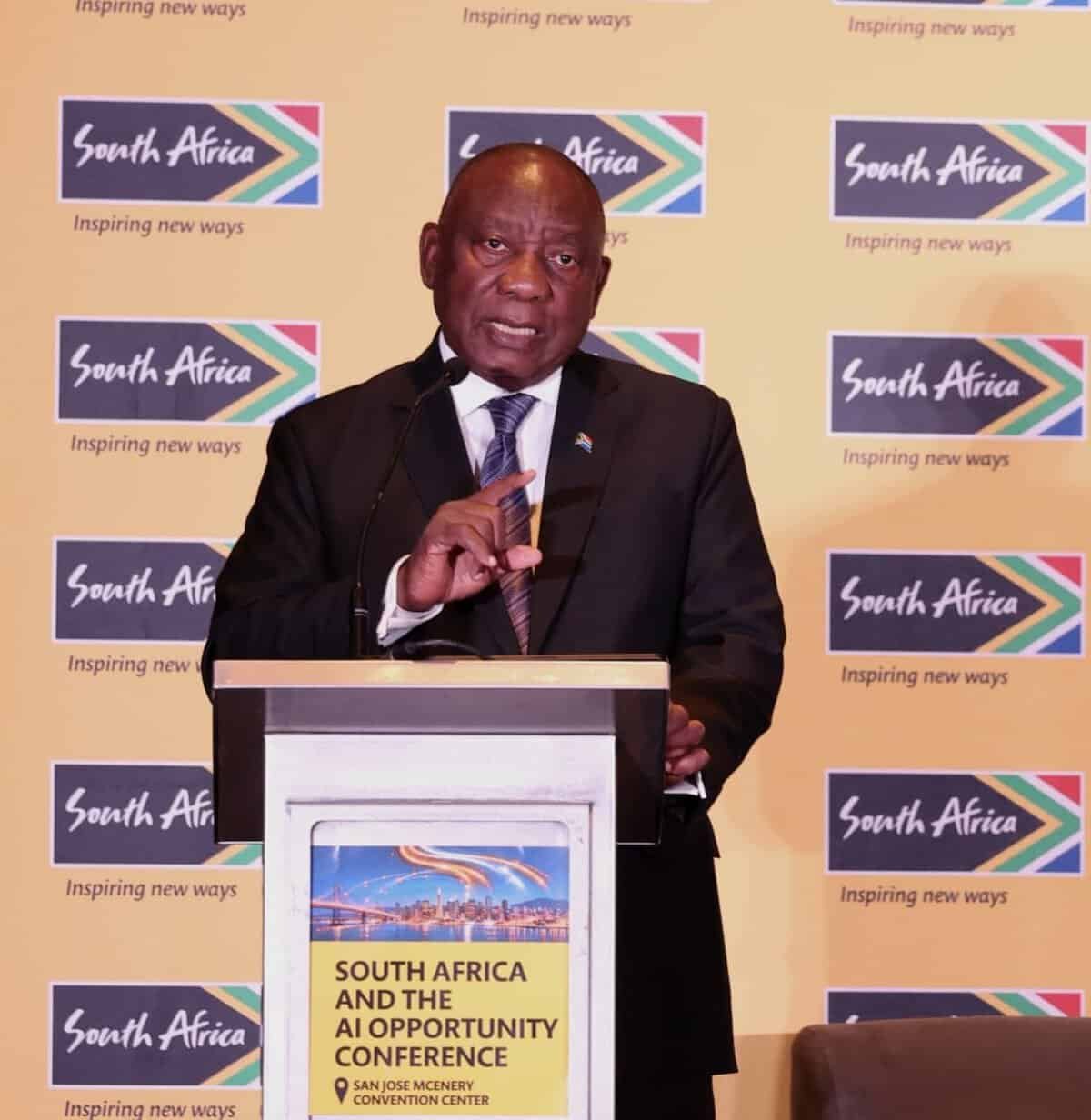
President Cyril Ramaphosa has challenged South Africa to move beyond being a consumer of artificial intelligence (AI) technology and become a producer, developer and owner of innovations, as he courted international technology companies to invest in the country’s digital economy.
Addressing the South Africa and AI Opportunity Conference in San Jose, Silicon Valley, on Wednesday, Ramaphosa said the country could not afford to miss another technological revolution or repeat the historical pattern of supplying raw materials to the world while importing expensive finished products.
He said Africa, despite being home to nearly one-fifth of the world’s population, accounted for only a tiny fraction of global data centre capacity, leaving the continent at risk of becoming increasingly dependent on technologies developed elsewhere.
“The countries that control computing infrastructure, advanced technologies, data and scientific capabilities will enjoy considerable advantages in the emerging global economy,” Ramaphosa said.
He warned that countries failing to develop these capabilities risked falling further behind as artificial intelligence transformed economies, industries and employment.
The President’s working visit to the United States comes as global investment in AI infrastructure accelerates, with the world’s largest American technology companies expected to invest close to $670 billion in the sector this year alone.
Ramaphosa described the investment as one of the biggest mobilisations of private capital in modern economic history, arguing that South Africa needed to position itself to attract a meaningful share.
He said the country had the industrial base, scientific expertise, universities, telecommunications networks and financial institutions needed to participate in the emerging AI economy.
However, he acknowledged that attracting investment would require reliable electricity, expanded transmission infrastructure, suitable land and a coordinated government approach.
Ramaphosa identified South Africa’s energy resources, particularly its solar and wind potential, as important competitive advantages.
He also pointed to the possibility of redeveloping ageing power station sites into data centres, advanced manufacturing facilities and digital industry hubs.
Such developments, he said, could give new economic life to communities that had historically depended on power stations for employment and economic activity.
A large data centre could attract billions of rand in investment while creating opportunities for local manufacturers supplying electrical equipment, cooling systems, transformers, switchgear and energy storage solutions.
However, Ramaphosa cautioned that building data centres alone would not create the broad-based employment and industrial development the country needed.
He said investment must be accompanied by skills development, stronger local supply chains and opportunities for South African businesses.
The President also called for greater investment in African language technologies, warning that existing AI systems were heavily influenced by data from a relatively small number of countries.
He said languages such as isiZulu, isiXhosa, Sesotho, Sepedi, Setswana, Tshivenda and Xitsonga remained underrepresented in leading AI systems.
This could leave millions of people without equal access to emerging technologies.
He urged universities, research institutions and technology companies to collaborate on developing African datasets and AI applications that respond to local needs, while protecting personal information and privacy.
Ramaphosa said artificial intelligence could also help address some of South Africa’s longstanding economic and service delivery challenges.
In mining, the technology could improve mineral exploration, equipment maintenance and workplace safety. In agriculture, it could help farmers manage water, identify crop diseases and improve production.
In healthcare, AI could support earlier diagnosis and improve access to specialist expertise, while municipalities could use the technology to identify water losses, maintain infrastructure and improve service delivery.
However, he warned that technological advancement could also deepen unemployment and inequality if its benefits were concentrated among a small group of companies and individuals.
With South Africa already battling high unemployment, he said government needed to prioritise mathematics, science, digital literacy and computer skills while expanding training opportunities for engineers, data specialists, technicians and artisans.
He also called for retraining programmes to help workers whose jobs could be affected by automation.
Ramaphosa invited American technology companies to establish research and development facilities in South Africa, partner with universities, train young people and support local technology entrepreneurs.
He said the country should use its position as a gateway to the African market, particularly with opportunities presented by the African Continental Free Trade Area.
“We are not asking for charity. We are presenting an investment and partnership opportunity,” he said.
He added that the success of his Silicon Valley visit should not be measured by the number of companies visited or meetings held, but by the investments, research partnerships, businesses and employment opportunities that followed.
Ramaphosa said South Africa wanted to become a major centre for AI research, software development, engineering and technology entrepreneurship.
He urged young South Africans accompanying the delegation to return home inspired to build their own technology companies and innovation centres.
“The next generation of great technological innovations should not come only from Silicon Valley, Beijing, London or other established centres of innovation. Some of them should come from Johannesburg, Cape Town, Tshwane, Durban, Gqeberha and other centres across our country,” he said.
He said South Africa had to translate the engagements into concrete partnerships and investments that would drive economic growth, create jobs and improve people’s lives.
“We have not come to Silicon Valley to ask for a place in someone else’s future. We have come to build partnerships through which we can help shape a future of our own,” Ramaphosa said.