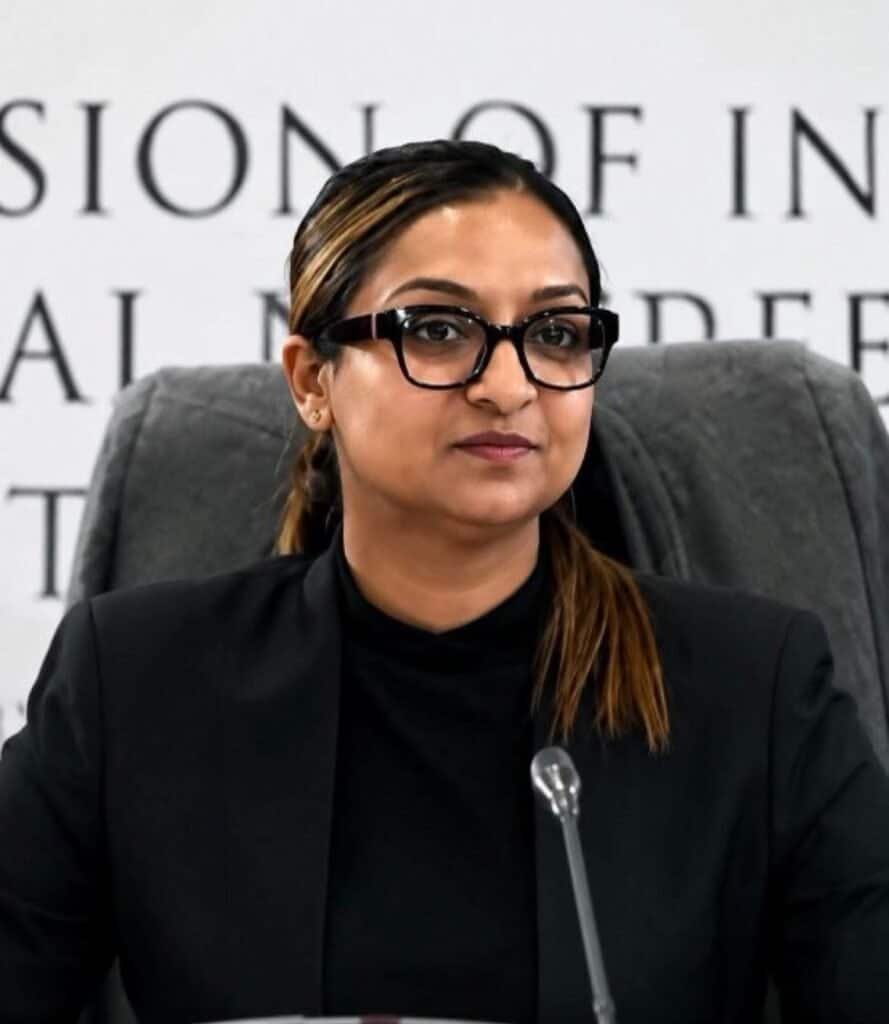
The Madlanga Commission has heard explosive allegations that former Investigating Directorate Against Corruption (IDAC) head Andrea Johnson wanted a senior police brigadier investigated and charged, allegedly creating an opportunity for her husband to occupy the position.
IDAC prosecutor Advocate Drushantha Ramsamy made the allegations during her testimony on Tuesday, as she continued to detail what she described as serious irregularities in the directorate’s handling of investigations involving senior Crime Intelligence officials.
Ramsamy told the commission that Johnson instructed her to find evidence that could be used to charge Brigadier Ashine Krishnadutt, who was acting in the position previously occupied by Major General Feroz Khan in the Crime Intelligence vetting structure.
According to Ramsamy, Krishnadutt was also the superior of Johnson’s husband, Junaid Johnson.
Ramsamy said the instruction raised concerns because Krishnadutt had been promoted before Andrea Johnson.
She told the commission that Johnson wanted Krishnadutt added to one of the vetting investigations involving Crime Intelligence.
When she was asked whether Johnson could have learned information about Krishnadutt and her promotion through discussions with her husband, Ramsamy declined to answer.
The exchange comes after Johnson herself previously faced questions over the potential conflict between her role as IDAC head and her husband’s position within Crime Intelligence.
Johnson told Parliament’s ad hoc committee last year that she and her husband maintained strict boundaries and did not exchange confidential information about their respective work. She famously told the committee that “pillow talk gets people killed” while denying that information from her husband had influenced her work at IDAC.
Ramsamy’s testimony now places that issue under renewed scrutiny.
She also told the commission that she had repeatedly raised concerns about the conduct and direction of investigations within IDAC, including the probe into the controversial Medicare24 contract.
Ramsamy said suspended IDAC chief investigator Dylan Perumal told her that then Police Minister Senzo Mchunu had arranged for an Inspector-General of Intelligence report concerning Crime Intelligence to be flown to the Eastern Cape and delivered to him.
She said the report was subsequently made available to Perumal and later to her through WhatsApp, despite the Inspector-General of Intelligence having previously refused to release it to IDAC.
Ramsamy said the document was still in its confidential, raw and top-secret format when it was shared.
The commission also heard that Perumal allegedly claimed the minister had facilitated access to the report, which related to investigations conducted by the Inspector-General of Intelligence into Crime Intelligence.
Ramsamy further detailed concerns around the Medicare24 investigation.
She said Chief Risk Officer Charity Matlou submitted a Section 27 referral to IDAC in June 2025, but the authorisation for the investigation had already been signed in May.
This, Ramsamy said, raised questions about the sequence of events and created the impression that investigators had been “working backwards”.
She added that she had never seen a Section 27 referral dated February 16, 2025, which Johnson had referred to during her testimony before Parliament’s ad hoc committee.
Ramsamy also questioned why Matlou, who had submitted the referral as a complainant and was not an IDAC employee, was subsequently included in the Medicare24 investigation team.
She said she was told that Johnson had authorised Matlou’s involvement.
The Medicare24 investigation has already come under intense scrutiny at the commission. Johnson previously defended IDAC’s decision to charge suspended National Police Commissioner General Fannie Masemola in connection with the R228 million contract awarded to Vusimuzi “Cat” Matlala’s Medicare24 company.
The commission questioned whether the charges against Masemola fell within IDAC’s mandate.
The contract was initially valued at about R360 million before being awarded for approximately R228 million. More than R50 million had reportedly been paid before the contract was terminated after an internal audit raised concerns.
Ramsamy also raised concerns about the Brigadier Dineo Mokwele investigation, saying an unsigned affidavit attributed to Perumal appeared to contradict Johnson’s account of who contacted Crime Intelligence official Cedrick Nkabinde.
Johnson had told the commission that Nkabinde contacted her. Ramsamy said the document indicated that Johnson had contacted Nkabinde instead.
The Mokwele case has become one of the most controversial investigations conducted under Johnson’s leadership.
Johnson previously described Mokwele’s appointment as a “token appointment” and initially claimed she was not appropriately qualified. However, after commissioners took her through Mokwele’s qualifications and employment records, Johnson conceded that her earlier assessment was wrong and apologised.
The National Prosecuting Authority has since withdrawn the prosecution of Crime Intelligence boss Lieutenant General Dumisani Khumalo and other senior officers linked to the Mokwele matter after NDPP Advocate Andy Mothibi reviewed the case.
Ramsamy also told the commission that she had objected when Johnson, Perumal and Brian Padayachee allegedly wanted IDAC to oppose bail applications involving Major General Philani Lushaba, Lieutenant General Dumisani Khumalo, Nosipho Madondo and Mokwele.
She said a magistrate had refused to impose certain bail conditions on Lushaba and the others, prompting dissatisfaction from Johnson and members of her team.
Ramsamy said she maintained that IDAC did not have a proper case but was effectively “voted out” when her concerns were rejected.
She further testified that Johnson instructed her that representations in the Lushaba matter should be sent directly to her, which Ramsamy said was outside applicable prosecution policy.
The testimony also touched on the alleged preparation of a case against National Police Commissioner Fannie Masemola.
Ramsamy said an email showed Johnson requested a meeting on January 16, 2025, which eventually took place on January 22. According to Ramsamy, discussions at the meeting concerned how Masemola could be “set up” ahead of his appearance before Parliament’s Portfolio Committee on Police.
Co-commissioner Sandile Khumalo questioned whether such a plan could have worked without IDAC knowing beforehand what questions Masemola would face.
Ramsamy said this led her to question what Johnson and Perumal knew and how they could have known it.
She ultimately concluded that members of IDAC may have been communicating with members of the Portfolio Committee.
Ramsamy’s testimony has painted a picture of an IDAC under intense internal strain, with disagreements over investigations, prosecution decisions, evidence and the handling of sensitive intelligence.
Ramsamy also alleged that Johnson had given the commission “many untruths” during her own testimony, further deepening questions about the directorate’s conduct.
Her evidence has yet to be tested in full and the allegations remain allegations.
Ramsamy’s testimony was stood down on Tuesday and will resume on August 14.
The commission adjourned after Advocate Seegels-Ncube raised concerns about Ramsamy’s persistent cough and asked whether her evidence could be postponed.