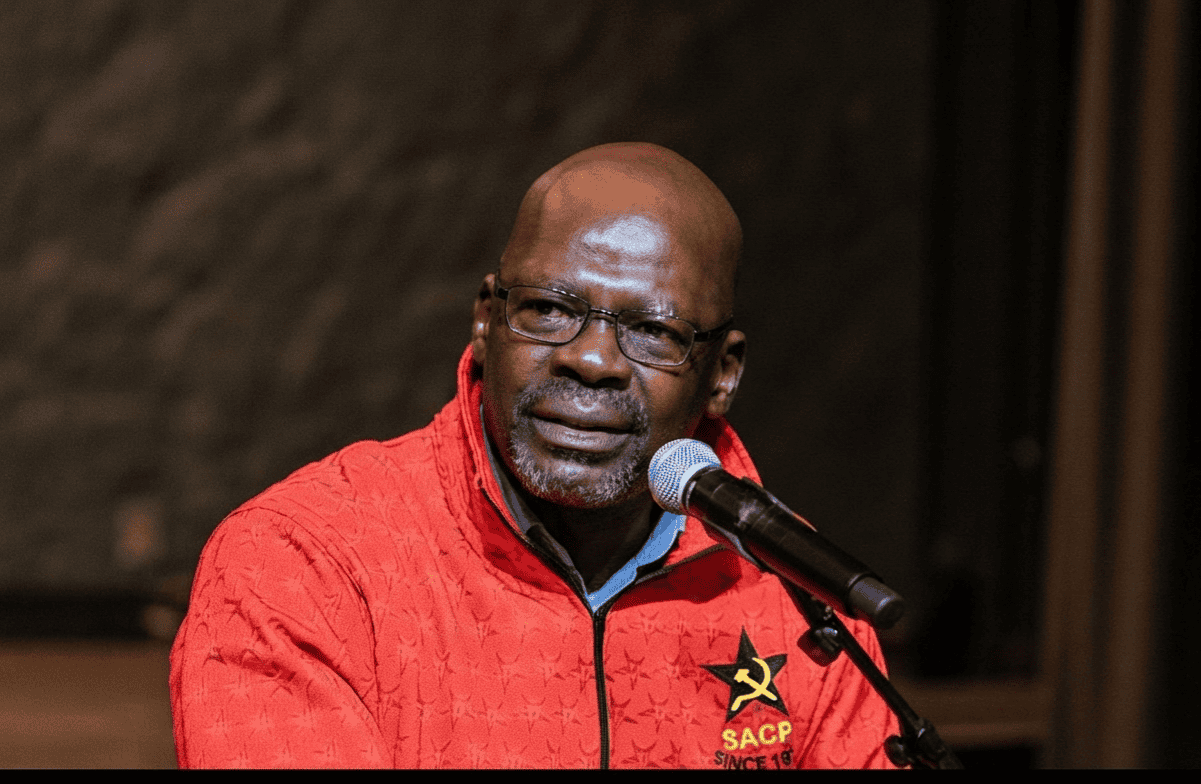
South African Communist Party (SACP) General Secretary Solly Mapaila has claimed that the African National Congress (ANC) and the Democratic Alliance (DA) had already reached an understanding to govern together before South Africans went to the polls in the 2024 general election, alleging that the post-election negotiations were merely for public consumption.
Speaking during a recent public engagement, Mapaila said the Government of National Unity (GNU) was effectively decided before the election results were announced, dismissing the widely publicised negotiations that followed the ANC’s loss of its parliamentary majority.
“The GNU with the DA was formed even before the elections,” Mapaila said, adding that ANC Secretary General Fikile Mbalula had been “pretending to negotiate all along.”
The remarks are among Mapaila’s strongest attacks yet on the ANC leadership’s handling of the GNU and are likely to fuel renewed debate about how the coalition government was formed after the watershed 2024 elections.
The ANC lost its outright majority for the first time since the advent of democracy, securing just over 40% of the national vote. Following weeks of negotiations, the ANC and the DA, together with several smaller parties, agreed to establish the Government of National Unity, guided by a publicly signed Statement of Intent that committed participating parties to cooperate in government and Parliament.
Mapaila suggested the negotiations presented to the public after the election were misleading because, according to him, the political agreement had already been reached.
His comments reinforce the SACP’s long-standing criticism of the ANC’s partnership with the DA, which the communist party argues undermines the ANC’s historic alliance with the SACP and COSATU.
The SACP has repeatedly accused sections of the ANC leadership of pursuing a centrist political agenda that favours cooperation with the DA instead of strengthening the Tripartite Alliance.
Mapaila has also been one of the leading voices calling on the ANC to reconsider its relationship with the DA, arguing that the GNU has weakened the ANC politically while creating ideological contradictions within government. His latest remarks come at a time when tensions between the ANC and the DA remain high over governance disputes, policy disagreements and allegations that the governing arrangement has not functioned as originally intended.
The DA has, in recent months, accused the ANC of repeatedly violating the GNU’s Statement of Intent by failing to consult coalition partners on key decisions, while the ANC has defended the coalition as necessary to ensure stability after the 2024 election.
Mapaila did not provide evidence to support his claim that an agreement existed before the election. Neither the ANC nor Mbalula had immediately responded publicly to the allegation. The claim is nevertheless likely to reignite political debate over the transparency of the GNU negotiations and whether discussions between major political parties began before voters cast their ballots.
Since its formation, the Government of National Unity has faced repeated challenges, including disputes over Cabinet appointments, policy implementation and decision making processes. Despite these tensions, the coalition continues to govern under the framework established by the Statement of Intent signed by participating parties after the election.